I spent a few hours at the Australian Museum in Sydney on Saturday and today. I wish I visited more often. I have a membership so can get in for free, so I should make effort to visit. The problem is - to many wonderful things to draw, to many projects !
 |
| The Australian Museum |
Although there are many wonderful floors to explore and sketch, I seem to always head for the Search & Discover Room . It is an information and resource centre. You have a chance to touch and feel real specimens, and take them to a desk to position and sketch. I had SUCH a good time. Sometimes lines just flow from the pencil. It happened here.
I have sketched a few Australian birds before . As with any subject, the more you draw and really LOOK and SEE it, the more understanding you have of it and the better you get.

I usually draw in a 13 x 19 cm Moleskine Watercolour sketchbook. The only times that I want to draw BIG are at the Museum and the Zoo. So I took an A3 sketchbook this time.
I also took an old ledger that I had bought. I want to explore drawing on printed surfaces.
 |
| Currawong |
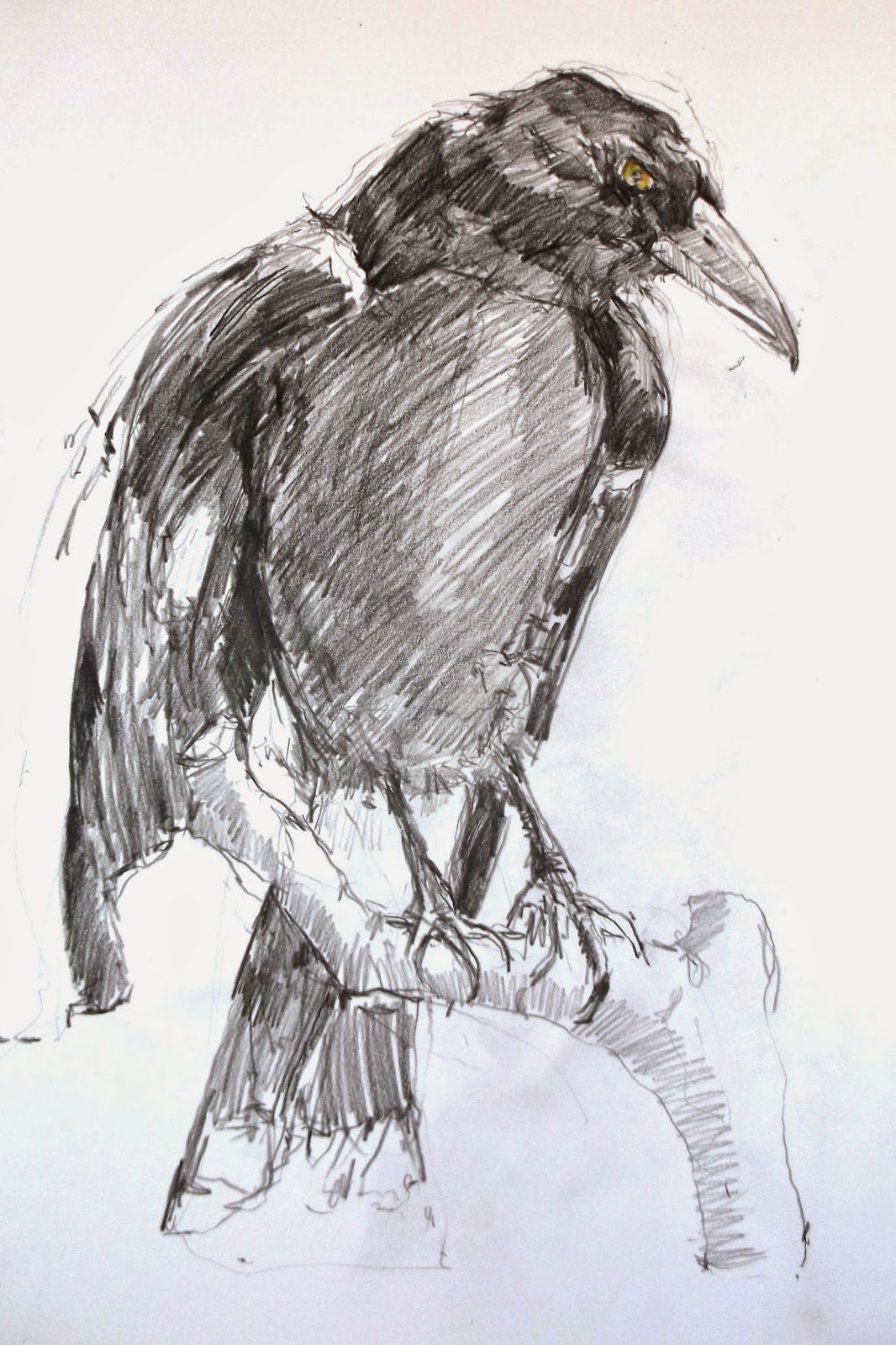
He is almost all black in colour. but I decided to finish in this sketch stage and not "colour in"
A3 Arches 300 GSM Smooth Watercolour Paper
Pied Currawongs are found throughout eastern Australia. They prefer forests and woodlands, and has become well adapted to suburban areas. Throughout its range it is common and familiar. Average size: 48cm Source: http://www.birdsinbackyards.net/species/Strepera-graculina
 |
| Currawong |
I sketched him again, but really had to add all black otherwise he looked like a penguin with a white front.
 |
| magpie |
The Australian Magpie is black and white. It is slightly smaller than the currawong Its nape, upper tail and shoulder are white in males, grey in females. Across most of Australia, the remainder of the body is black. They are common and conspicuous birds.Australian Magpies are found wherever there is a combination of trees and adjacent open areas, including parks and playing fields. Australian Magpies can be very aggressive during breeding season and attacks on humans and pets can occur.
They have a beautiful song which I love to hear. It is a loud musical flute-like song, often performed as a duet or by groups

I always draw in watercolour pencil. On this page I was showing another sketcher, Jane how I use watercolour pencils to draw and blend. I have been using them everyday for over five years and love what can be done with them.
see more of my nature drawings at https://www.flickr.com/photos/alissaduke/sets/72157620757803544/
feathers and nests at https://www.flickr.com/photos/alissaduke/sets/72157633270801883/
I draw lots of things and they all go on flickr https://www.flickr.com/photos/alissaduke/