Showing posts with label nature journaling. Show all posts

Thursday, June 9, 2022

Reciprocity

Graphite and ink on paper
 

Nature replenishes my spirit in so many ways. Clean air and water. The simultaneous serenity and thrill while standing on the edge of millions of acres of public lands. Sunshine warming my face. The sound of rain on my rain jacket. Watching a bee fly; toads, deserts, murmuration.

Trees are an organism for which I am supremely grateful. I have always loved them, even before I could understand the depth of what that means.

On a grand scale, trees have sustained cultures for millennia. Closer to home and more personally, trees provide life-saving shelter, shade from the powerful sun, bone- and muscle-warming heat, magnificent beauty, the sound of wind moving through the leaves.

So I've been pondering lately, what do I give back to them? Indeed, what is the exchange between all of nature and myself? It did not take me long to make the connection.

A spotlight. Through my art and writing I shine a spotlight on the beauty, magnificence, importance, and cultural community that trees and forests provide; the very reasons we should be protecting, respecting and thanking them.

My hope is that my work will inspire others to broaden their interest in trees, to the point of finding themselves caring about trees in their own environment, maybe even becoming stewards of the land.

In the spirit of paying it forward, for the trees, click here for a beautifully made documentary created by a young Alaskan woman about the clear cutting of old growth forests in the Tongass National Forest of southeast Alaska.


Reciprocity.


Wednesday, January 6, 2016

John Muir Laws' Laws Guide to Nature Drawing and Journaling

The Laws Guide to Nature Drawing and Journaling by John Muir Laws is a don't-miss-it book for your studio

I am so delighted to have had the chance to preview this book--thick as a city phone book (312 pages!), covering every nature-drawing subject you can imagine in John Muir Laws' inimitable clear, encouraging, and inspiring fashion, this one will stay in my collection of essential art books forever.

John covers using pencil, colored pencil, watercolor, gouache and more, and the variety of subject matter is a nature-artist's delight.  

But it's not simply a book on technique.  It includes chapters on Observation and Intentional Curiosity, Projects that Focus Awareness, Methods of Deepening Inquiry, Visual Thinking and Displaying Information, as well as materials and supplies, notes, and exhaustive references.

 Take a peek at these pages: 


If you've been fortunate enough to have seen John's previous book, The Laws Guide to Drawing Birds, you KNOW how good this one is.  It covers birds and much, much more.

Pre-order John Muir Laws' amazing new book HERE--it's coming out in March of 2016!

Wednesday, July 6, 2011

Sandy Williams - End of June flowers


Since I've been doing this series of flower sketches in my moleskine I've found that I really "look" at the garden and all the things that have been right under my nose that I just didn't notice before. Case in point -- how beautiful are the potato blossoms and leaves! These sketches were done in pen and ink with watercolor pencils and white gouache.

Sunday, May 15, 2011

More and More Flowers


I'm trying to carry on my normal and busy life but every time I turn around there's another flower blooming and I grab my sketching tools and sketchbook! I know the laundry and vacuum will wait patiently, as they have done so many times before.

Sunday, January 16, 2011

New Contributor Introduction - Sandy


This is my first contribution to the Sketching in Nature group and I'd like to introduce myself. The main medium I've worked in for many years is gouache. For a full size painting (a full sheet of watercolor paper) I spend anywhere from six to ten weeks. For some of my botanical studies, done strictly from life, I work off and on during the plant's life cycle and if I happen to miss a phase I put the painting away until that phase comes around the next year. Needless to say, after doing that for many years I began to look around for an alternative way to record the things around me that didn't require such a committment of time. That's when I was lucky enough to run across Kate's watercolor pencil workshop in early 2008. I will never give up gouache because I'm an addict when it comes to detail, but I've also developed a love of watercolor pencil and pen and ink. I had to give up art entirely for well over a year because of near blindness, and as my vision began to return and I reconnected to the internet, what was one of the first things I ran into? -- Kate's Journaling class! What an inspiration she and my classmates have been. Starting January 1st, 2010, I began a journal dedicated to nature subjects and these three images are selections from it. I've enjoyed browsing through all your posts here and I'm looking forward to seeing more.

Sunday, December 13, 2009

November Fruit- Pam Johnson Brickell


This is page 3 and 4 of my autumn journal. I can't resist featuring the fruits of autumn. I originally planned on having 3 different sprigs of plants with fruits on this page but the Waxmyrtle took over :) One never knows how things will turn out. I love how journal pages take on a life of their own.

Wednesday, November 18, 2009

Swamp-Lily, A Last Hurrah - Pam Johnson Brickell


Last week my friend, Kate, called to say she saw a flower off in the woods and thought it was something special. It sure was! A Swamp-Lily! Also known as String-Lily, Crinum americanum L.

A few days later, I was able to go take a look at it. The weather was threatening but, I did manage to make an ink sketch of it in my journal.  Then it started to sprinkle so I took a photograph, and off the the shelter of my car I went!  I painted the ink drawing from my reference photo.

I was a bit dismayed, as I didn't leave much room for the flower names......... ah well.

I call this 'A Last Hurrah' as the lily's bloom time is from June to October.  I saw quite a few plants around the area, but all had long since bloomed.  It's in the amaryllis family. A real beauty and uncommon in SC, though it can be found in the southern coastal area of the state.  That's us :)

Monday, November 2, 2009

Hunter's Moon - Pam Johnson Brickell


I was hoping for a clear sky this evening, but not. The Hunter's Moon did peak out at one point, but not enough to light up my view of the Okatie River.  Still, a beauty of an evening :)

My favorite star gazing web site says:
The Hunter's Moon highlights the sky tonight. In most years the Harvest Moon comes in September, with the Hunter's Moon in October. But this year October's full Moon was closer to the fall equinox, so both the Harvest and Hunter's moons were pushed back a month.

Sunday, November 1, 2009

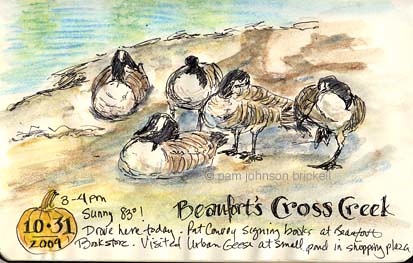
Canada Geese - Pam Johnson Brickell

Canada Geese II

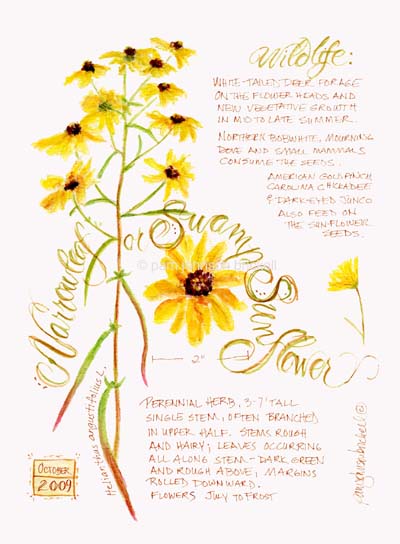
Narrowleaf or Swamp Sunflower - Pam Johnson Brickell

SwampSunflower
Last week, I finally found a semi-quiet road where I could pull over to stop and quickly pick a stem of these sunflowers. The top flowers started to wilt the next day! Guess they don't like tap water!

I used Derwent pastel pencils that I've had for years but never realized they are water soluble!!!!! I like the painterly effect. I did the calligraphic type with traditional watercolors using a rigger brush. The rest of the body copy was written with a Micron 005 pen.

Saturday, October 31, 2009

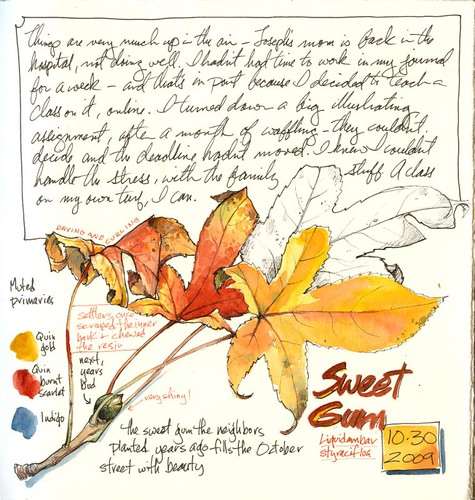
Autumn Leaves...sweet gum!

Sweet Gum Autumn

I hadn't had much time to journal lately, due to family pressures and gearing up for the new journal-keeping class I'm teaching online. But yesterday, those gorgeous leaves that had blown down in our near-gale-force winds spangled the neighborhood with bright, warm color. They really glowed, with the scudding blue-gray clouds!

People used to scrape the resin from the inner bark of Liquidambar and chew it like gum...hence, I suppose, the common name!

More about this fascinating, colorful tree HERE

And a lovely post from our own Laura Frankstone in this blog, HERE.

Friday, September 11, 2009

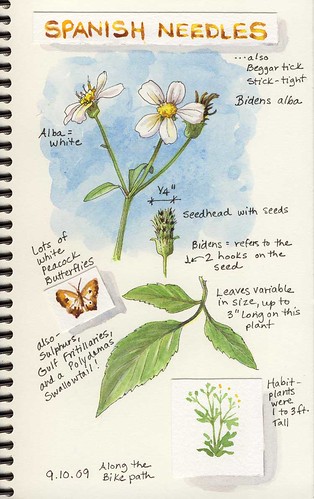
Spanish needles - Elizabeth Smith


Spanish needles, originally uploaded by Elizabeth Smith.

Spanish needles, Aster family

Hated by hikers and gardeners, beloved by butterflies

Right now these scruffy wildflowers (or weeds) are growing and blooming like crazy. The butterflies are feasting! They’re also setting seed, those troublesome little slivers with hooks on the end that hitchhike onto our sneakers, socks, cuffs, and pets. I read that one plant can produce 1250 of these seeds! Once one plant gets a foothold in your garden, it seems they show up forever after. They’re still attractive to me; they are survivors and cheery-looking, and anything that attracts so many butterflies can’t be all bad.

Click on the image above to view larger on my Flickr photostream page.

~ Elizabeth Smith
Naples, Florida, USA

Saturday, September 5, 2009

Three Evenings - Pam Johnson Brickell

Our time in New York is almost at an end. When we arrived in July, I had envisioned a lot more time on the boat taking in the evening colors. Silly puddin'!

Nursing a husband through major back surgery, taking care of elderly in-laws and keeping Basenjis in line in an non-Basenji proofed house, rather fills the day :)

P.S. I so miss my scanner!

Friday, September 4, 2009

Groundcherry - Pam Johnson Brickell

Back in mid-August I came upon a wildflower I'd not encountered before. I sketched it in my small Moleskine, and because I had failed to pack my wildflower guides for our NY trip, I asked my blogging friends to help me out with it's I.D. Here's the 'Mystery Solved' completed journal page.

I've been wanting to create a larger page to celebrate my new find and finally, yesterday, I managed to escape to the creek. I remembered to bring a towel to sit on (grass stains on white pants last time) and there I sat for an hour, in the late afternoon sun, watercolor pencils laid out in front of me on my tote bag, sketchbook in my lap.

This time there were only a few flowers in bloom and most were at the end of the plant's stems. Lantern shaped casings covered most of the plant. They had grown quite a bit since my first sketch and I could feel the small fruit inside.

My internet research on Groundcherry provided interesting facts and I wanted to include 'Faunal Associations' on my page. That's where I started and worked the illustrations around this type block. First, I split one of the casings in order to get a good look at the fruit. There was a loose dried up piece of plant in the casing - part of the flower? I was hoping the berry would be larger and I'm assuming they will grow more as this fruit was green. When ripe they can be yellow or red in color and the casing turns brown.

I wrote and sketched with a .005 Micron pen that kept wanting to dry up. I had to retrace some letters - not always a fun thing to do. I finished drawing just before 5 p.m. and then was attacked by skeeters! Coloring waited until after dinner.

It's funny. A lot of time lapsed between the initial sketch and yesterday's. Plenty of time for me to think about page design for my next entry. HA! Working in the field can oft times take you on a different ride. While initially disappointed in my endeavor (crooked type and date block, light ink on words....) today, when I photographed the page, I felt like it was fresh and immediate - just as it should be for field work.

Wednesday, August 26, 2009

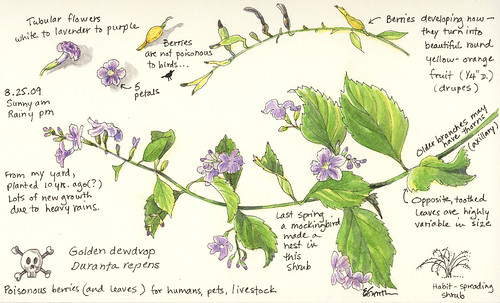
Golden dewdrop--Elizabeth Smith


Golden dewdrop, originally uploaded by Elizabeth Smith.

Golden dewdrop
Verbena family

This lovely shrub is blooming right now in southwest Florida. Once thought to be native to the Florida Keys, this status is questionable and newer references label it as a probable introduced ornamental. I bought this plant years ago to attract birds, bees, and butterflies, and to add it to my other native plantings. Oh well…the birds do like the berries, and a mockingbird nested there earlier this year. The foliage is very dense now, and the older woody branches develop thorns in the leaf axils; a perfect hideaway for birds!

The Duranta part of the scientific name refers to an Italian physician of the 16th century, Castor Durante, who also studied botany and published herbals. The species name repens means “spreading.” It does have beautifully spreading and arching branches; it’s a very graceful plant. As I browse the web further to learn more, I’m a bit saddened to see that it’s become an invasive exotic in Australia.

Click on the image to go to my Flickr photostream in order to see it larger.

~ Elizabeth Smith
Naples, Florida, USA

Wednesday, August 19, 2009

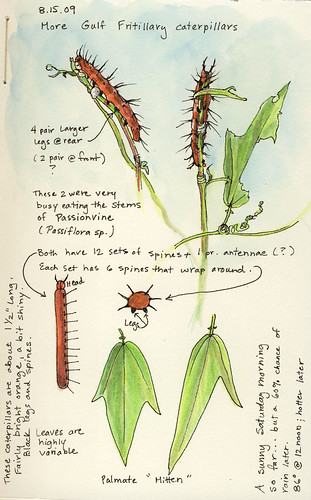
More caterpillars--Elizabeth Smith


More caterpillars, originally uploaded by Elizabeth Smith.

The butterflies have been busy laying eggs, and these caterpillars have been eating and growing like crazy. There seem to be a lot of these Gulf Fritillary caterpillars this year; some years there are hardly any.

I'm still waiting for the earlier chrysalis I sketched, hopefully the butterfly will emerge soon.


Click on the image to see this larger on Flickr.

~ Elizabeth Smith
Naples, FL, USA

The Building of a Journal Page--Pam Johnson Brickell


On Sunday I sketched two plants that I'd seen plenty of times when living in Western NY, but had never taken time to sit and study them. I left room for plant names only to discover that I forgot to pack my wildflower guide book!!!!!!!! Arguhhhhhh!

Lucky for me, that a blogging friend, Carol, came to my rescue. It was driving me crazy that I might have to wait a few more weeks to find the answer!

Keeping this craziness in mind....... does anyone know what plant this is? Suggestions so far are loosestrife or abutilon families, but when I google this info, none of the images match my specimen. The flowers hang down and are single. I'm thinking that perhaps the 'lantern' type structure grows more after the flower dies...... but then, I could be all wet :) The plant is growing right beside the Nightshade and Jewelweed, next to a creek, full sun, western NY.

Friday, August 7, 2009

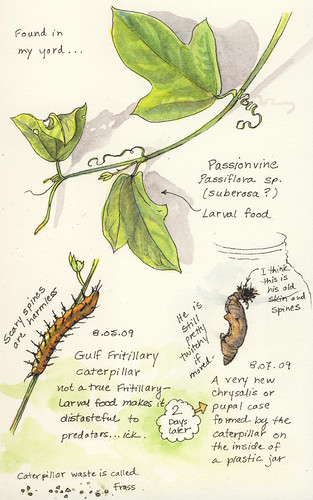
Gulf Fritillary caterpillar and passionvine

Gulf fritillary and passionvine

In my yard there are numerous volunteer native passionvines, hiding themselves in shrubs and surreptitiously climbing trees. They aren’t very large; the leaves are maybe 3 inches (7.6 cm) wide if pressed flat. I think this is one of the corky-stemmed passionvines, Passiflora suberosa (the older part of the stem bases become woody, but with a cork-like appearance and texture). The flower is a nondescript pale yellow to green miniature version of the showy purple or red passion flower with which most people are familiar. No blooms now, but there are plenty of tattered and bite-ridden leaves.

The guilty party is the caterpillar of one of our beautiful longwing butterflies, the Gulf Fritillary. I found this striking caterpillar toward the end of his larval stage. He was about 1 ¼ inch long (3.2 cm), and created a chrysalis that is about 1 inch (2.5 cm). You can read more about the Gulf Fritillary here: http://en.wikipedia.org/wiki/Gulf_Fritillary

I hope that I’ll be able to sketch him when he emerges.

Click on the image to access larger sizes on my Flickr page.

~ Elizabeth Smith
Naples, FL, USA

Tuesday, August 4, 2009

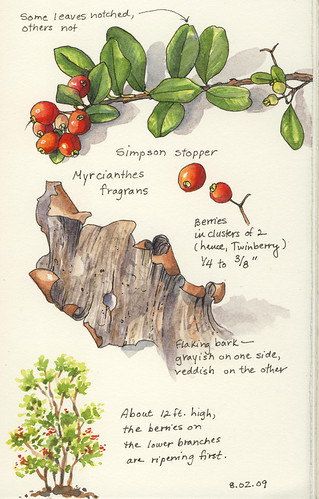
Simpson stopper


Simpson stopper, originally uploaded by Elizabeth Smith.

Simpson’s or Simpson Stopper
Myrcianthes fragrans
Myrtle family

Simpson’s stopper forms a lovely compact small tree or large shrub in (mostly) full sun, which is where mine grows. It’s in fruit right now, heavy branches of berries in all stages from green to orange to red. The berries are said to be edible for humans, as well as favored by wildlife, especially mockingbirds. It’s also a nectar source for butterflies; the long white stamens make the flowers appear like tiny, frothy puffballs. Ethnobotany lore has it that the common name of stopper comes from the “stopping” powers of the leaves used in a treatment for diarrhea.

Simpson’s stopper has two other common names: twinberry and nakedwood. I assume the twinberry refers to the two-berry stems that I noticed on mine, and the nakedwood refers to the exfoliating bark habit. Nakedwood would be my favorite, but there is another Florida tree with the same common name and I dislike confusion. After reading more about the Simpson namesake, though, I’m convinced of its perfection. Charles Torrey Simpson was a self-taught botanist and malacologist (one who studies mollusks), and has been called “the father of all South Florida naturalists.” He first visited Florida in 1881, beginning a love affair with the state that lasted the rest of his life.

My botanical names book states that the genus Myrcianthes refers to the myrtle family. Fragrans is self explanatory: the flowers are quite fragrant and the leaves contain aromatic oils, some say reminiscent of nutmeg. My stopper smells just faintly fragrant, not quite nutmeg-like. It has numerous leathery and glossy medium-green leaves on somewhat stiff stems that range from copper-colored to brownish-gray. The peeling bark is similar to that of ornamental guava. With all of these wonderful traits, you might wonder why I planted it behind the house in a hidden corner. I do. Next time I’ll plant it where I can enjoy it every day!

Click on the image to go to my Flickr site to view larger.

~ Elizabeth Smith
Naples, Florida, USA

Monday, July 27, 2009

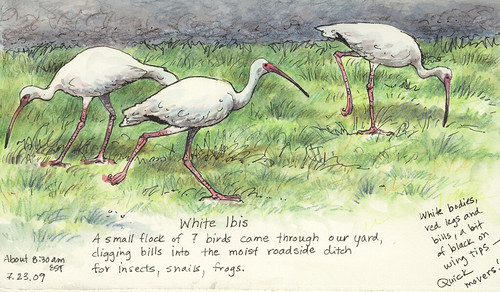
White Ibis


White Ibis, originally uploaded by Elizabeth Smith.

White Ibis

These large and beautiful wetland birds wander from time to time through residential settings, along with the common Cattle Egrets. Ibis always seem to travel in numbers, though, and it’s quite a spectacular sight to see a large flock foraging in moist low grassy spots, then moving along at a brisk pace.

If you’d like to read more about the White Ibis, the Florida Fish and Wildlife Conservation Commission has a nice information sheet available online:
http://www.myfwc.com/bba/docs/bba_whib.pdf

Click on the photo above to see the whole thing on my Flickr page.


~ Elizabeth Smith
Naples, Florida, USA