Showing posts with label Alissa Duke. Show all posts

Thursday, January 1, 2015

the colour of leaves

I drew these gum leaves while my relatives watched television shows. 
We had picked the leaves off the ground during the daytime on a walk.

As I drew them I became more wonderous and amazed at the colours and intricacies of nature. 

These leaves were scattered all over the ground at the park. However, they do not have the overall colour and intensity en masse to make you look at them on the ground. 

However individually they are a riot of colour.


Watercolour pencil in Moleskine watercolour sketchbook


Saturday, November 22, 2014

Pacific Black Duck - Australia


Fitzroy Gardens , Melbourne
I am fortunate that the first part of my walk to work in Melbourne city is through the beautiful Fitzroy Gardens, with its traditional English plantings and ponds. I have discovered here are a few families of birds that live there : two Australian wood duck families, one with ducklings that are just past their fluffy stage,  peewees (mudlark), a kookaburra and magpies, crows and my favourite duck...


the Pacific Black Duck.
 
I liked the descriptions online that call it a sociable and a dabbling duck.  
 
The Pacific Black Duck is found in all but the most arid regions of Australia. Outside Australia, its range extends throughout the Pacific region. The Pacific Black Duck is one of the most versatile of the Australian ducks. It frequents all types of water, from isolated forest pools to tidal mudflats. The Pacific Black Duck is closely related to the Mallard (Source  http://www.birdsinbackyards.net/species/Anas-superciliosa)


I know where to find them by the pond and how close I can get to them on land before they dive into the water. The more I draw them the more familiar I become with the shape of their body and head - the curves and subtleties that give them their form and character.

 
I also know immediately which colour of watercolour pencils (Walnut Brown. Burnt Umber and Ivory mixed with a little Yellow) to use to draw them. I can pick the colours out of my pencil wrap and start straight away !


It has a dark body, and a paler head with a dark crown and facial stripes. There is an iridescent green patch on the wing. This is when the Derwent Inktense Teal Green comes out of the box !


Monday, August 4, 2014

sketching birds at the Australian Museum

I  spent a few hours at the Australian Museum in Sydney on Saturday and today. I wish I visited more often. I have a membership so can get in for free, so I should make effort to visit. The problem is  - to many wonderful things to draw, to many projects !
 
The Australian Museum
 
Although there are many wonderful floors to explore and sketch, I seem to always head for the Search & Discover Room . It is an information and resource centre. You have a chance to  touch and feel real specimens, and take them to a desk to position and sketch. I had SUCH a good time. Sometimes lines just flow from the pencil. It happened here.
 
I have sketched a few Australian birds before . As with any subject, the more you draw and really LOOK and SEE  it, the more understanding you have of it and the better you get.


I usually draw in a 13 x 19 cm Moleskine Watercolour sketchbook.  The only times that I want to draw BIG are at the Museum and the Zoo. So I took an A3 sketchbook this time.
I also took an old ledger that I had bought. I want to explore drawing on printed surfaces.
 
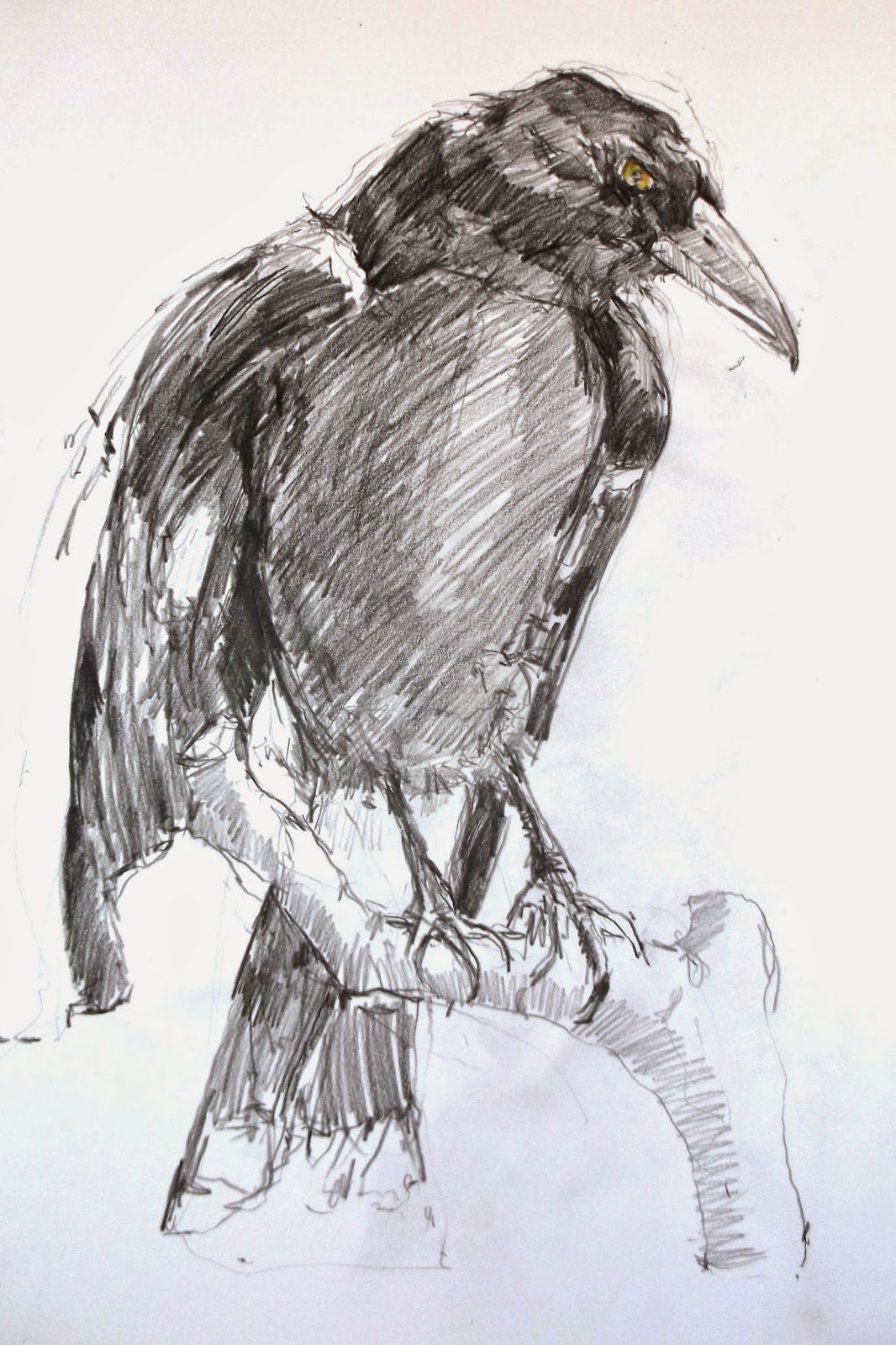
Currawong


He is almost all black in colour. but I decided to finish in this sketch stage and not "colour in"
 
A3 Arches 300 GSM Smooth Watercolour Paper
 
Pied Currawongs are found throughout eastern Australia. They prefer forests and woodlands, and has become well adapted to suburban areas. Throughout its range it is common and familiar. Average size: 48cm Source: http://www.birdsinbackyards.net/species/Strepera-graculina
Their song  can be heard in Australian suburbs

Currawong
 
I sketched him again, but really  had to add all black otherwise he looked like a penguin with a white front.


magpie
 
The Australian Magpie is black and white. It is slightly smaller than the currawong  Its nape, upper tail and shoulder are white in males, grey in females. Across most of Australia, the remainder of the body is black. They are common and conspicuous birds.Australian Magpies are found wherever there is a combination of trees and adjacent open areas, including parks and playing fields. Australian Magpies can be very aggressive during breeding season and attacks on humans and pets can occur.
They have a beautiful song which I love to hear. It is a loud musical flute-like song, often performed as a duet or by groups


I always draw in watercolour pencil. On this page I was showing another sketcher, Jane how I use watercolour pencils to draw and blend. I have been using them everyday for over five years and love what can be done with them.
 
 
I draw lots of things and they all go on flickr https://www.flickr.com/photos/alissaduke/

Monday, March 10, 2014

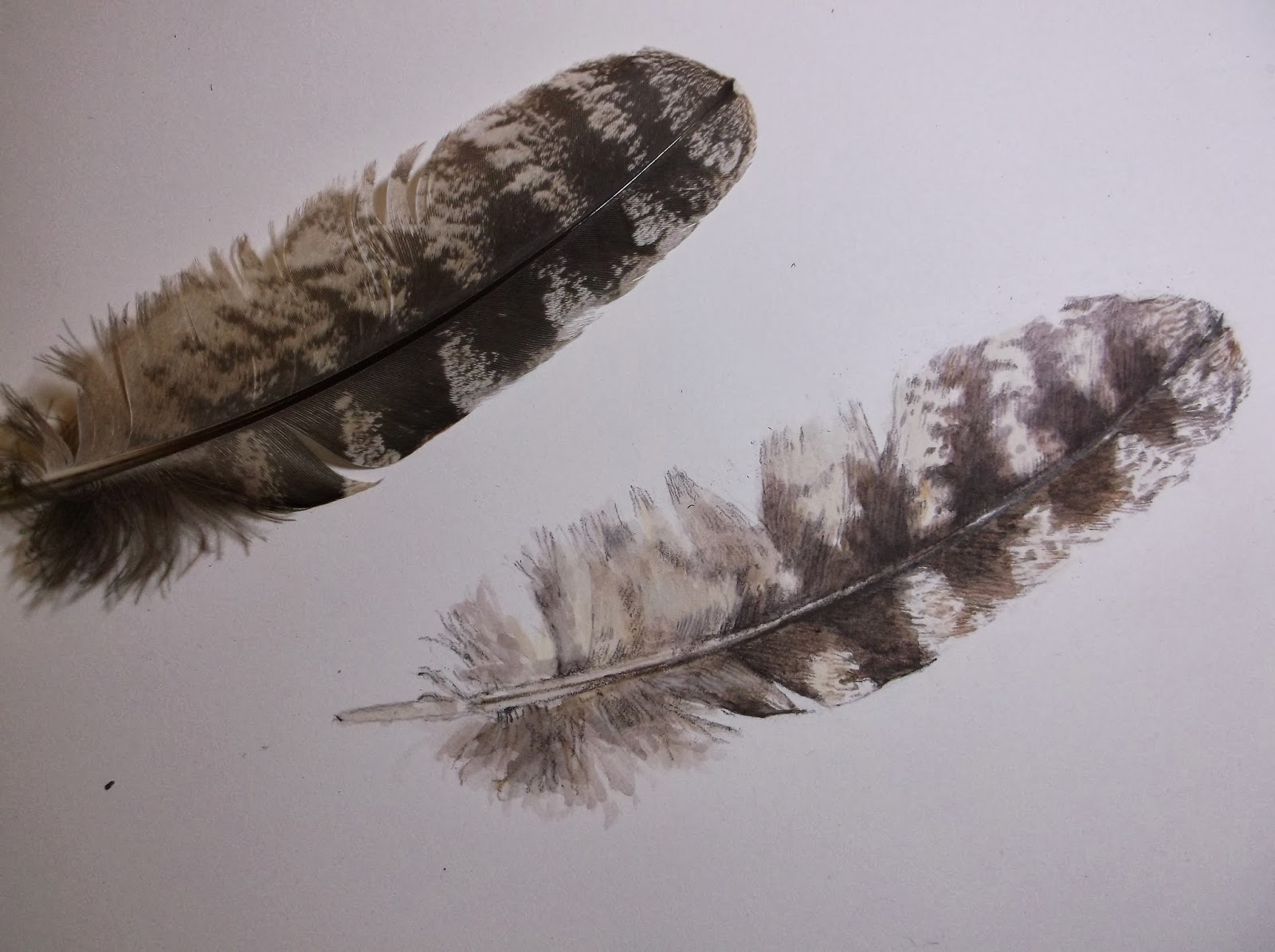
drawing a tawny frogmouth feather

This post is about drawing the feather of a tawny frogmouth. I have quite a few of these feathers in my collection. I am not sure why I have so many, as you don't see that very many tawny frogmouth birds about. This is probably because they blend in so well with the tree branches they are on and they are nocturnal. However I still think that there appears to be a disproportionate amount of feathers compared to birds you see everyday, such as magpies. Tawny frogmouths are one of my favourite birds (I seem to have a few)

Tawny frogmouths. Photo: Keith Smith Photography

The Tawny Frogmouth is found throughout Australia. They are about 35–50 cm and can be seen in almost any habitat type except the denser rainforests and treeless deserts. Frogmouths are often confused with owls, but are actually more closely related to the nightjars. This feather was collected off the ground in Toowoomba, Queensland.

I often draw feathers, but they are usually simple and one or two colours. And I complete them over an evening or two. See them here . In this post I wanted to share my love of watercolour pencils and what can be achieved using this medium

The tawny frogmouth feather was more of a challenge as their feathers are highly patterned. This is the second time I have attempted to draw one and I am still figuring out how to do it. I was halfway through this one when I discovered that Derwent Inktense Bark watercolour pencil is the perfect colour for the tawny frogmouth feather. The pencils I was using were too brown or too grey and I was trying to blend them.
 
This time I remembered to take these photographs along the way to try to show my work in progress. It shows the real feather at the top and my drawing next to it. I started it in February this year and then put the drawing aside for about two weeks between the last two images.


STEP 1

 
STEP 2


STEP 3


in detail


STTEP 4 - FINISHED !


Drawn on Arches 300gsm Smooth Watercolour paper.

main Colours

Bark - Derwent Inktense
Walnut Brown - Faber Castell Albrecht Durer
Burnt Umber- Faber Castell Albrecht Durer
Ivory - Faber Castell Albrecht Durer
Raw Umber - Derwent

I have found that the Derwent pencils are too soft for the finer "feathery" details of the feather (the "afterfeather") as you can see the texture of the pencil on the paper. Faber Castells are harder and give a finer line, which can also be dissolved beautifully to give the fluffy look. This is the area I love to draw.  This particular feather was a bit of an experiment. I am very pleased with the final result, and have learnt a lot along the way. NEXT TIME I need to figure out a way to achieve the dark colour patterns and the fine lines of the feather (I think these are called the barbs). I feel that it is a little heavy handed and muddy in this one. However, I am not looking for a photorealistic drawing of feathers. My drawings are more about the impression of detail, rather then actual detail.


Tawny frogmouth and chick drawn from photo, 2010
 

Saturday, January 26, 2013

snails and cicadas

Drawing of insects from an Australian garden, given to me by friends and family - a snail and cicada
Watercolour pencil in Moleskine Sketchbook


I had always called both of these cicadas and so when I was drawing these I had to actually find out what they were. I was right . They ARE both cicadas. The shell is what the nymph discards when it emerges from living underground.. I remember them being on paperbark trees. At high school we used to put them on our jumpers  like a  brooch.

This particular cicada is a Bladder Cicada. Not the nicest of names, but definitely the prettiest cicada. It ia the less ïnsect-looking" cicada I think

Cicadas are well known for their song/drone. It happens in summer around dusk. The noise is so loud that we always had to close the windows on those hot Queensland summer nights toblock the noise.
The male Bladder Cicadas have the greatly enlarged abdomen, largely hollow. This is the resonating chamber to amplify the loudness of their songs. Females are smaller in size and relatively smaller abdomen.


and here is the snail......


Wednesday, January 9, 2013

jellyfish on the beach - Australia

Gold Coast, Australia. I spent two days at the sunny Gold Coast in Queensland. (where it was much cooler than Sydney)


I had a few hours to myself at the end of the afternoon and went back to the beach specifically to draw. The first object was a bluebottle jellyfish.


I had particular interest in drawing this creature as I had been stung by one while swimming in the ocean that morning. It was not big, but had a large fine tentacle that wrapped around my legs. OUCH it stung ! That lasted about 15 minutes and then welts were there for a few hours. http://en.wikipedia.org/wiki/Portuguese_man_o'_war

When I returned to the beach later in the day to draw, there were signs up at the patrolled beaches warning of Marine Stingers in the water.
Studying and drawing the jellyfish was fascinating – the blue colour is so intense in some area - it is almost jewel-like.


I drew other things on the beach and then came across a bell or blubber jellyfish. These are the sort of jelly fish that I vaguely remember seeing on the beach as a child. However, none has been as perfectly formed as this one !!


I am not a beach person and did not grow up on the coast or have beach holidays. So this past few days was an education and an adventure !

Tuesday, January 1, 2013

Royal Botanic Garden Sydney : Alissa Duke

Congratulations to Kate and to the the Sketching in Nature blog for winning the Making a Mark Award. This is a wonderful site and opportunity for sharing and exploring nature around the world  through art!

Last week, a sunny Summers day in Sydney was the perfect opportunity to do some urban nature sketching in the Royal Botanic Garden in the center of Sydney.

I sketched with three friends and we started under the shade of a large Moreton Bay Fig. I was distracted by a Dusky Moorhen that had built its nest right next to the fountain spout in a nearby pond. There were a few young dusky moorhens around the pond area, so I am not sure if there were any eggs. I wonder if the Gardens staff have kept the fountain off during these months.?


These White Ibis are prolific in Sydney city, seen around rubbish bins, as well as in the parks and gardens. They are very beautiful lookings birds. If only there were not so many of them., and they were not a nuisance.They are great subjects to capture quickly on paper. I used ink and then added some watercolour pencil.The tagged one caught my eye. I have since found out that Research is currently under way that involves banding and wing-tagging Australian white ibis (Threskiornis molucca) within the Sydney region. The aim is to monitor ibis’ movements, breeding and habitat preferences. Colour-banding and numbered wing-tags allow identification of individual ibis; observations have been received from across the Sydney region and as far away as Shepparton (Vic), Coffs Harbour (NSW), Brisbane and Townsville (Qld).


The Lotus Pond is  always changing. There was only one Lotus flower in the pond, but lots of green leaves to draw.
And my favourite, quintessential  duck is the Pacific Black Duck. They have so much character in their face with those lovely markings.


Sunday, September 30, 2012

birds nest project : Alissa Duke

This is a small (8cm x 4 cm x 6cm) nest that I was given. I am not sure what bird it belonged to. It is from SouthEast Queensland, Australia. I have looked online today and not found an answer. I will go the the library and look into it and also maybe send a photo to the museum.
My project now is to explore methods of drawing this little birds nest. The ink version is ok. It is when I attempt to draw nests in watercolour pencil that I have problems.The problems are with the colour and shadow and line . and trying to find a method that suits my own style of drawing. I have three other birds nests at home to draw, and so I am keen to learn.. I  Thankfully Nature Artists group members (below) have provided me with some suggestions and guidance.


SUGGESTIONS
Karen Engelbretson: Book - America's Other Audubon" by Joy M. Kiser. Also, artist Wendy Brockman paints nests.
Mindy Lighthipe: http://www.johnmuirlaws.com/drawing-birds Drawing Birds Tutorial
John Muir Laws
Antshrike Artist: Book calledAvian Architecture How Birds Design, Engineer, Build Book
Peter Goodfellow HB

Candace Millsop: Claudia Nice uses pen & ink w/watercolor and has several books and Cathy Johnson has really great books too! And one called Bird, Egg, Feather, Nest by Maryjo Koch

Susan Fox: You might google Alphonse Mucha to see how he handled the design of women's hair and think about how what he does relates the problem you're trying to solve.

Laura Gould I did a step by step record of a wrens nest I did late this past winter. http://www.flickr.com/photos/jizogarden/sets/72157629375590967/with/6916005781/


Monday, September 24, 2012

A visit to the beach in Adelaide, Australia: Alissa Duke

 I spent the weekend in Adelaide, South Australia for a seminar . I had some free time before 9am and walked  a few blocks to the beach. I did a small sketch at the beach, before it started to rain lightly. That is not so great with watercolour pencils and paper.
So I stopped drawing and walked down onto the beach and collected some shells. It is amazing that different beaches can produce new and exciting shells. I only had  about half an hour to spare, but could have spent all morning there. I put the shells in my sunglasses case, as it as the only place I could think to store them !


I think the bit and pieces of shells and stones are more interesting as the perfect shells that I used to look for on the beach when I was little. I have been drawing these shells back home in Sydney this week and there are a few more to sketch.


Sunday, January 8, 2012

Fungi on stick

I was given this fungi on stick to draw. It was picked up off a footpath in Toowoomba, Queensland Australia and probably came from an oak or plane tree, as there are lots of those planted along the footpaths there. Unfortunately that is as specific as I can be.


For Christmas, I was also given lots of nature objects that my family had been collecting for me from the walks around the waterbird habitat, parks and footpaths. They had as much fun picking things up off the ground as I will have drawing them . These include seed pods, leaves, feathers , eggs, a nest, insects. (many are still to be identified......) The BEST Christmas present !

Monday, October 24, 2011

Lantana - Alissa Duke

Lantana - a noxious weed around the world.

This is from a vacant lot next door to me in inner city Sydney. But this is the same plant that I remember coming across when hiking in National Parks in Queensland when I was young. We would walk on trails, but these plants would be by the trailside, scratching and ripping at any bare legs, their prickly leaves sticking to jeans. All of these memories came back to me as I handled and drew it.


Wednesday, October 19, 2011

Acacia in spring - Alissa Duke

Acacia oxycedrus or Spike Wattle

I must admit that I had never seen one of these before (perhaps I was not looking very hard) . At first I thought it was a white callistemon , but a quick search corrected me. This acacia is a prickly, dense shrub up to 3 meters. The flowers are in cream spikes which occur in winter and spring. It is found in Australia in SA, Vic., NSW. This is from a local inner city Sydney area of land which , over the last few years, has been cleared of introduced species and weeds, and replanted with indigenous plant by our Landcare group, http://www.pyrmontultimolandcare.org.au/


I picked this from a shrub and put it in a glass of water at home. I sketched a bit on Sunday night and returned to it on Monday night to discover the flower spikes were beginning to blossum. This is truly a work in progress.

Monday, October 10, 2011

Australian Rockery plants at Sydney Royal Botanic Gardens

Sydney Sketch Club went to the Australian Rockery at the SydneyRoyal Botanic Garden. It is Spring here at the moment and some of the Australian native plants are in flower.


I drew Xanthorrhoea (grass trees) which are a unique Australian plant. They have a large base of grassy leaves and a long flower spike. As with many Australian native plants these plants can quickly regenerate after a bushfire, with new leaves sprouting from the blackened stump. The indigenous aboriginies used the spear shafts and also resin from the plant for tools.

As I drew this, I made notes on my page of all the sounds I could hear around me. Kookaburras, children playing and fighting, the tourist train, party boats on the Harbour, a helicopter, jetboats, tourists. sketchers chatting.. and in the moments of quietness I could hear leaves falling or the water lapping against the sea wall.


I then drew Gymea lilies


Kerry ( RBG staff) told me of the signifigance of everything in my drawing.

In the background, beyond Sydney Harbour are the headlands, where the ships carrying the First Fleet of European settlers arrived in Sydney in 1788.

In the mid-ground is the sea wall, a sandstone wall built in 1848 as about 3 acres of tidal land at the edge of the Gardens was reclaimed at Farm Cove.

In the foreground are Gymea Lilies, which are a plant of the Sydney region. They have a flower spike of about 6 meters, which flowers in Spring and Summer. They were used as a source of food for the indigenous Eora pople. They are now being used as indicator as part of climate change project as their flowering time is so precise.

Wednesday, August 3, 2011

Banksia & Grevillia - Alissa Duke

Grevillea and Banksia flowers

I picked these two flowers from a local area where weeds and imported species are being removed by the local Landcare group and the area has been gradually replanted with species indigenous to the Sydney area. See our Landcare website http://www.pyrmontultimolandcare.org.au/

Grevillea sericea "pink spider flower"
Flowers are this size. bush grows to 2 meters


Banksia intergrifoli. known as Coast Banksia - flower spikes are a bit larger than this size. The tree grows to 16 meters


Thursday, July 21, 2011

Eucalyptus - Alissa Duke

Eucalyptus leaves


There are over 700 species of eucalyptus and I don't know which one this is! It was growing locally and this sprig (not sure if that is the correct word) was given to me to draw. It is winter here in Australia, so there are not many eucalyptus in flower. The eucalypt dominates many Australian landscapes and is only absent (or at least reduced in diversity) in rainforests and truly arid environments.

Tuesday, July 19, 2011

Moreton Bay Fig - Alissa Duke

Moreton Bay Fig


I love to see these plants in Sydney parks, because they are magnificent AND because Moreton Bay is in the area of Queensland where I used to live. A little reminder fo home....


Ficus macrophylla is a medium to large, spreading tree 15 to 35 metres high with a similar spread. It often has a butressed trunk. The genus Ficus consists of about 800 species distributed throughout India, parts of Asia, the Pacific islands and Australia. There are about 40 Australian species most of which are found in tropical areas


The fruits are 20-25 mm in diameter, yellowish and turning purple when ripe. They occur on stalks from 10-20 mm long.

Moreton Bay fig makes an excellent, bushy plant for a large container but it should not be planted in the ground in a normal suburban environment. In the ground it develops into a tree with a vigorous root system - it is far too large for a suburban garden and can damage pavements and house foundations. It is an excellent shade tree for parks and larger properties and is widely used as a feature tree in parks and gardens around the world. (Source: Australian Native Plant Society http://anpsa.org.au/f-mac.html)

Sunday, July 17, 2011

Bottlebrush - Alissa Duke

Bottlebrush (callistimon) is found in East and South East Australia from tropical to temperate zones. This flower spike that I have drawn usually occurs in Spring & Summer. It is winter here, so this species must be a little different.They are a very familiar plant here, found in the bush, in backyard gardens, and also in parks.


The bottlebrush is a very hardy plant and commonly used by local councils in parks and alongside footpaths on the nature strip. They have a lovely striking flower, which attracts the rainbow lorikeet bird. I have drawn a two rainbow lorikeets on this blog. I have not been able to figure out how to add the link here or include the image, but they will come up in a search of the site