Showing posts with label bird sketching. Show all posts

Monday, September 9, 2013

Kite's foot detail - Maree

“The wild hawk stood with the down on his beak
And stared with his foot on the prey.”
- Lord Alfred Tennyson


Kites are raptors with long wings and weak legs which spend a great deal of time sitting on overhead wires and hovering when they have spotted prey. They have featherless feet, but they also developed a range of other impressive adaptations that help them hunt most anything in their environment. Each foot has four powerful toes with sharp talons. Tiny projections on the bottom of their feet called “spicules” help kites grasp their prey.

The Black-shouldered Kite occurs in India, South-East Asia, south-western Europe and across sub-Saharan Africa, from southern Mauritania to Eritrea south to southern Africa. Here it is very common across the region but especially in South Africa, north-eastern Zimbabwe and central Botswana, occurring in most habitats but generally preferring grassland, transformed fynbos and cultivated land. It is largely absent from closed woodland, forest and desert.

A Staedtler HB pencil sketch detail of the Black-shouldered Kite's foot in my Moleskine large sketch-book 8" x 5"

Thursday, September 5, 2013

African Joy and Sorrow - Maree

"The triumph of life is the joy experienced thereafter." 
- Maree 

Guinea standing on the wall, forlornly calling his missing wife.

A couple of years ago, one of my guinea fowl sitting on eggs was killed by a dog, leaving 10 eggs, on the point of hatching, without a mother. I gathered all the eggs and put them in a basket with a hot water bottle, trying to keep them warm to see if any of them would hatch. Two days later still nothing, but on the third day I heard a weak peep-peep from one of the eggs. None of the others showed any sign of life, so I decided to take matters into my own hands and open the one that was peeping. I gently peeled away the shell and lifted out a perfectly formed little guinea fowl, and placed him on the warm towel, drying his little body with a soft cloth until he lifted his little head and stared me straight in the eye. 

That was the beginning of a beautiful, long relationship with "Guinea", who spent five years following me everywhere and providing us with endless hours of pleasure with his surprising antics. He even lured a wild guinea fowl female from the wild (they used to pass through our property in large flocks, travelling from one field to another) and together they reared 5 clutches of beautiful little guinea fowl, all of whom stayed on our property for many years. 

When Guinea's wife disappeared one day, he was inconsolable, standing on the wall and calling for hours in that haunting 'phe-twee, phe-twee, phe-twee' that is so typical of the South African bush. After that, he would often disappear for a day or two until, one day, he didn't come home at all. I hoped and presumed that he had found another family and was happily roaming the fields surrounding our property. 

“This life as you live it now and have lived it, you will have to live again and again, times without number, and there will be nothing new in it, but every pain and every joy and every thought and sigh and all the unspeakably small and great in your life must return to you and everything in the same series and sequence -- and in the same way this spider and this moonlight among the trees, and this same way this moment and I myself. The eternal hour glass of existence will be turned again and again -- and you with it, you dust of dust!”
 - Friedrich Nietzsche 

::

Tuesday, September 3, 2013

Golden Bishop (Euplectes afer) - Maree

“Birds are a miracle because they prove to us there is a finer, simpler state of being which we may strive to attain.” 
- Doug Coupland


W&N watercolour on in my Moleskine Nature Journal

For years I’ve been entertaining and been entertained by the Red Bishop in my garden (Tarlton, Gauteng, South Africa) and yesterday, for the first time ever, I had nine new visitors – Golden Bishops! My heart fairly bounced when I saw the splashes of golden yellow amongst the red of the Red Bishops at the feeding table – it looked like a colourful table setting for the festive season, mixed with the softer green-yellow of the Weavers. I immediately fetched my Bird Book, just to make sure, and to make notes, which I always do when I find somebody new in my garden.

I did a quick sketch while he was on the reed at my pond and then referenced the colours from one of my bird books. This is the Golden Bishop’s breeding colours and he is difficult to distinguish from the Red Bishop when not breeding, but is generally much paler below, with faint streaking confined to the sides of the breast and the flanks.

This bird is known as the “Goudgeelvink” in Afrikaans and when not breeding, is nomadic in large flocks over grasslands. They prefer to breed in reed beds surrounding dams and near rivers.

It is locally common in the Eastern half of South Africa, with more localised populations in northern Namibia, northern and south-eastern Botswana and Zimbabwe. In the breeding season it mainly occupies marshes or seasonally flooded areas, but when isn’t breeding it can move into dry habitats such as cultivated areas.

.

Monday, November 7, 2011

Blackeyed Bulbul (Pycnonotus barbatus) - Maree

Let the farmer remember that every bird destroyed, and every nest
robbed, is equivalent to a definite increase in insects with which he
already has to struggle. He will soon appreciate the fact that he has
a personal interest, and a strong one, in the preservation of birds.
- Henry Oldys


The Blackeyed Bulbuls are regular visits to my garden, enjoying a snack at the various bird tables and splashing in the shallows at the pond. They are very gregarious birds and will call one another incessantly should they lose sight of one another. They are also always the first to spot a snake in my garden, and their alarm calls always lure me out to see what's going on. They eventually have the whole garden bird population in uproar, flitting from branch to branch above the snake, letting it know in no uncertain terms that it's definitely not welcome! They have the same reaction when they spot Torti, my Mountain tortoise, although I can't for the life of me think why!

Found just about everywhere in Africa except in the dry South West and on the Cape.

Sunday, November 6, 2011

Blackeyed Bulbul sketch - Maree

“I know why the caged bird sings, ah me,
when his wing is bruised and his bosom sore;
when he beats his bars and he would be free,
it is not a carol of joy or glee,
but a prayer that he sends from his heart's deep core.”
- Paul Laurence Dunbar


Pencil sketch in hand-made sketchbook with Daler-Rowney Acid-free Heavy Weight 220gsm (135lbs) sketching paper - 6" x 8"

The Bulbuls were very frisky in my garden this afternoon - lots of chattering and fighting going on, I'm not sure over what, but they were decidedly upset and no matter how hard I looked, I couldn't find any reason like maybe a crow or a snake or some other stranger that they might not like in the territory.

Saturday, November 5, 2011

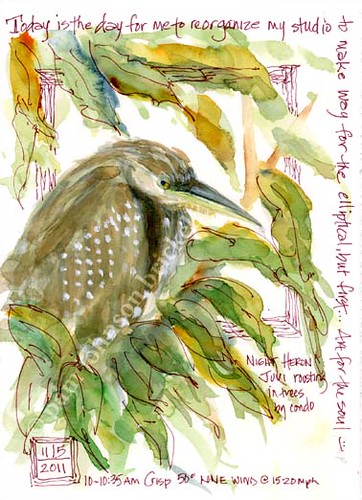
Black-crowned Night Heron Juvi

Black-crowned Night Heron Juvi by PJBee
Black-crowned Night Heron Juvi, a photo by PJBee on Flickr                                                                                 Great Egrets and Night Herons have been roosting of late in the trees surround a pond by our home.

This morning there were five egrets and a couple of herons but by the time I made it back out to sketch them the egrets were gone.

This juvi paid me no mind and posed beautifully. I should have had my scope as peering through bins then looking down to the paper was a bit challenging. You can lock a scope to one spot. I had to search for the bird each time I held the bins up :) Ah, but it's all part of the joy of sketching plein air!

Saturday, October 22, 2011

A Northern Harrier Hunting--Vickie Henderson

The Northern Harrier is categorized in a bird family all its own because of its unique habits and body structure.  Unlike other hawks, they hunt from sound, as well as sight and have stiff facial bristles, similar to owls, to help conduct sound.    
Besides appearing enormous because of their slender bodies and 40-46 inch wing span (102-118 cm), these birds are amazing acrobats, able to hover in place to hone in on their prey.  The duration of this hovering is unique to Northern Harriers and the American Kestrel in North America.  

Because they breed in northern states and are just arriving on wintering grounds in east Tennessee, placing this bird in this painting this time of year presented me with a challenge.  But I am always encouraged by the amount of information that gets stored away in our memories while we are observing nature.  And even more amazing, it's ready to be retrieved and guide us when we need it!  
I used many reference photos to help with the finer details on the bird and a generous amount of imagination to create the landscape, one that I'm familiar with from having seen this bird gliding over fields many times, and as recently as last spring.  Above you see some initial sketches I made to work out the body position before beginning the painting. On the left, a male hovering, and to the right a female gliding.  You can see the owl-like appearance in the sketch to the right and also the difference in gender color.  The male has grayish plumage above, and is white below, gaining him the nickname of ghost bird, while the females are shades of golden brown.  Both have banded tails.    

To see more of my explorations while creating this painting visit:  Northern Harrier Hunting at Vickie's Sketchbook.  More information about the Northern Harrier can be found at Cornell's "All About" page.

Monday, July 25, 2011

Cape Wagtail thinks it's Spring! - Maree

Birds are a miracle because they prove to us there is a finer, simpler state of being which we may strive to attain.
- Doug Coupland


I have a clear view from my bath into the bathroom court yard, where the Wagtails have been nesting in my Fan Palm for the last 2 seasons. While in the bath this morning, I was watching them through the open doors chasing the Weavers, who steal bits and pieces of the Fan Palm to build their nests with, and the reason soon became clear. Both parents were busily carrying nesting materials and obviously revamping their old nest for this season's babies. The Fan Palm's trunk is covered in a thick, coarse type of hairy stuff, and they have neatly hollowed out a space and lined it with lots of soft materials like feathers and woolly bits. Whenever the babies hatch and start to fledge, it's such a pleasure watching them in the court yard begging for food until they manage to get enough height to clear the wall and follow their parents into my garden.

Can I take it, then, that Spring is just around the corner...?

Friday, July 22, 2011

On a windy day - Maree

On a windy day let's go flying
There may be no trees to rest on
There may be no clouds to ride
But we'll have our wings and the wind will be with us
That's enough for me, that's enough for me.
— Yoko Ono


Pen and wash sketch in my Moleskine watercolour sketch-book of a Seagull as they passed over my property. I pretended to have some food and this chap came quite close to have a look!

Saturday, July 16, 2011

Whoooo? You! - Maree

“A wise old owl sat on an oak;
The more he saw the less he spoke;
The less he spoke the more he heard;
Why aren't we like that wise old bird?”
- Unknown


Had a visit from the Spotted Eagle Owl last night. It's full moon and it was beautifully bright outside. When I heard him I softly crept into the garden and spotted him sitting in one of the trees. I just love talking to him and he talks right back! When he goes Whoo Wh-o-o-o! and I mimic it, he immediately replies with another Whoo Wh-o-o-o-o! I even had him following me around the corner of the house, wanting to see WHO this intruder is that dares to challenge his territory! The female was also close-by, I could hear her Whoo Whoo - Wh-o-o-o-o! but didn't catch a glimpse of her.

It's nice to know that they are still around and hopefully catching the rats, which I struggle to keep under control because I refuse to put down rat poison. However, I did hear that there's a product on the market now that is more humane on the rats and also safe as far as pets and owls go.

This Owl is a medium to large owl with prominent ear tufts, its height is 45cm and its weight is from 480 to 850g. The wingspan is 33cm. They are nocturnal hunters, and spend most of the day concealed in trees, rock ledges or abandoned burrows.

Sunday, July 10, 2011

White-browed Sparrow Weaver - Maree

A Bird
A bird came down the walk,
He did not know I saw;
He bit an angleworm in halves
And ate the fellow, raw.
And then he drank a dew
From a convenient grass,
And then hopped sidewise to the wall
To let a beetle pass!
- by Emily Dickinson


These White-browed Sparrow Weavers used to be regular visitors to my old garden and, sad to say, I've not spotted them at all since moving to our new smallholding many years ago. My last sighting was in May 1996. I see their environmental status is listed as LC "Least Concern", so I cannot understand the reason at all as to why I have not noticed them lately. They have a general, harsh 'chik'chik' call when they're flocking, as well as a loud, liquid 'cheeoop-preeoo-chop' whistle, which I really miss...

The White-browed Sparrow-Weaver is found in greatest numbers in north-central southern Africa. While this species most densely populates at dry regions with woodland or wooded grassland in northern South Africa, its range includes Botswana, the North-west Province and Western Gauteng, northern and central Namibia, and western Zimbabwe. It is seen very often in South Luangwa National Park, Zambia and southern Malawi. Populations may be found as far north as Ethiopia.

Thursday, June 16, 2011

Kite sketch - Maree

Eagles may soar, but weasels don't get sucked into jet engines!
- John Benfield


Sketching has always been one of my great passions, but of late I've been neglecting it in favour of doing mostly watercolours. I've decided to go back to basics and sketch a lot more. Sketching forces you to look in more detail, and ask yourself what you actually see. You’ll end up seeing a lot more than you would otherwise. There’s something about holding a pen or pencil in your hand that gets your creative juices flowing in a much different way than holding a brush. When you get used to sketching, the movements of your hand become much more fluid and it becomes really easy and natural. The more you practice, the better you will become at sketching.

A Charcoal sketch of a Black-shouldered Kite (Elanus caeruleus), a common, grey and white raptor in South Africa with a black shoulder, done in my Moleskine large sketch-book.These beautiful little birds (they're not much bigger than a pigeon) often sit on the telephone lines outside our property and to watch them hovering over a field when they've seen some dinner is one of my greatest pleasures.


Saturday, June 11, 2011

Sketching Water Birds at Pinckney Island WMA

I had the good fortune to meet and bird with Kelly, of Red and the Peanut blog this week. I sooo love meeting blogging friends :)

Our destination was Pinckney Island Wildlife Management Area, Hilton Head Island, SC. This wonderful place is just about 6  miles from my house and I'm ashamed to say I just don't get a chance to go there that often. We walked to Ibis Pond. Kelly has a keen eye and pointed out many a bird treat.  The first was a Boat-tailed Grackle, Quiscalus major, nest built within the cattail reeds - a beautiful, deep structure constructed from dead cattail reeds and woven into living cattails.

Kelly captured this sketching moment for me :) My scope is just in front of me. I love sketching with a scope. My sketching combines both blind and modified contour techniques.

The Grackles were flying above us, sounding like helicopters. Just as I was about to move on, I saw a Grackles beak rise above the side of the nest!

I moved a bit more to the left and started to draw a pair of Ibis. The Funky Ibis on the left side of the page was totally blind contour.... thus it's beak is a bit on the funky side :) This one was perched above and to the left of a nest, the other laying on the nest. Just when I was going to start sketching the Ibis on the nest, they traded places. Dang... But, it was fun to see the changing of the guard :)

Then I spotted two juvi Tricolored Herons, Egretta tricolor, with fantastic 'bad hair' heads. Oooo they are so fun!

We moved around to see the more densely populated trees. Just amazing. Kelly said the bird numbers are actually down from her visit here last year.  We are in the midst of a drought which directly affects nesting. I can't believe how much the cattails have filled in the pond since my visit in 2009.  It's a wonder there's any open water. 

Here's a taste of what we were viewing...
White Ibis, Eudocimus albus, in rookery


This short video of Little Blue Herons, Egretta caerulea, shows adults flying in to feed their babies.  Immature Little Blues are always white. Their feathers will start to darken after their first spring. You can distinguish them from Snowy Egrets, Egretta thula, by noting coloration of their beak (pale grayish green) and legs (pale dull green). I shot this with my little Nikon Coolpix.  I so love this camera :) Kelly's doing most of the narrative. She's so funny!

And, the completed journal page... I added color at home.
It was so good to finally meet you, Kelly!! Let's do this again :)

Thursday, May 19, 2011

Greater Striped Swallow - Maree

“Daffodils that come before the swallow dares, and takes the winds of March with beauty.”
- William Shakespeare

Done in Moleskine Watercolour sketch-book

My Swallows were late in leaving this year, still saw them around just a week ago. Now their twitterings that I love to listen to as they swoop over my garden or sit on my Satellite dish are silent. They returned to their old home in the pump house in early September 2010 and I'm always humbled and honoured to think that they choose to return to me after thousands of miles of travelling.

They managed to rear two babies this season and it was a delight watching the parents teaching them all the sweeping moves over our vast expanse of grassland and it wasn't long until they too were balancing on the wires strung up in my (open-air) potting shed, which I use to hang flowers for drying, happily calling to one another. It's always a worry to me, wondering whether the babies will make the long journey safely. And it's always only the parents returning every year (for the past 5 years now), so I often wonder where the babies head off to...?

If our summer is exceptionally hot or dry, I leave the hosepipe dripping on an empty piece of ground in the garden and I have spent hours watching them gather mud for their nest-building.

Some info : The Greater Striped Swallow (Hirundo cucullata syn. Cecropis cucullata) is a large swallow. It breeds in Southern Africa, mainly in South Africa, Namibia and southern Zimbabwe. It is migratory, wintering further north in Angola, Tanzania and southern Zaire. It builds a bowl-shaped mud nest with a tubular entrance on the underside of a suitable structure. The nest has a soft lining, and is often reused in later years. It is common, unafraid of humans, and has benefited from the availability of nest sites around habitation. It feeds mainly on flying insects, but has been known to eat small fruits. It's conservation status is LC (Least Concern).

Monday, April 11, 2011

White Stork (Ciconia ciconia) - Maree

As long as I live, I'll hear waterfalls and birds and winds sing. I'll interpret the rocks, learn the language of flood, storm, and the avalanche. I'll acquaint myself with the glaciers and wild gardens, and get as near the heart of the world as I can.
- John Muir


A couple of weeks ago, as I was doing some garden chores, a White Stork glided over my garden, did a u-turn and clumsily landed with a plop on the lawn, staggering to its feet as it landed. I was quite amazed at this sight and quietly observed him for a while before slowly approaching him. He unsteadily wandered a couple of paces and took shelter in the shade of one of my White Stinkwood trees (Celtis africana), standing quite still, looking in my direction. I've seen many storks foraging on our smallholding, especially after a veldfire, when they snack on the rich pickings of dead and burnt insects, and I've never seen one on its own, they're always together in a small flock.

Not knowing what to do, because he didn't look all that well to me, I let him rest for a while, thinking he would take to the air shortly. They weren't due to migrate for Europe until late-March, early-April, so it's not as if he could be tired. I thought maybe it was a fledgling, but when I later approached him and he made no attempt to wander away, I gave him a close inspection. He was extremely weak and very thin, and the only conclusion I could come to was that it was either a very old bird or very sick.

The White Stork in my garden

The garden had enough water in various bird baths and little ponds, so I carried on with my chores and just let him be. By the time it was getting dark, he was still wandering unsteadily around the garden, and finally he just settled next to some leaf cuttings still lying in the pathway.

I went to bed, spending most of the night worrying whether he would be Ok, even getting up a couple of times to check up on him, but, sadly to say, when I went out at dawn the next morning, I found him lying dead on the cuttings, as if fast asleep. I'd like to think that he was an old chap that had led a rich and full life with many a migration behind his belt.

Saturday, November 27, 2010

Jackie Hangman

My morning prayer :
“Bless the flowers and the weeds, my birds and the bees.”


The Fiscal Shrike has been a busy little lady, filling up her larder in one of my Celtis trees - this morning I found a Finch fledgling spiked through one of the thorns on the tree and Jackie was sitting close-by, keeping a watchful eye on me.

I love my Shrikes living in my garden and they know when I approach the feeding tables that it's snack-time. I have a special feeder just for them, where I fill a pine cone with mince and suet, their favourites.

They provide me with hours of pleasure, watching and sketching them as they either sit in the top of an old dead tree or swoop down suddenly, landing on target of some tasty morsel. They are cheeky and precocious, harassing other birds no end, making sure their territory is clear of competition for food. They are also not past raiding nests, often taking newly hatched nestlings, much to my consternation as I helplessly watch.

The Fiscal Shrike is also named 'Jacky Hangman' due to its habit of impaling its prey on Acacia thorns to store the food for later consumption. In my garden they also use the White Karee, which has thorns all along it's trunk when it is young. My Fiscals often spike grasshoppers, small lizards and even mice on these large thorns and they also use the barbed wire and the spikes on top of the palisade fencing.

Friday, November 19, 2010

Sweet Wintering Sparrows--Vickie Henderson

I didn't know much about sparrows until I began to volunteer at a bird-banding station last year. Besides loving the close up views of the birds, I was impressed with the work that is done by the volunteer banding team, important conservation work.  
I have not released a bird from the mist net, yet.  Makes me too nervous.  But I have recorded the data and enjoyed the camaraderie of a dedicated group of people who love birds and want to help insure that their health and numbers are monitored before another species is imperiled.  The banding site I visit is a local wildlife refuge made up primarily of grasslands, a habitat that is considered one of the most vulnerable to climate change, and whose resident and wintering species are already declining.

In the image above you see a Savannah Sparrow that winters in Tennessee.  And below, a sketchbook spread of this sparrow being released from the mist net and receiving its band during a session.  (click images to enlarge)
It was during these intimate moments at the banding table that I fell in love with sparrows.  They are quiet birds with sweet personalities. And even though they have the reputation of being "little brown jobs", they are far from that if you take a closer look, even with binoculars or a camera.  Their feathers are exquisitely beautiful,a tapestry in cream, white, brown, black and rust, perfectly designed to keep them camouflaged from predators.  When they are still, you can't find them at all, even if you just heard one.  And when you do see them, it is a wonderfully satisfying experience.

Besides the magazine article that I previously posted, I also published an article about sparrows at Knoxville's Wild Birds Unlimited website.  The article includes images of two other beautiful sparrows, the maroon red and gray Fox Sparrow, and the exquisite rusty winged Swamp Sparrow, a bird that otherwise looks grayish all over.

Links:
More about my bird banding experiences 

And on a different subject, but still about birds, if you love Sandhill cranes and don't want to see then hunted in the eastern USA where they've never been hunted before, visit either of my blogs, Vickie Henderson Art or Vickie's Sketchbook.  At the top right sidebar of each you will see this sandhill sketch.  Under it you will find easy links where you can voice your opinion.  Take a minute to help us stop Greater Sandhill Crane hunting in the east before it starts.  

Saturday, November 13, 2010

Sketching and the Fun of Publishing! -- Vickie Henderson

I didn't fully appreciate how much fun this would be.  It was a goal and something I've always wanted to accomplish.  But not until seeing it in print, did I fully realize the satisfaction of researching and writing an article for a magazine and contributing both art and photographs to its publication.  

Below you see one of the sketches I created this year while working on a bird banding article for the TN Conservationist magazine, an idea that came to me when I was introduced to bird banding two years ago.  While this sketch was not included, another fun sketch of an Eastern Towhee was published in the article.
What I've loved the most about banding sessions, besides the opportunity to enjoy the detailed beauty of a bird's feathers, is observing bird personalities.  That's what the sketch above is about, those special characteristics and behaviors that are as much a part of a bird's identity as its color and the habitat it selects.  To have all of these characteristics close at hand is a marvel.  To sketch it is to slow it all down, absorb it more deeply, and internalize the bird in a way that produces even more awe and gratitude for nature's wonder and beauty.

And then there are the funny moments.  The sketchbook page that was published in the article told a story, the funniest story I've heard at the banding table.  While a bander-in-training was processing a female Eastern Towhee, she laid an egg in his hand!
To read more about the article and see the two-page layout, visit Tracking the Birds of Seven Islands at Vickie Henderson Art. and TN Conservationist Magazine, Banding and Sketching at Vickie's Sketchbook.

Friday, November 5, 2010

Feeder birds


It's always so much fun to see what birds visit our feeders--in this case a new one at my shed!  I've seen cardinals, sparrows, finches, and these guys...favorite winter birds!  Here, on toned paper, a titmouse, chickadee. and nuthatch...

You have to move fast to capture the overall shape, then you can add details later...including notes and borders!

Monday, October 25, 2010

Hooray, first bird I've seen

...on the new feeder! He was gone before I could sketch him, but happily everything else stayed the same. Pretty sure it was an English sparrow, but I was just glad to see anything find it!

English Sparrows were first introduced into this country in the middle of the 19th Century when they were released in Central Park...and BOY did they adapt and spread!  Now, they're also known as House Sparrows, so ubiquitous are they.