Showing posts with label egret. Show all posts

Monday, July 11, 2011

June 2011: Herons and Egrets Tree

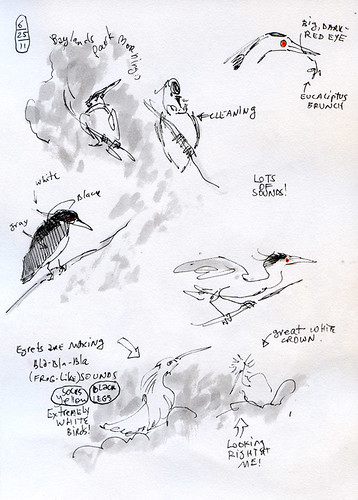
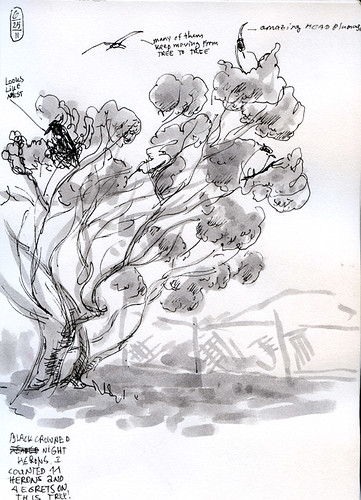
I recently found this amazing alley of trees with dozens of birds nesting. Surprisingly very loudly! I was able to identify egrets and black crowned night herons and enjoyed listening to the conversation for a little while trying to make out where nests were.

June 2011: Herons and Egrets Tree

Thursday, July 7, 2011

Australian birds - Alissa Duke

Three birds drawn today on a visit to the Australian Museum , with Wendy and Annie. Two hours flew by in no time. We left just as it was getting busy and loud as it is school holidays.


Spur-winged Plovers
The southern subspecies of Maskd Lapwing is also known as the Spur-winged Plover
Average size: 36 cm
Masked Lapwings are large, ground-dwelling birds that are closely related to the waders. The Masked Lapwing is mainly white below, with brown wings and back and a black crown. Birds have large yellow wattles covering the face, and are equipped with a thorny spur that projects from the wrist on each wing. The spur is yellow with a black tip. The Masked Lapwing is common throughout northern, central and eastern Australia. Masked Lapwings are also found in Indonesia, New Guinea, New Caledonia and New Zealand.

Honestly – most people know this bird for it’s defence of its nest. They nest in open areas (such as sports grounds, parks) and will aggressively attack people walking by. I have not had much experience with them, but have seen them in parks. If you mention plovers, people will immediately know the bird you are talking about !
Call : A loud "kekekekekekekek". (I can't seem to insert the audio link)
http://www.birdsinbackyards.net/species/Vanellus-miles


Cattle Egret
A relatively small snowy-white egret, the Cattle Egret is distinguished during breeding season by its orange crown, neck and breast, with similarly tinted long loose neck plumes. Originally found in Africa, Europe and Asia, the Cattle Egret is now found on nearly every continent, with birds in Australia originating from Asia.

http://www.birdsinbackyards.net/species/Ardea-ibis


White-browed Scrubwren
Average size: 12 cm

The White-browed Scrubwren is the most common and widespread of Australia's five species of scrubwren. Its range extends from northern Queensland, in a broad coastal band through South Australia to the mid Western Australian coast, and Tasmania.
The White-browed Scrubwren lives in rainforest, open forest, woodland and heaths. It is usually seen in pairs, low down in the thick vegetation. I am sure I would have heard them scurrying in the undergrowth of rainforest, but thy would blend in to the forest floor and look like they would be very active,
The call is an almost persistent harsh chattering of scalding notes, especially when disturbed. White-browed Scrubwrens are also accomplished mimics.
http://www.birdsinbackyards.net/species/Sericornis-frontalis

Saturday, June 11, 2011

Sketching Water Birds at Pinckney Island WMA

I had the good fortune to meet and bird with Kelly, of Red and the Peanut blog this week. I sooo love meeting blogging friends :)

Our destination was Pinckney Island Wildlife Management Area, Hilton Head Island, SC. This wonderful place is just about 6  miles from my house and I'm ashamed to say I just don't get a chance to go there that often. We walked to Ibis Pond. Kelly has a keen eye and pointed out many a bird treat.  The first was a Boat-tailed Grackle, Quiscalus major, nest built within the cattail reeds - a beautiful, deep structure constructed from dead cattail reeds and woven into living cattails.

Kelly captured this sketching moment for me :) My scope is just in front of me. I love sketching with a scope. My sketching combines both blind and modified contour techniques.

The Grackles were flying above us, sounding like helicopters. Just as I was about to move on, I saw a Grackles beak rise above the side of the nest!

I moved a bit more to the left and started to draw a pair of Ibis. The Funky Ibis on the left side of the page was totally blind contour.... thus it's beak is a bit on the funky side :) This one was perched above and to the left of a nest, the other laying on the nest. Just when I was going to start sketching the Ibis on the nest, they traded places. Dang... But, it was fun to see the changing of the guard :)

Then I spotted two juvi Tricolored Herons, Egretta tricolor, with fantastic 'bad hair' heads. Oooo they are so fun!

We moved around to see the more densely populated trees. Just amazing. Kelly said the bird numbers are actually down from her visit here last year.  We are in the midst of a drought which directly affects nesting. I can't believe how much the cattails have filled in the pond since my visit in 2009.  It's a wonder there's any open water. 

Here's a taste of what we were viewing...
White Ibis, Eudocimus albus, in rookery


This short video of Little Blue Herons, Egretta caerulea, shows adults flying in to feed their babies.  Immature Little Blues are always white. Their feathers will start to darken after their first spring. You can distinguish them from Snowy Egrets, Egretta thula, by noting coloration of their beak (pale grayish green) and legs (pale dull green). I shot this with my little Nikon Coolpix.  I so love this camera :) Kelly's doing most of the narrative. She's so funny!

And, the completed journal page... I added color at home.
It was so good to finally meet you, Kelly!! Let's do this again :)