Showing posts with label mushroom fungus. Show all posts

Saturday, June 4, 2011

bits of Arkansas

bits of Arkansas

While visiting friends last week in Arkansas, we spent a lot of time in their yard --- at the edge of the woods next to Norfolk Lake. (Bill and I had the ticks to prove it -- never had 'em before.)

With recent rains, there were loads of mushrooms --- these are only a few of those found in their yard. Not sure if I named them correctly; my field guide is pretty old.

Tuesday, October 12, 2010

STINKHORN!


 Order Phallades

Oh, gag. By the time I finished these rough sketches I was ready to hurl. After they've lost their gelatinous outer cover, they develop their full fetid odor. It got worse and worse as I sketched.

The flies and other small insects that help disperse the spores, which are not airborne, were delighted.

I wasn't!

And let me tell you, this is way, WAY too close to be to a mature stinkhorn...


Saturday, October 2, 2010

Wild Mushroom - Teri Casper


Wild Mushroom
Originally uploaded by Teri DC
We have had a few weeks of rain and the wild mushrooms exploded. I found this one and several more under our pine trees. It was very fun to paint.

Monday, March 8, 2010

Scarlet Elf Cups ~ Sigrid Frensen

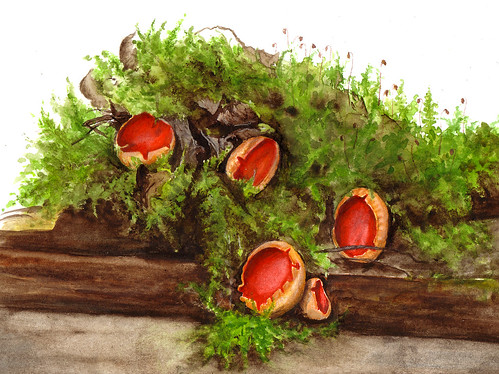
Winter seems a strange period to go hunting for mushrooms. But there are a few that only can be found in this period of the year. The Scarlet Elf Cup (Sarcoscypha coccinea) is one of them. It loves snow and freezing temperatures. This fungus grows on decaying branches in damp spots on forests floor. It's a rare fungus in the Netherlands... or so they say. Winter, snow, freezing cold and crawling under bushes isn't a very pleasant combination for most people, so it's not surprising it's not such a common sight.

Scarlet Elf Cups

I painted this little group of Scarlet Elf Cups like they were found. On the branches, with moss and dead leaves. I first painted the Fungi because I knew they loved the cold and damp.... not my dry and warm studio. The interior of the cups is bright red and very smooth. The outside is lighter and orange. later they turned even lighter, almost white. Maybe that had something to do with the dry, warm air. They are quite small, about 2 cm.
The hardest part was to paint the moss around the mushrooms. So delicate and fluffy. But I decided not to get into details too much since the focus should be on the fungi. I think I managed to do it. Creating this very tiny little world from the forest floor.

Thursday, February 4, 2010

Mushroom for brunch

It was supposed to rain early this morning but I took my chances and headed for Howarth Park to see what I could see. Luckily, and not surprisingly, the weather forecasters were wrong and there was only a little bit of drizzle here and there, not even enough to make the paper wet. Toward the end of my walk I found this mushroom, Agrocybe praecox, one of the harbingers of spring in these parts. I used the compact mirror, that I carry for just this application, to examine the underside of the mushroom and confirm my tentative identification. When I saw the slug munching away I knew that I had to get a quick sketch. I drew the slug first and was glad I did as it left soon after I got there.

Monday, February 1, 2010

Helvella

Helvella lacunosa are a fairly common fungus in northern California that seem to fruit longer than most. The fruiting bodies are quite sturdy and persist for a good long while. I'm told that they fruit with conifers but I find them mostly in association with one of our native trees, coast live oak (Quercus agrifolia). Helvella don't have gills or pores. Rather, they produce their spores on the upper surface of the wrinkly cap.

I had collected several of these, with caps in various shades of gray and black, planning to do several watercolor sketches. They languished in the refrigerator for over a week and today, when I finally got around to sketching, they were rather old and funky. Every time I moved one, or opened the container, spores swirled up, up and about the room. It was sort of like a dust storm. Blggghhh! They're still fruiting so tomorrow I'll try to find some that are a bit fresher.  Apparently they're edible. I've seen several suggestions of ways to cook and eat them while reading about fungi online lately. Not that I'm going to eat them myself! But I did lay them to rest in my backyard. We have a valley oak (Quercus lobata), which is a poor mushroom host, but maybe I'll get some to fruit in my yard next season! My very own helvella garden! How cool would that be? Oh, the sketch of the black capped fungus was done with ball point pen and the color sketch was done in ball point and watercolor.

Thursday, January 21, 2010

A decaying log hosting a lot of fungi


These fungi are fruiting on an old log in a little dell that I like to visit in Howarth Park, a beautiful city park in Santa Rosa CA, with some lovely trails meandering through mixed woods. Mixed woods mean more mushrooms because fungi and trees form relationships that are beneficial to each and the more types of trees, the more fungi. I would have had to draw a much bigger picture to fit all of the fungi that were actually on this log, but I focused on the lacy white entity on the left of the picture. It's called Hericium abietis and is one of the tooth fungi.

The mushrooms to the right of the Hericium abietis are Mycena haematopus, identifiable by a stalk that "bleeds" red juice when cut or pinched.

Finally, the black lumps behind the Hericium abietis are called Annulohypoxylon thouarsianum with a common name of cramp balls, presumably after someone tried to eat them? They're very common and persist even in dry weather so are especially easy to find.

The reason all of these fungi are on this log is because they're all wood-rotters, the under appreciated composters of our forests. It's interesting to watch a log as it decomposes because different fungi appear at different stages of decomposition.

Monday, January 4, 2010

One of my favorite mushrooms


These pretty little mushrooms appear around Christmas here in northern California and are called Marasmius plicatulus. One rainy December I saw a huge troop of hundreds or more, all in one place. Mostly, where I walk, they appear in smaller groups and you have to look very carefully to find them because they blend so well with the leaves. I drew some a week ago in black and white because I love working in black and white, but I wanted to try to capture the lovely colors, so today I made a little watercolor sketch. It was very cold and I kept waiting for the sun to come out and make it warmer. I finally gave up and packed my things to go home and finish up. As I walked out of the park, the sky cleared.

Monday, October 5, 2009

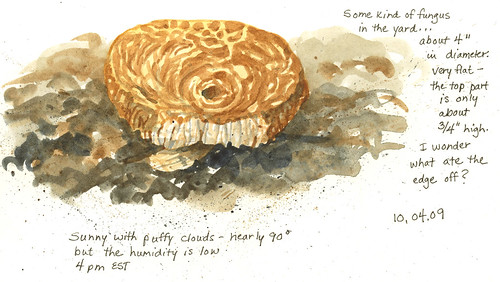
Fungus - Elizabeth Smith


Fungus, originally uploaded by Elizabeth Smith.

In my yard I found this interesting-looking mushroom; it looked just like a piece of pastry with a nibbly edge. I sat on the ground and did a quick sketch of it with my travel set of watercolors and aquabrushes.

I know very little about wild mushrooms beyond bracket fungi and morels, so I have no idea what kind this might be. In the amazing manner of synchronicity that runs through life like a silver thread, I had just watched a fascinating documentary on the Sundance Channel about fungi!

You can click on the image to view larger on my Flickr photostream.

~Elizabeth Smith, Naples, Florida, USA