Showing posts with label birds. Show all posts

Monday, October 12, 2020

Rose-breasted Grosbeaks in October--Vickie Henderson

Rose-breasted Grosbeaks are striking birds, especially the males with their black and white markings mixed with a splash of rose on their breasts.  They visit Tennessee mostly during migration in both spring and fall. The exciting thing about fall is the juveniles are still changing their "paint".  

Like birdy watercolors, each one is unique as their feathers morph from juvenile brown to the brightly colored markings of an adult.  Not a single two of them are alike!  The sketch above was created after observing my feeders for about an hour on my porch.  In the rain!  Full of fun surprises, including a shy juvenile grosbeak.  Being still in nature observing brings so much wonder and inspiration. Naturally that makes me want to sketch and paint!

Visit my blog post:  Rose-breasted Grosbeaks, Red-breasted Nuthatches and a Hairy Woodpecker at Vickie Henderson Art.  

Saturday, June 8, 2019

EYE TO EYE WITH GANNETS

 
We've just returned from a cruise to visit the cities of the Baltic and on our first day at sea I was privileged to witness a flock of gannets flying alongside our ship.  I was sitting on our deck 10 balcony at just the perfect level when they came swooping by and stayed with us for over an hour.  I'm sure they came to have a look at me too while I was studying them!

Saturday, December 10, 2016

Irish fields

I love Ireland, and its green, green fields. I like standing there sketching what I see, listening to the birds cawing, making out the jackdaws from the crows by their calls. These were carrion crows. As I was drawing the fog descended and by the time I finished the trees on the horizon were not visible anymore. So beautiful.

Friday, December 2, 2016

Autumn leaves

 
I waited for days to sweep up the leaves in the garden while the rain fell and the winds blew and eventually realised that they had all blown away over the hedge.  The only leaves left were lodged under the shrubs and a blackbird was busy scattering them all over the grass again in his search for worms!

Friday, September 2, 2016

Birdwatching in Hamburg


           Hamburg is full of canals and parks, and the waterfowl and birds are very trusting. They make wonderful models, and they are a delight to watch.
           The immature herring gull perched for a long time in front of me, while a young girl was finishing her sandwich. They know to wait for their snacks!
           I had just bought of drawing pens, the ones I used here are Derwent Graphik. They are smooth and the colour is great-

Saturday, January 23, 2016

Feeder Birds

Quick sketches of various birds, and our very colorful female cardinal

LOVE my cardinals!  I counted 17 the other day...

The yellow shafted flicker is more rare to my backyard...I've only seen the male once this year, but the female shows up frequently, if briefly.

I'm always delighted to see purple and house finches together.  We see a lot of house finches but not so many purples.

Winter is such an active time at our feeders, and I'm very grateful we can afford to care for our little cousins!  They pay me back by modeling...

Thursday, July 23, 2015

a painted bunting's visit


I knew that there are painted buntings in central Texas but we had never seen one. Until yesterday. I was standing at my kitchen sink when I looked up and there he was at one of our bird feeders. His colors are amazing! I couldn't see him close enough for details so I did the larger sketch from a field guide photo.

Wednesday, January 14, 2015

Winter Sketching

From my window, from our Jeep...
I love sketching the feeder birds!

The subtle color of female cardinals always challenges me...

Sunday, December 21, 2014

LONG TAILED TITS

 
Our dining table faces the garden and I have a wonderful view through the patio doors.  I keep the binoculars handy in case we get some interesting visitors.  Look what came this week, a flock of about 15 long tailed tits, fluttering about the branches like butterflies, only landing to feed for a few seconds before moving on to another tasty morsel.

Saturday, September 27, 2014

hummingbirds


When we moved here to central Texas, there was a wee wooden sign posted in one corner of our property reading "Lake Forest Wild Bird Sanctuary". It has proven to be fact!

At our small 1920 apartment building in Kansas, we saw lots of house sparrows and, rarely, an occasional blue jay or cardinal. A year or so ago an unknown raptor nested in our old elm tree, scaring away all other birds (except those silly, brave sparrows).

Here in the woods, we have identified over 30 types of birds in our yard in the past 7 months, many more in the neighborhood. And they keep on coming! Of course, when I chose to sketch as many as I could see on Thursday, none showed up except the constant hummingbirds . . . . We have both ruby-throated and black-chinned hummers.

(Who knew they actually SQUEAK like a dog's squeaky toy?!? I knew you could hear the "hum" of their wings but our hummers perch in a nearby crepe myrtle and squeak at us!)

Monday, August 4, 2014

sketching birds at the Australian Museum

I  spent a few hours at the Australian Museum in Sydney on Saturday and today. I wish I visited more often. I have a membership so can get in for free, so I should make effort to visit. The problem is  - to many wonderful things to draw, to many projects !
 
The Australian Museum
 
Although there are many wonderful floors to explore and sketch, I seem to always head for the Search & Discover Room . It is an information and resource centre. You have a chance to  touch and feel real specimens, and take them to a desk to position and sketch. I had SUCH a good time. Sometimes lines just flow from the pencil. It happened here.
 
I have sketched a few Australian birds before . As with any subject, the more you draw and really LOOK and SEE  it, the more understanding you have of it and the better you get.


I usually draw in a 13 x 19 cm Moleskine Watercolour sketchbook.  The only times that I want to draw BIG are at the Museum and the Zoo. So I took an A3 sketchbook this time.
I also took an old ledger that I had bought. I want to explore drawing on printed surfaces.
 
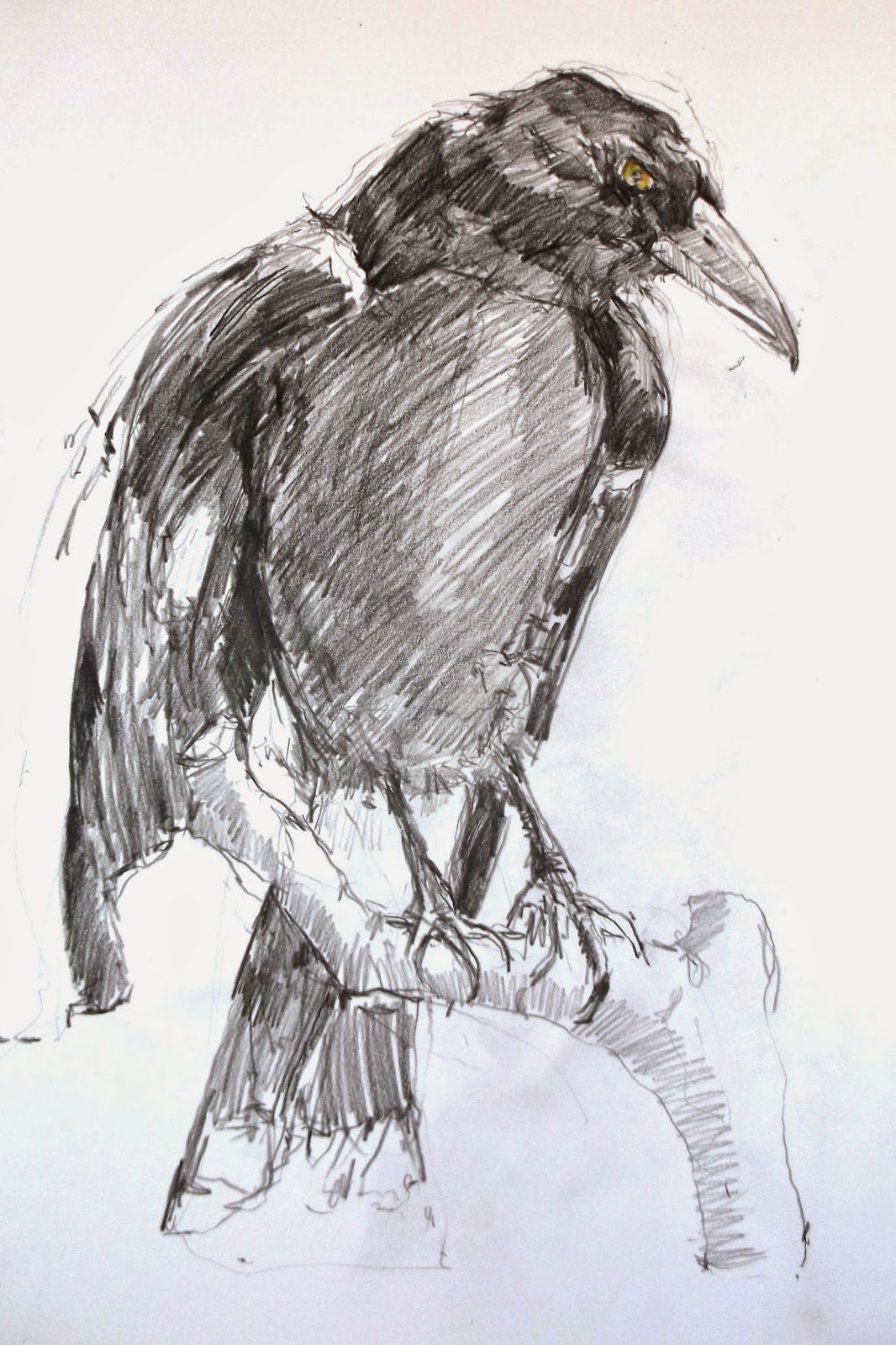
Currawong


He is almost all black in colour. but I decided to finish in this sketch stage and not "colour in"
 
A3 Arches 300 GSM Smooth Watercolour Paper
 
Pied Currawongs are found throughout eastern Australia. They prefer forests and woodlands, and has become well adapted to suburban areas. Throughout its range it is common and familiar. Average size: 48cm Source: http://www.birdsinbackyards.net/species/Strepera-graculina
Their song  can be heard in Australian suburbs

Currawong
 
I sketched him again, but really  had to add all black otherwise he looked like a penguin with a white front.


magpie
 
The Australian Magpie is black and white. It is slightly smaller than the currawong  Its nape, upper tail and shoulder are white in males, grey in females. Across most of Australia, the remainder of the body is black. They are common and conspicuous birds.Australian Magpies are found wherever there is a combination of trees and adjacent open areas, including parks and playing fields. Australian Magpies can be very aggressive during breeding season and attacks on humans and pets can occur.
They have a beautiful song which I love to hear. It is a loud musical flute-like song, often performed as a duet or by groups


I always draw in watercolour pencil. On this page I was showing another sketcher, Jane how I use watercolour pencils to draw and blend. I have been using them everyday for over five years and love what can be done with them.
 
 
I draw lots of things and they all go on flickr https://www.flickr.com/photos/alissaduke/

Friday, July 18, 2014

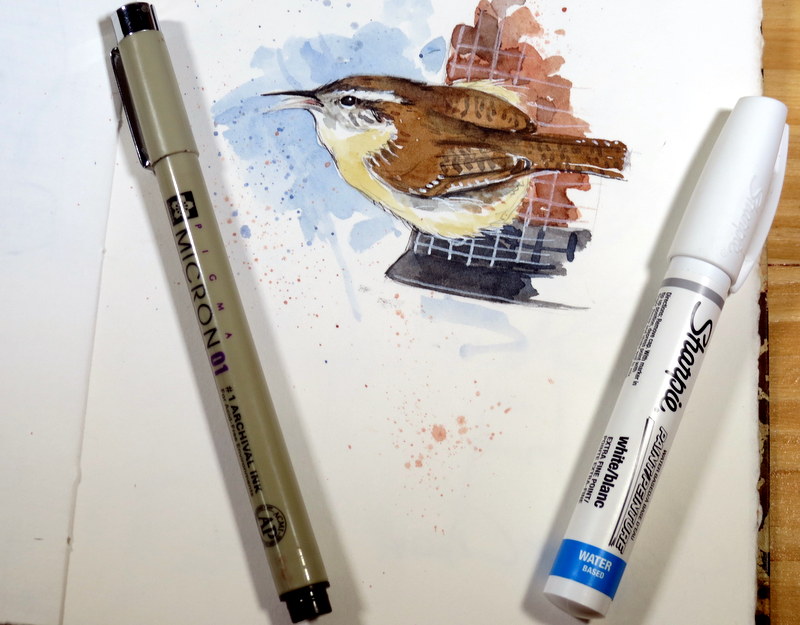
our resident Berwick's Wren


When we moved in to this log cabin, there were two ornamental log houses left on the bookshelf by the former owners. I needed the space for books, so I moved these outside to a plant shelf in our covered patio. It sits in the corner, up against the place where corner logs meet and overlap.

Recently I was messing about with a plant on the middle shelf when I was surprised by a wee bird flying out from the larger of the two houses. (OK, Bill said I jumped and shrieked.) Apparently a Bewick's Wren has moved in! I haven't seen a wren since I was around 6 years old in Illinois.

I've now seen a pair of wrens sitting on the back of a porch swing, the female having a bit of food in her beak. So I'm wondering if there is a baby inside?

Sunday, June 1, 2014

Doing a bit of sketching...


For a lesson on nature drawing, for Danny Gregory's "Sketchbook Skool"--I worked from photos for these two, my birds weren't cooperating!

Tuesday, April 29, 2014

Killdeer Egg - Laura Gillis


First, I want to apologize for my long absence from this blog. I let life get in the way and I have missed being here but I have enjoyed seeing your posts! So, here’s a little sketch I did in my nature journal. I’m so happy to be back in the journal and on the blog. 

I found this Killdeer egg in the driveway yesterday and at first glance it looked like a perfect egg... just far from any nests and in the wrong place. Then I realized that it was broken. 

We have several Killdeer around our place this spring and I am always looking for their nests and they are hard to find. About the only way I have found a nest is to see mama bird dragging her wing and trying to lead me away from the eggs. These crazy birds like to nest in the gravel along side the road - a pretty dangerous place to be out here.


Sadly, I think it is highly probable that Shorty or one of the neighboring dogs had an omelette for yesterday’s breakfast.

Thursday, March 27, 2014

Barn Owl (Tyto alba)


Ghostly pale and (not) strictly nocturnal, Barn Owls (Tyto alba) are silent predators of the night world. Lanky, with a whitish face, chest, and belly, and buffy upperparts, this owl roosts in hidden, quiet places during the day. By night, they hunt on buoyant wingbeats in open fields and meadows. You can find them by listening for their eerie, raspy calls, quite unlike the hoots of other owls. Despite a worldwide distribution, Barn Owls are declining in parts of their range due to habitat loss. I for one do not see them as often as I used to, but a few nights ago I was thrilled to hear one screeching just before dawn.

The Owl Rescue Centre is the only raptor centre in South Africa that primarily focus on owl species. They give all their time and attention to owl species because of the high mortality rate of owls in South Africa, making owls vulnerable to a decreasing population. They rehabilitate and release 200 – 250 Spotted Eagle Owls, 100 – 150 Barn Owls and 80 -100 other owl species each year. SHOULD YOU FIND AN OWL THAT YOU SUSPECT MIGHT BE INJURED, PLEASE CALL THEM ON 082 719 5463 (24/7 emergency line – South Africa)

.

Sunday, March 23, 2014

Amethyst Sunbird female - Maree

W&N watercolour on Bockingford 300gsm 
Amethyst Sunbird female feeding on the Kniphofia (Red Hot Poker) flowers in my garden

I'm always utterly thrilled when these little beauties visit my garden. With all the rain we've had, my Red Hot Pokers have been an absolute magnet for insects and birds and when I hear these sunbirds twittering in my garden I always rush out, sketchbook or camera in hand. The male is pitch black with the most gorgeous metallic throat patch and one could easily miss his inconspicuous little wife perched on the flowers.

The Amethyst Sunbird, also called the Black Sunbird (Chalcomitra amethystine) mainly occurs in Africa south of the equator. Its natural habitat is dry savannah but it is extremely fond of gardens.

 It goes out of its way to visit a large clump of nectar-bearing plants. Here in my garden, it feeds on nectar from the Aloe, Kniphofia, Halleria lucida (Tree fuchsia) and a nectar mix in one of my bird feeders. It’s diet is supplemented with insects and often hawks flying insects from the trees or bushes, also gleaning them from leaves and branches. Nectar is obtained either from flowers or from garden feeders, which it uses readily (note that in feeding experiments it was found to prefer sucrose rather than sugar).

This Sunbird is not threatened, in fact its range has increased recently due to the spread of wooded gardens.

.

Tuesday, March 4, 2014

Black-headed Oriole - Maree

W&N watercolour on Bockingford 300gsm 

The Black-headed Oriole (Oriolus larvatus) is a frequent visitor to my garden (Tarlton, Gauteng, South Africa) and I’m always thrilled to hear his liquid call, upon which I rush out to refill the oranges and apples, which seem to be his favourite fruit.

The Black-headed oriole is common and widespread, occurring throughout sub-Saharan Africa, from East Africa to southern Africa. It is quite adaptable, occupying a variety of habitats, including savannah, woodland, parks, farmland and gardens. It eats a variety of invertebrates, fruit and seeds, often foraging in mixed species flocks in the tree canopy. The nest is a deep cup of woven old-man’s beard strands, moss and grass, placed between stems of a fork in a slender tree branch. It is usually placed between the stems of a fork in a horizontal branch, often far from the main tree trunk, usually 6-9 metres above ground.

Bright yellow in colour with black head and black flight feathers, it has a flesh-coloured beak and grey feet. In the Northern Hemisphere, the Golden Oriole is bright yellow with black wings.

.

Saturday, March 1, 2014

Barn owls - Maree

Ink sketch and W&N watercolour on Bockingford 300gsm

I've been so lucky this past summer in having the barn owls in our blue gum bush again and I've had plenty of sightings during the day and been thrilled by their screeching at night. I've mostly spotted this one particular pair and I was so hoping to see babies but I have no idea where the nest is.

Barn owls are most commonly monogamous, although several reports of polygamy exist. Pairs typically remain together as long as both individuals live.

Courtship begins with display flights by males which are accompanied by advertising calls and chasing the female. During the chase, both the male and the female screech. The male will also hover with feet dangling in front of the perched female for several seconds; these are known as moth flights.

Copulation occurs every few minutes during the nest site search. Both sexes crouch down in front of each other to solicit copulation. The male mounts the female, grasps her neck, and balances with spread wings. Copulation continues with decreasing frequency throughout incubation and chick rearing.

.

Tuesday, February 4, 2014

Nature's little mysteries


This male cardinal had a divot out of the feathers at the back of his head; it seems a bad time to molt, as cold as it is!

Later, I got a photo of him and discovered he'd lost feathers around his right eye, too--

A strange time for parasites, too...what's up with this poor guy?

Tuesday, October 15, 2013

My Swallows are back! - Maree


Greater-striped Swallow sketch in my Nature Journal
.
My swallows are back! 10 Oct 2013 - stealthily and imperceptibly they arrived; was I unconscious? 


They were very late this year, usually they arrive the beginning of September, maybe that's why I missed them. But we also had no rain in September, with our first shower happening on the 8th October. This leads me to believe they time their arrival with the rains... 


Wonder if they'll be using last year's half-completed nest?
.
The Greater Striped Swallow (Hirundo cucullata syn. Cecropis cucullata) breeds in Southern Africa, mainly in South Africa, Namibia and southern Zimbabwe. It is migratory, wintering further north in Angola, Tanzania and southern Zaire. 

::