Showing posts with label bird watching. Show all posts
Tuesday, April 10, 2012
Which warbler?
For a few weeks in March it seemed that everywhere I walked in Howarth Park I heard a bird singing a loud, trilling song, often from trees right in front of me. I'd scan the canopy with my binoculars yet never was able to see the singer. When I'm patient I usually can solve the little mysteries that I come across as I wander about the woods and meadows in the park. So, I kept trying to find the trilling bird and, near the end of the month, as I watched several species of birds flitting madly through some oaks, I again heard the song that had been haunting me. At first, as usual, I was unable to find the singer and then I spotted him perched at the top of a tree. He preened for a bit, giving me time to make some sketches and then was gone.
Once home, I began looking through my field guides and listening to sound samples at the Macaulay Library. I was certain of my identification of Wilson's warbler (Cardellina pusilla) and made notes on my sketch. A little over a week later, as I prepared to publish a post about my abilities at bird identification, I revisited the information I'd found about the warbler and began to realize I'd been, perhaps, a bit too hasty in my identification. My heart sank as I flipped through the warbler pages in my Sibley guide and saw that there were at least two other possibilities. Even more discouraging, I couldn't quite remember the song and when I listened to all three birds they sounded terribly alike. I've been trying to work out ways to make better notes about bird song and this just emphasized the need.
I've almost certainly ruled out Wilson's warbler now. The male bird has very distinctive markings, including a very black cap. My bird had none. I would be surprised to find that this bird was a female. He sang like a fellow telling the world that he was ready to go forth and procreate and that he'd found the place to do so. If he'd been a Yellow warbler I would've seen some bright red stripes on his manly breast. An Orange-crowned warbler would've had dingy stripes on his.
Well, maybe the females are the territorial singers in one of these species. Maybe the light or my own sloppiness kept me from seeing important details that would've helped me identify that darned bird. If I'd had more ability to make notes about bird song, I might've been able to narrow that down. Maybe the bird had a cap and I just couldn't see it. Well, you get the idea. Sometimes you can convince yourself that you're really brilliant and other times you learn that it just isn't so. Not at all.
I haven't heard that song in the past week, leading me to believe that the unknown warbler has probably found a mate and gotten down to the business of procreating. No more need for loud and glorious song. Maybe next year I'll have learned enough to name that bird. In the meantime, patience and humility, patience and humility, patience and...
Here are some links to information about the birds I think are the most likely suspects:
Yellow warbler (Setophaga petechia)
Orange-crowned warbler (Vermivora celata)
Wilson's warbler (Cardellina pusilla)
Tuesday, March 20, 2012
A new acquaintance
One of the best ways to see birds is to sit quietly in a place that they like to visit, usually for food. One of my favorite places to do this is Santa Rosa Oddfellows Cemetery.
It's an open, grassy place with a mix of native and non-native trees in a central area. I can spend hours in shade or sun and observe the comings and goings of songbirds stopping by to forage on the ground or in spruce, oak and an old, gnarly Peruvian pepper tree (Schinus molle). There are also some hawks that hunt the area, Northern flickers (Colaptes auratus) in winter and American crows (Corvis brachrhynchos) and Western scrub jays (Aphelocoma californica).
One gray winter morning I watched a juvenile White-crowned sparrow (Zonotrichia leucophrys) stop to rest in the pepper tree. A larger, shadowy figure appeared in my peripheral vision and piqued my curiosity.
Even in the murky light I could see that the bird had a red head, not something I see on any of the birds that frequent our area. I crept closer and closer, until I could see enough detail to do some rough sketches to take home and use to help me identify this lovely and, to me, exotic bird. While sketching I noticed that the tree was riddled with neatly drilled holes in tidy rows, something I hadn't ever seen before. I hoped that the pattern might help me identify the bird making them.
Once home, I looked in my copy of Sibley's Guide to the Birds and was able to easily identify the bird as a Red-breasted sapsucker (Sphyrapicus ruber), a bird that drills neat rows and columns of holes in living trees and returns later to drink the sap and eat any insects that may have been attracted to the sap. This led me to hope that I might have another chance to see her. When I arrived the bird was working the tree as though she'd never left. Closer examination showed that the Pepper tree was neatly pierced up and down it's trunk and larger limbs. This bird had clearly been around for a while.
I've returned several times, at different times of day, and most of the time have found the sapsucker working the tree. The last time I was there, an Acorn woodpecker (Melanerpes formicivorus) flew in noisily and began drinking sap from one of the holes the Sapsucker had drilled. The Sapsucker immediately moved to another limb of the tree and waited. The intruder continued to drink for a few minutes then flew off. As soon as he was gone the Sapsucker returned as though nothing out of the ordinary had occurred.
Surprisingly, this sapsucker was one of the least shy birds I've encountered. Each time I've gone to observe her I've been able to sit, as long as I like, very near where she's working. She checks on me every now and then but mostly keeps drilling. She often stops and appears to rest while watching the comings and goings of a Nuttall's woodpecker (Picoides nuttallii), several Lesser goldfinches (Spinus psaltria) and the occasional Yellow-rumped warbler (Setophaga cornonata) as they forage nearby.
One gray winter morning I watched a juvenile White-crowned sparrow (Zonotrichia leucophrys) stop to rest in the pepper tree. A larger, shadowy figure appeared in my peripheral vision and piqued my curiosity.
Even in the murky light I could see that the bird had a red head, not something I see on any of the birds that frequent our area. I crept closer and closer, until I could see enough detail to do some rough sketches to take home and use to help me identify this lovely and, to me, exotic bird. While sketching I noticed that the tree was riddled with neatly drilled holes in tidy rows, something I hadn't ever seen before. I hoped that the pattern might help me identify the bird making them.
Once home, I looked in my copy of Sibley's Guide to the Birds and was able to easily identify the bird as a Red-breasted sapsucker (Sphyrapicus ruber), a bird that drills neat rows and columns of holes in living trees and returns later to drink the sap and eat any insects that may have been attracted to the sap. This led me to hope that I might have another chance to see her. When I arrived the bird was working the tree as though she'd never left. Closer examination showed that the Pepper tree was neatly pierced up and down it's trunk and larger limbs. This bird had clearly been around for a while.I've returned several times, at different times of day, and most of the time have found the sapsucker working the tree. The last time I was there, an Acorn woodpecker (Melanerpes formicivorus) flew in noisily and began drinking sap from one of the holes the Sapsucker had drilled. The Sapsucker immediately moved to another limb of the tree and waited. The intruder continued to drink for a few minutes then flew off. As soon as he was gone the Sapsucker returned as though nothing out of the ordinary had occurred.
Surprisingly, this sapsucker was one of the least shy birds I've encountered. Each time I've gone to observe her I've been able to sit, as long as I like, very near where she's working. She checks on me every now and then but mostly keeps drilling. She often stops and appears to rest while watching the comings and goings of a Nuttall's woodpecker (Picoides nuttallii), several Lesser goldfinches (Spinus psaltria) and the occasional Yellow-rumped warbler (Setophaga cornonata) as they forage nearby.
Learn more about Red-breasted sapsuckers:
Wednesday, March 7, 2012
Name that bird
![]() |
| Ruby-crowned kinglet |
One morning in early March, as a very cold wind blew through Howarth Park, I found myself sitting in the sun in the middle of a meadow surrounded by bay, oak and manzanita trees, trying to get warm. A few birds drifted through the shrubs around me while American crows soared high above, dipping and banking in the wind and looking as though they were having some kind of fun. Out of the corner of my vision I noticed movement in a nearby shrub and raised my binoculars to see a bird that I thought was probably a Ruby-crowned kinglet. I watched it as it moved from shrub to tree and back again, singing "Pweep - Pweep - Pweep." loudly and repeatedly. Something about it just didn't seem right for the kinglet, but I couldn't clarify what made me feel that way so I made as many notes as I could in order to mull it over later.
![]() |
| Hutton's vireo |
At home I looked at the Ruby-crowned kinglet article at All About Birds. I looked at a few other pages, too, and read, on more than one of them, about the uncanny similarity between Ruby-crowned kinglet and Hutton's vireo (Vireo huttoni). By this time I'd listened to the Ruby-crowned kinglet sound recording and felt fairly certain that my hunch had been correct and the bird I'd seen wasn't a kinglet. I listened to the Hutton's vireo recording and knew I'd found my bird! Pweep!
Friday, February 24, 2012
Birdwatching at the Orchard

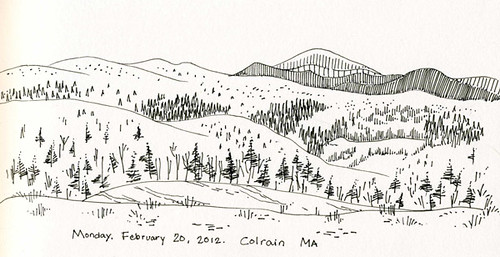
©2012 Carolyn A Pappas, Greenfield as seen from Colrain. Pen in large handbook journal.
My husband took me to a nearby apple orchard to do some nature sketching the other day. The orchard sits upon a high hill which has a 180° view of the mountains surrounding Greenfield, MA. It's too bad that I didn't have my colored pencils or watercolors with me because they would have been great for this scene. All I had in my purse were some pens, which are my favorite sketching tool, but it felt a bit awkward for drawing all these trees.
When we were sitting in the car sketching, we noticed three or four bluebirds on the nearby apple trees. I was amazed because bluebirds are very rare. Then, the bluebirds started acting crazy and they all scattered when a giant hawk swooped down right near us. The hawk was being attacked by two crows, which chased the it all the way down into the valley. The hawk must have been threatening the crow's nest or something along those lines. This happened too quick for me to make a sketch or even take a photo, but it was exciting to watch.
My husband snapped a photo of me in the car sketching, looking very serious with my coffee!
Wednesday, December 28, 2011
A flicker of red
Red-shafted northern flickers (Colaptens auratus) are one of the first birds I learned to recognize. Their distinctive call heralds the coming winter here in northern California and the bright red under their wings as they fly is like a neon sign on a gray autumn day. Unlike other woodpeckers, this species often forages on the ground, turning up leaves and earth with a slightly curved beak, to find insects, flying up in a frenzy if you disturb one as you're walking. In the eastern United States flickers are yellow-shafted and in between the east and west the two color forms hybridize to make various shades of orange.I never really thought about the name of this bird until the other day when I found this colorful cluster of feathers in the woods of Howarth Park. After a moment thinking the color was artificial and had been left by careless humans, I recognized the color and pattern as I really grasped what was red-shafted about the northern flickers in these woods.
Birds: ballpoint, colored pencil, on 8.5 x 11" Hahnemuhle Ingres paper
Feathers: graphite, watercolor on Fabriano Artistico HP
Tuesday, October 18, 2011
A fine autumn day
Every morning, I begin my walk with a sense of adventure, wondering what I'll see as I wander about. Although there are days when not much seems to be happening, most of the time there's a least one thing that inspires me to draw or to ask questions or both. Some days there's so much going on that it's hard to contain myself! That's how it was one day in September, when there seemed to be excited activity wherever I walked. Joining in the spirit of things, I had a blast sketching birds as they moved about the edge of the woods gathering food. First year birds chased each other wildly through the trees. A pair of young juncos flew so close that I could hear their wings beat as the sped past me. A Downy woodpecker (Picoides pubescens) spent a good ten minutes demolishing an oak apple gall (Andricus californicus) to eat the larvae inside. Chickadees (Poecile rufescens) traveled through the treetops in search of insects to eat and a lovely but unfamiliar song led me to my first female Western Tanager (Piranga ludoviciana), a shy dingy yellow bird who I never would've found without hearing her first.
Friday, August 19, 2011
A life bird at the feeder. Whooee!
This morning I sat in our kitchen to try and decide where I was going to walk when the fog lifted. It was 8:30 and there was no sign of sun so I had plenty of time to decide. I looked up at the bird feeder and noticed what I thought was a very large pigeon on it. When I looked closer I saw that it wasn't a rock pigeon (Columba livia). It was bigger, had yellow feet and a yellow and black beak. There was a very faint white bar on the back of her neck with a few iridescent green feathers underneath, which I would have missed if I didn't know to look for them (after consulting David Sibley's Guide to Birds) I got out some paper and began sketching, thinking she would be leaving sooner than later. As I sketched, I noticed how unhealthy she looked and the way she moved her beak as she ate, as though something was caught in her throat. Not to mention the fact that she stayed at the feeder even though I was only 2 feet (61 cm) away from her. An hour later I stopped to walk to the bank with my dog. Still no sun.
When I returned at 11 am the sun was finally beginning to show and several birds were lined up on the phone wire above the bird feeder looking down at the mystery bird, who had fallen asleep, preventing them from getting to their morning meal. I went inside and was pleased to see that she had perked up a bit and ate some more seed before flying off at 11:30. I'd already discovered that she was a Band-tailed Pigeon (Columba fasciata), a native to the western United States. Having never seen one before I wasn't surprised to find that these birds are normally found in coastal woodlands here in northern California. I'll bet that there's a good story about how she ended up at a feeder in Santa Rosa, a good 35 miles from the coast and I hope that whatever ails her is temporary and that she'll be winging her way south for the winter.
As I wrote this post in the late afternoon my husband came to my studio to tell me that she's back at the feeder so maybe she'll stick around for a while.
More information about Band-tailed pigeons:
All About Birds
Wikepedia
Audubon
Whatbird
Saturday, June 11, 2011
Sketching Water Birds at Pinckney Island WMA
I had the good fortune to meet and bird with Kelly, of Red and the Peanut blog this week. I sooo love meeting blogging friends :)
Our destination was Pinckney Island Wildlife Management Area, Hilton Head Island, SC. This wonderful place is just about 6 miles from my house and I'm ashamed to say I just don't get a chance to go there that often. We walked to Ibis Pond. Kelly has a keen eye and pointed out many a bird treat. The first was a Boat-tailed Grackle, Quiscalus major, nest built within the cattail reeds - a beautiful, deep structure constructed from dead cattail reeds and woven into living cattails.

Kelly captured this sketching moment for me :) My scope is just in front of me. I love sketching with a scope. My sketching combines both blind and modified contour techniques.
The Grackles were flying above us, sounding like helicopters. Just as I was about to move on, I saw a Grackles beak rise above the side of the nest!
I moved a bit more to the left and started to draw a pair of Ibis. The Funky Ibis on the left side of the page was totally blind contour.... thus it's beak is a bit on the funky side :) This one was perched above and to the left of a nest, the other laying on the nest. Just when I was going to start sketching the Ibis on the nest, they traded places. Dang... But, it was fun to see the changing of the guard :)
Then I spotted two juvi Tricolored Herons, Egretta tricolor, with fantastic 'bad hair' heads. Oooo they are so fun!
We moved around to see the more densely populated trees. Just amazing. Kelly said the bird numbers are actually down from her visit here last year. We are in the midst of a drought which directly affects nesting. I can't believe how much the cattails have filled in the pond since my visit in 2009. It's a wonder there's any open water.
Here's a taste of what we were viewing...
Our destination was Pinckney Island Wildlife Management Area, Hilton Head Island, SC. This wonderful place is just about 6 miles from my house and I'm ashamed to say I just don't get a chance to go there that often. We walked to Ibis Pond. Kelly has a keen eye and pointed out many a bird treat. The first was a Boat-tailed Grackle, Quiscalus major, nest built within the cattail reeds - a beautiful, deep structure constructed from dead cattail reeds and woven into living cattails.

Kelly captured this sketching moment for me :) My scope is just in front of me. I love sketching with a scope. My sketching combines both blind and modified contour techniques.
The Grackles were flying above us, sounding like helicopters. Just as I was about to move on, I saw a Grackles beak rise above the side of the nest!
I moved a bit more to the left and started to draw a pair of Ibis. The Funky Ibis on the left side of the page was totally blind contour.... thus it's beak is a bit on the funky side :) This one was perched above and to the left of a nest, the other laying on the nest. Just when I was going to start sketching the Ibis on the nest, they traded places. Dang... But, it was fun to see the changing of the guard :)
Then I spotted two juvi Tricolored Herons, Egretta tricolor, with fantastic 'bad hair' heads. Oooo they are so fun!
Here's a taste of what we were viewing...
![]() | |||||||||||||
| White Ibis, Eudocimus albus, in rookery |
This short video of Little Blue Herons, Egretta caerulea, shows adults flying in to feed their babies. Immature Little Blues are always white. Their feathers will start to darken after their first spring. You can distinguish them from Snowy Egrets, Egretta thula, by noting coloration of their beak (pale grayish green) and legs (pale dull green). I shot this with my little Nikon Coolpix. I so love this camera :) Kelly's doing most of the narrative. She's so funny!
It was so good to finally meet you, Kelly!! Let's do this again :)
Labels:
bird sketching,
bird watching,
birds,
egret,
heron,
micron pen sketching,
Pam Johnson Brickell • Low Country SC,
watercolor pencils
Monday, May 23, 2011
Downies and Hairies (woodpeckers, that is...)
It's been fun watching the woodpeckers at our peanut feeder at the shed...we normally have a lot of little downy woodpeckers, fewer hairies, but also some flickers and red bellied woodpeckers. They love the peanut butter feeder on the porch, but we seldom catch them there, we just see where they've been!
I never realized the larger hairy woodpeckers had a different kind of red patch till I started keeping binoculars by my chair. LOVE seeing the detail...
I can't see to get a very good photo, though!
Sunday, September 5, 2010
Juvenile Ruby-throated Hummingbirds--Vickie Henderson
I have had many more hummingbirds at my feeders this summer than in the past two combined. I have no explanation for why, but I've taken advantage of the opportunity to observe them as often as possible. This precious time has provided me with tons of reference photos, many surprises, and a special place for hummingbirds burned ever more deeply into my heart.
Fall migration is naturally a very busy time of year. Not only do we have all the adults from northern breeding grounds coming through our yards in the southeastern USA, but the air is full of this year's fledglings. It is these juveniles that have impressed me the most this year. On three occasions I have watched what I have come to call 'flight wrestling', as two fan-tailed, spiraling juveniles carry their dispute all the way to the ground. Always my jaw drops and I marvel at the intensity of their fiery spirits. They quickly recover and I know that these disputes are preparing them for the skills and stamina they need to survive both their rigorous migration journey and competition for food on their wintering grounds.
Visit my blog post, Ruby-throated Hummingbird Migration to enjoy some of the fun images I've captured at my feeders this season, and in Ruby-throated Hummingbirds and Sea Turtles, I share how nature and art come together for me, making my world a richer place.
Monday, August 23, 2010
Hummingbird Fledglings--Vickie Henderson
Hummingbirds! They fill the air with their chirps, wing buzzing and deep dives. But on a few occasions, the activity settles and the males who guard the feeders are quiet. This happens when a female brings her fledglings to the feeder.
You wonder what's happening as two hummers with white throats settle on the feeder together. One fiercely chases off an intruder, while the other watches then resumes drinking. And the males? They remain settled on their perches. Ah, it's those subtle communications we know nothing about. A communication between male and female, a bargain that allows, if only for a brief interval, the youngest of the young to drink and learn.
These watercolor sketches showing the postures of a begging hummingbird fledgling were created on 90# Artistico Fabriano paper. To see more views and the story of these fledgling sketches, visit hummingbird fledglings at Vickie Henderson Art.
You wonder what's happening as two hummers with white throats settle on the feeder together. One fiercely chases off an intruder, while the other watches then resumes drinking. And the males? They remain settled on their perches. Ah, it's those subtle communications we know nothing about. A communication between male and female, a bargain that allows, if only for a brief interval, the youngest of the young to drink and learn.
These watercolor sketches showing the postures of a begging hummingbird fledgling were created on 90# Artistico Fabriano paper. To see more views and the story of these fledgling sketches, visit hummingbird fledglings at Vickie Henderson Art.
Sunday, August 15, 2010
Fun at the Hummingbird Feeders - Vickie Henderson
Ruby-throated hummingbirds from northern breeding grounds are migrating through Tennessee right now, adding to the numbers of local hummers and their fledged off-spring. As if it's not enough to see so many hummers zipping around the feeders, I've had the added pleasure of another frequent guest, a male Downy Woodpecker.
When I hear his call, I often step to the window to watch the activity. Hummers zip all around him, ignoring his presence while they fling their fury at one another in U-shaped dives. But on this occasion, a hummer hovered for an instant to get a better look, then settled down on the feeder to drink right along with him!
To see more about how this sketch was created visit Triple the Fun of Painting at Vickie's Sketchbook and to view more of my hummingbird sketches, visit Ruby-throated Hummingbirds.
When I hear his call, I often step to the window to watch the activity. Hummers zip all around him, ignoring his presence while they fling their fury at one another in U-shaped dives. But on this occasion, a hummer hovered for an instant to get a better look, then settled down on the feeder to drink right along with him!
To see more about how this sketch was created visit Triple the Fun of Painting at Vickie's Sketchbook and to view more of my hummingbird sketches, visit Ruby-throated Hummingbirds.
Saturday, May 8, 2010
Time Out for Sketching--Vickie Henderson
I've just returned from the New River Birding and Nature Festival in West Virginia, a fun, camp-like and personable way to learn about birds from the experts. And an equally fun way to meet other people who love nature.
The above sketch is the New River Gorge Bridge, an impressive structure that is unique in the world. Not only is the ground below it honey-combed with abandoned coal mines, its structure is a single-span arch, the largest in the world. And below it is the beautiful New River, a place of white water and boulders surrounded by ridges and wood warbler nesting. No matter how much I wanted to sketch the beauty around me, I did well to survive the rigor of the schedule and take in all that was available to enjoy and learn. So my sketchbook journey now becomes a way of slowing down my experience, gleaning out my favorite discoveries and enriching my world as I integrate all that I learned on my sketchbook pages.
To see more about this birding adventure, visit my New River Festival Posts at Vickie Henderson Art.
And for more on the challenge of time, visit The Hardest Thing About Sketching is Time at Vickie's Sketchbook.
Tuesday, March 30, 2010
Extraordinary
On Sunday, a beautiful sunny spring day, I set out to walk to Santa Rosa Rural Cemetery, a mere two miles from my house. A block from home I saw a bird at the top of a spruce and whipped out my binoculars to see what it was. I was thrilled to see what I thought was a Bullock's oriole and stopped to do a quick sketch so that I could confirm the identification when I returned home. While sketching I heard a bird making an unfamiliar call over and over. And over. At first I thought it might be the oriole but soon followed the sound across the street. The bird looked very much like a northern mockingbird (Mimus polyglottos), a very common bird in my area. The thing is, mockingbirds sing other birds' songs, usually belted out in ever-changing medleys, delivered in a style that rivals that of Ethel Merman. Singing one call over and over isn't anything I've noticed one doing before. I sketched it, just in case I was wrong, and as I finished drawing, the mockingbird began to sound like a mockingbird. You can see in the sketch that both birds were quite puffed up. It was cold and the sun was just beginning to warm things up. Mockingbirds eat insects, which were probably waiting for some warmth before starting to buzz about, so I think it was as if that mocking bird just hadn't had that first cup of coffee yet.
Oh, when I got home later and looked up Bullock's oriole (Icterus bullockii), I was surprised to find that I'd most likely seen a Hooded oriole (Icterus cucullatus) instead. Both occur in my area but the Bullock's is more common and that's what I was expecting to see. I was pleased that my drawing helped me sort out the difference!
Subscribe to:
Posts (Atom)