

Showing posts with label fungi. Show all posts
Showing posts with label fungi. Show all posts
Friday, April 9, 2021
Mesmerized by fungi

Monday, July 6, 2015
gifts from Bill
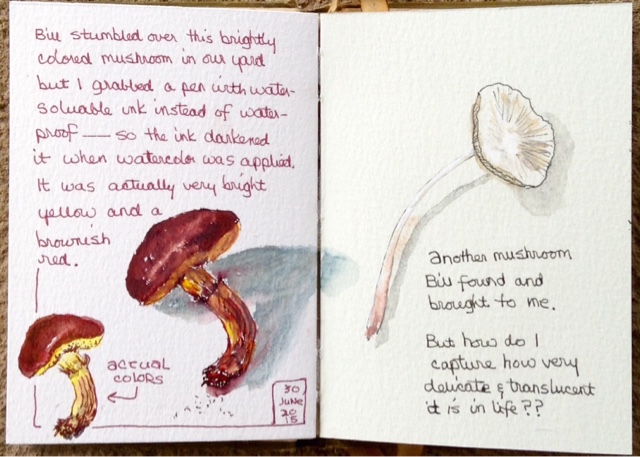
Some women love when their husbands bring them bunches of flowers. My own dear man knows me well . . . He brings me interesting bits of nature to sketch! On two occasions last week, he found more unusual mushrooms while mowing and brought them to me.
The first one was brilliant yellow with an earthy-red top but I grabbed a pen loaded with water-soluble ink which darkened my first sketch. The second find was extremely fragile and translucent, something very hard for me to capture.
Monday, December 22, 2014

I drew them from a photo I took last week --- with a bit of a mishap adventure at the time. (story on my own blog)
Saturday, June 16, 2012
A royal surprise
It's been hot and dry here so mushrooms were the last thing I expected to find in the woods at Howarth Park! Agaricus augustus is also known as The Prince. They are considered to be quite tasty but a seething mass of larvae got there first.


Read more about The Prince:
Tom Volk's Fungus of the Month, August 2002
California Fungi
Morel mushroom hunting
Wikipedia


Tom Volk's Fungus of the Month, August 2002
California Fungi
Morel mushroom hunting
Wikipedia
Saturday, February 25, 2012
Mushrooms!

However, the other day, as I walked through an area in Howath Park where children get pony rides on weekends, I noticed a large pile of horse manure with several mushrooms sprouting merrily out of it. Imagine my joy at finding mushrooms, any mushrooms! That they were fruiting in manure was an added bonus because it meant that I would be able to more easily identify them.
Most mushrooms are saprophytic. That is, they nourish themselves by growing on dead organic matter such as fallen trees, dead insects and animals, fallen leaves and excrement. In the process, the mushrooms decompose the material they feed on, providing what I like to think of as essential janitorial services for the forests and meadows that I walk in. Saprophytic mushrooms are often specialists, so if you find one in, say, horse manure, then it won't be too difficult to find out that you're looking at Panaeolus papilionaceus. Oh, and if you like learning new words then you'll be happy to know that mushrooms that feed on manure are coprophilous.
Disturbingly, during the research for this post I found that this is considered an edible mushroom. Uh, bon appétit?
The sketches were done with graphite, ink, watercolor, gouache, colored pencil on 8.5 x 11 inch Canson mi-teintes paper. The black circle at the top right is a spore print from one of the mushrooms, an essential identification aid.
More about the ways fungi nourish themselves:
The Royal Horticultural Society
The Hidden Forest
Especially the coprophilous varieties:
Wikipedia
And about Panaeolus papilionaceus:
Wikipedia
MushroomExpert
The Fungi of California
Sunday, January 8, 2012
Fungi on stick
I was given this fungi on stick to draw. It was picked up off a footpath in Toowoomba, Queensland Australia and probably came from an oak or plane tree, as there are lots of those planted along the footpaths there. Unfortunately that is as specific as I can be.


For Christmas, I was also given lots of nature objects that my family had been collecting for me from the walks around the waterbird habitat, parks and footpaths. They had as much fun picking things up off the ground as I will have drawing them . These include seed pods, leaves, feathers , eggs, a nest, insects. (many are still to be identified......) The BEST Christmas present !


For Christmas, I was also given lots of nature objects that my family had been collecting for me from the walks around the waterbird habitat, parks and footpaths. They had as much fun picking things up off the ground as I will have drawing them . These include seed pods, leaves, feathers , eggs, a nest, insects. (many are still to be identified......) The BEST Christmas present !
Sunday, September 5, 2010
Why we like Lichen - Linda C. Miller
Linda C. Miller, Lichen
Originally uploaded by Linda C. Miller
Originally uploaded by Linda C. Miller
 During my Master Naturalist training, we spent one full day with Charlie Dubay and Hugh Beard, two of the most unique and gifted botanists you can ever know. On that day, I learned so much and especially -- we like Lichen. Seeing Lichen on our trees is a sign that our air is clean. Lichen will not grow where there is air pollution!
Lichen can live for many years and will actually go "dormant" in times of drought.
Hummingbirds use lichen to build their nests.
Deer and caribou eat lichen.
Lichen
Size: 7 inches high by 1.5 inches wide
Watercolor and Ink on 300lb HP Paper
Specimen: Williamsburg
copyright 2010

Have a great day with nature!
Linda
Linda C. Miller
Williamsburg, Virginia
Artist, Naturalist and Instructor
Saturday, August 7, 2010
unknown fungi
I found these under my chives, growing out of the mulch, while watering my tiny herb / rose bed --- no idea what it is.

Monday, March 8, 2010
Scarlet Elf Cups ~ Sigrid Frensen
Winter seems a strange period to go hunting for mushrooms. But there are a few that only can be found in this period of the year. The Scarlet Elf Cup (Sarcoscypha coccinea) is one of them. It loves snow and freezing temperatures. This fungus grows on decaying branches in damp spots on forests floor. It's a rare fungus in the Netherlands... or so they say. Winter, snow, freezing cold and crawling under bushes isn't a very pleasant combination for most people, so it's not surprising it's not such a common sight.
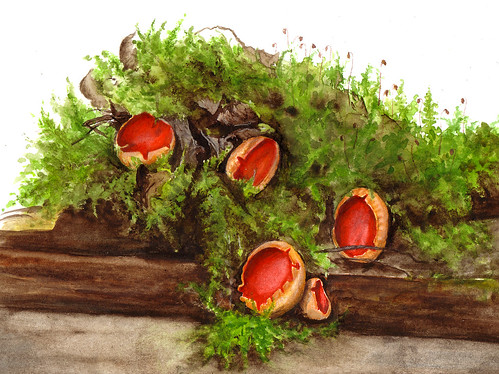
I painted this little group of Scarlet Elf Cups like they were found. On the branches, with moss and dead leaves. I first painted the Fungi because I knew they loved the cold and damp.... not my dry and warm studio. The interior of the cups is bright red and very smooth. The outside is lighter and orange. later they turned even lighter, almost white. Maybe that had something to do with the dry, warm air. They are quite small, about 2 cm.
The hardest part was to paint the moss around the mushrooms. So delicate and fluffy. But I decided not to get into details too much since the focus should be on the fungi. I think I managed to do it. Creating this very tiny little world from the forest floor.
I painted this little group of Scarlet Elf Cups like they were found. On the branches, with moss and dead leaves. I first painted the Fungi because I knew they loved the cold and damp.... not my dry and warm studio. The interior of the cups is bright red and very smooth. The outside is lighter and orange. later they turned even lighter, almost white. Maybe that had something to do with the dry, warm air. They are quite small, about 2 cm.
The hardest part was to paint the moss around the mushrooms. So delicate and fluffy. But I decided not to get into details too much since the focus should be on the fungi. I think I managed to do it. Creating this very tiny little world from the forest floor.
Thursday, February 18, 2010
Looking for earth tongues
 Every year, at about this time, I find earth tongues, quaint, tiny fungi that look like...well...tongues sticking out of the earth. This year I accidentally noticed that they were fruiting in a location other than the one I normally found them in. Which got me to wondering how common they really are. So, for about two weeks, I walked slow as a snail with my nose to the ground, looking for earth tongues. They are, indeed, quite common in some of the wooded areas, at least at Howarth Park. Aside from the two species I usually find, I got my first glimpse of a gorgeous green species when I found a few fruiting with some of the more familiar black ones. The drawing above is of Geoglossum sp. Without microscopic work, it's difficult to identify the Geoglossums to species.
One day I was admiring a Geoglossum that I found in a new location when I noticed a stick covered with little cup fungi, which are even harder to find (in my experience) than earth tongues. The largest one was only 9mm across. These cups are most likely Plectania sp. and, as you may have already guessed, fruit on wood.

Here's a link to a more detailed article about earth tongues.
Thursday, February 4, 2010
Mushroom for brunch

Monday, February 1, 2010
Helvella

I had collected several of these, with caps in various shades of gray and black, planning to do several watercolor sketches. They languished in the refrigerator for over a week and today, when I finally got around to sketching, they were rather old and funky. Every time I moved one, or opened the container, spores swirled up, up and about the room. It was sort of like a dust storm. Blggghhh! They're still fruiting so tomorrow I'll try to find some that are a bit fresher. Apparently they're edible. I've seen several suggestions of ways to cook and eat them while reading about fungi online lately. Not that I'm going to eat them myself! But I did lay them to rest in my backyard. We have a valley oak (Quercus lobata), which is a poor mushroom host, but maybe I'll get some to fruit in my yard next season! My very own helvella garden! How cool would that be? Oh, the sketch of the black capped fungus was done with ball point pen and the color sketch was done in ball point and watercolor.
Thursday, January 21, 2010
A decaying log hosting a lot of fungi

The mushrooms to the right of the Hericium abietis are Mycena haematopus, identifiable by a stalk that "bleeds" red juice when cut or pinched.
Finally, the black lumps behind the Hericium abietis are called Annulohypoxylon thouarsianum with a common name of cramp balls, presumably after someone tried to eat them? They're very common and persist even in dry weather so are especially easy to find.
The reason all of these fungi are on this log is because they're all wood-rotters, the under appreciated composters of our forests. It's interesting to watch a log as it decomposes because different fungi appear at different stages of decomposition.
Monday, January 4, 2010
One of my favorite mushrooms


Tuesday, November 17, 2009
a visit to Arkansas - Vicky Williamson

We spent the weekend visiting friends living at Norfolk Lake in Arkansas. The above sketch is from their backyard; the list is all the birds and animals I saw from their deck in one day --- I was especially excited to see and hear the two pileated woodpeckers talking to each other! Too bad I didn't have a camera or sketchbook in hand at that moment.

Also in the backyard, I sketched this twig with its teeny-tiny cup fungus, still unidentified. The upper two sketches are during the drive home; Jeanette Sclar identified the seed pods as bladdernut.
Thursday, October 29, 2009
Fungi Family - Sigrid Frensen
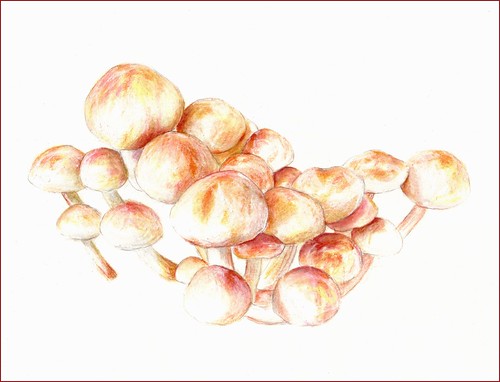
A few weeks ago I was in the beautiful forest of Roden. There were thousands of mushrooms, so many different kinds and all so pretty. I made some photos so I could maybe draw them at home. Bertus was with me so I couldn't sketch there. I picked this one for a drawing. It's not very detailed. I just don't have enough time and energy to do that. I made it on (bad) paper with coloured pencils and soft pastels.
Tuesday, October 13, 2009
Bracket fungi - Elizabeth Smith
Bracket fungi
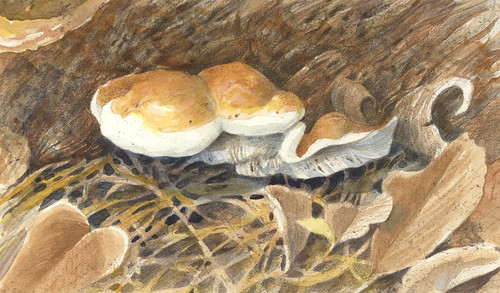
These little shelf or bracket fungi were nestled at the base of a Sea Grape tree. It seems that all of the mushrooms I’ve seen lately remind me of food – these were the most delectable shade of caramel!
The ground is finally drying out after our September rains. We’ve been enduring a heat wave, breaking records yesterday and today with temperatures in the middle 90’s. It’s been a long summer, and we’re ready for a change.
You can click on the image to see it larger on my Flickr photostream.
~ Elizabeth Smith, Naples, FL USA
Monday, October 5, 2009
Fungus - Elizabeth Smith
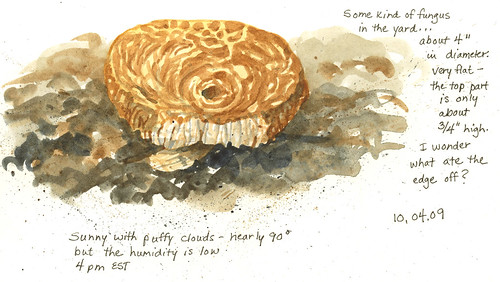
In my yard I found this interesting-looking mushroom; it looked just like a piece of pastry with a nibbly edge. I sat on the ground and did a quick sketch of it with my travel set of watercolors and aquabrushes.
I know very little about wild mushrooms beyond bracket fungi and morels, so I have no idea what kind this might be. In the amazing manner of synchronicity that runs through life like a silver thread, I had just watched a fascinating documentary on the Sundance Channel about fungi!
You can click on the image to view larger on my Flickr photostream.
~Elizabeth Smith, Naples, Florida, USA
Tuesday, May 26, 2009
The Ugly, Smelly Mushroom & Button Clover

This funky mushroom popped up in my yard yesterday. It was about 4 1/2 inches tall with an orange stem and an odd shaped cap. The cap looked like it was a cream color but that layer had mostly peeled back revealing an orange layer. Through both layers, were several “sink holes” in the cap with a brown slimy fluid. That same fluid had gathered at the base of the fungi forming a little moat. This mushroom had an odor (not pleasant) and the flies and gnats were very active and visiting the slimy stuff in the holes and the moat.
I have no idea what this was.... I do know that I sure wouldn’t want to eat it!

I also found some of this Button Clover in the yard. I was pretty excited about this because I think it is such a cool plant with the spiral seed pods.
Both sketches are Ink & watercolor on hemp paper.
Monday, May 18, 2009
Giant Puff Balls

I've only seen pictures of these in books . . . . until the recent rains. Then there were THREE of them in my yard, with a wonderfully rich, earthy smell. A type of gasteromycetes, the largest one measures 5 x 6" and was still growing larger with each new day. Until Bill mowed yesterday.
Wonder just how big they might have got?
Subscribe to:
Posts (Atom)