Showing posts with label "watercolour pencil". Show all posts
Sunday, July 15, 2018
Monday, March 10, 2014
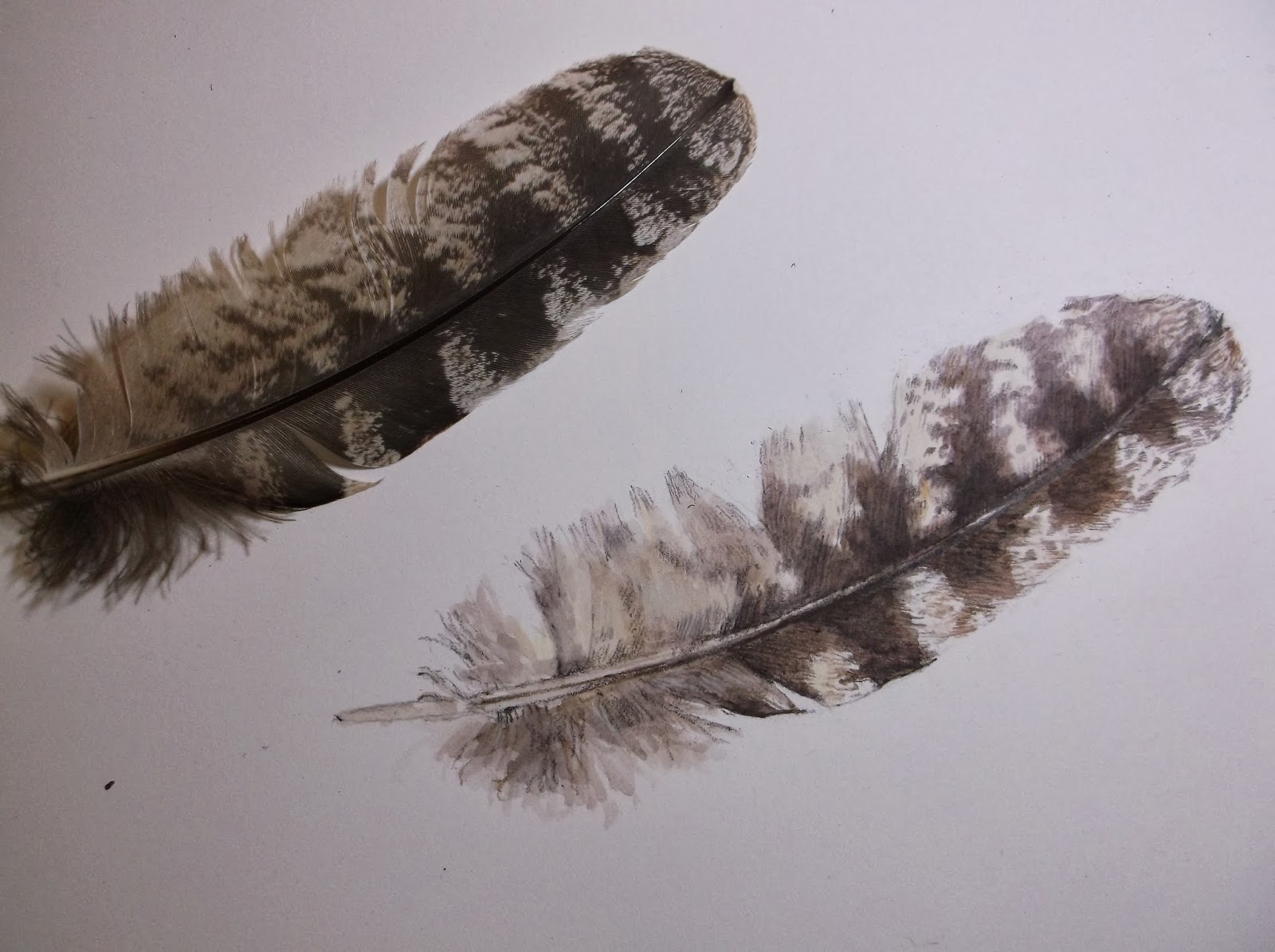
drawing a tawny frogmouth feather
This post is about drawing the feather of a tawny frogmouth. I have quite a few of these feathers in my collection. I am not sure why I have so many, as you don't see that very many tawny frogmouth birds about. This is probably because they blend in so well with the tree branches they are on and they are nocturnal. However I still think that there appears to be a disproportionate amount of feathers compared to birds you see everyday, such as magpies. Tawny frogmouths are one of my favourite birds (I seem to have a few)
![]() |
| Tawny frogmouths. Photo: Keith Smith Photography |
I often draw feathers, but they are usually simple and one or two colours. And I complete them over an evening or two. See them here . In this post I wanted to share my love of watercolour pencils and what can be achieved using this medium
The tawny frogmouth feather was more of a challenge as their feathers are highly patterned. This is the second time I have attempted to draw one and I am still figuring out how to do it. I was halfway through this one when I discovered that Derwent Inktense Bark watercolour pencil is the perfect colour for the tawny frogmouth feather. The pencils I was using were too brown or too grey and I was trying to blend them.
This time I remembered to take these photographs along the way to try to show my work in progress. It shows the real feather at the top and my drawing next to it. I started it in February this year and then put the drawing aside for about two weeks between the last two images.
STEP 1
STEP 2
STEP 3
in detail
STTEP 4 - FINISHED !
Drawn on Arches 300gsm Smooth Watercolour paper.
main Colours
Bark - Derwent Inktense
Walnut Brown - Faber Castell Albrecht Durer
Burnt Umber- Faber Castell Albrecht Durer
Ivory - Faber Castell Albrecht Durer
Raw Umber - Derwent
I have found that the Derwent pencils are too soft for the finer "feathery" details of the feather (the "afterfeather") as you can see the texture of the pencil on the paper. Faber Castells are harder and give a finer line, which can also be dissolved beautifully to give the fluffy look. This is the area I love to draw. This particular feather was a bit of an experiment. I am very pleased with the final result, and have learnt a lot along the way. NEXT TIME I need to figure out a way to achieve the dark colour patterns and the fine lines of the feather (I think these are called the barbs). I feel that it is a little heavy handed and muddy in this one. However, I am not looking for a photorealistic drawing of feathers. My drawings are more about the impression of detail, rather then actual detail.
Tawny frogmouth and chick drawn from photo, 2010
Monday, September 16, 2013
Autumn's treasures
My good friend Luba has only recently started gardening and she is delighted with her efforts at growing vegetables especially pumpkins. This one is only the size of a grapefruit and has hardly enough flesh to eat so I had a lot of fun drawing it instead!
Monday, April 2, 2012
little sketch in a pine wood-Concetta Flore
The "pineta" of Castelporziano used to be a vast pine forest extending behind Ostia, on the sea shore near Rome. A few years ago a devastating fire destroyed a large part of it, and though many pine trees have been re-planted, the maquis is still low. We walked towards an area that remained untouched and where the pine trees, still tall and healthy, harbored many songbirds and woodpeckers in full springtime activity.
I did this quick sketch on a small pad, 16x10 cm.
Wednesday, February 29, 2012
insects and beetles
For Christmas I was given a box of feathers, leaves, a nest, seed pods and a few beetles. In the last few days I have finally put aside time to draw some of them (in watercolour pencil in my Moleskine watercolour sketchbook) .
Unfortunately I am unable to provide very much technical information about them.I can tell you they were collected in Toowoomba, Queensland,Australia, probably along suburban footpaths, waterbird habitat or my mothers backyard !
This top page is what I always called a Stag Beetle. I have found out they are part of Rhinocerous Beetle family which covers many similar looking beetles with varying degrees of spiky and spiny features.

This second page has a few mysterious small black and brown insects. I know the highly un-technical name of the "click beetle" (middle left) which (when we were children) we used to put our finger on their back they would click and jump . The green cicada is also a familiar insect . Maybe the one above it is a Christmas beetle ???
I really enjoyed drawing ( or is it painting?) these. I also wanted to write all over it with notes. I have kept most of the beetles and bugs to draw again another day....
Monday, February 27, 2012
Cedrus deodara - Himalayan cedar
Cedrus deodara is a species of cedar native to the western Himalays in eastern Afghanistan. It is a large evergreen coniferous tree reaching 40-50 m tall. the leaves are medle-like, mostly 2,5 - 5 cm long.
The female cones are barrel-shaped, 7-13 cm long and 5-9 cm broad, and disintegrate when mature to relase the winged seeds.
It was imported in Europe as ornamental plant since 1800.
I found pine cone and branch in Subiaco, near Roma. The branches were on the ground because of snow in recent days.
Angela Maria Russo watercolour on Magnani sketchbook
Sunday, February 12, 2012
Friday, January 20, 2012
Monday, October 24, 2011
Lantana - Alissa Duke
Lantana - a noxious weed around the world.
This is from a vacant lot next door to me in inner city Sydney. But this is the same plant that I remember coming across when hiking in National Parks in Queensland when I was young. We would walk on trails, but these plants would be by the trailside, scratching and ripping at any bare legs, their prickly leaves sticking to jeans. All of these memories came back to me as I handled and drew it.
Wednesday, October 19, 2011
Acacia in spring - Alissa Duke
Acacia oxycedrus or Spike Wattle
I must admit that I had never seen one of these before (perhaps I was not looking very hard) . At first I thought it was a white callistemon , but a quick search corrected me. This acacia is a prickly, dense shrub up to 3 meters. The flowers are in cream spikes which occur in winter and spring. It is found in Australia in SA, Vic., NSW. This is from a local inner city Sydney area of land which , over the last few years, has been cleared of introduced species and weeds, and replanted with indigenous plant by our Landcare group, http://www.pyrmontultimolandcare.org.au/


I picked this from a shrub and put it in a glass of water at home. I sketched a bit on Sunday night and returned to it on Monday night to discover the flower spikes were beginning to blossum. This is truly a work in progress.
Subscribe to:
Posts (Atom)