![]() |
| Ring-necked Duck -- field sketch |
Showing posts with label nature sketching. Show all posts
Monday, January 28, 2013
Practice Sketching
Monday, February 13, 2012
One woman's treasure...
![]() |
| Graphite, colored pencil on 8.5 x 11 Strathmore paper |
Last Sunday I did just that early in the morning before the neighborhood was awake. I listened and watched as birds began to move about, looking for food and mates, not necessarily in that order. I noticed that the leaf buds on many trees were nearly ready to burst and that many lawns had been mowed. On one of those lawns I saw a pristine dead Roof rat (Rattus rattus) looking so natural that I hesitated before collecting her to take home, afraid she would leap up and take offense as I placed her into a bag. She didn't and I spent a couple of days sketching and admiring her.
I know I'm not really supposed to like rats. As I write this I'm listening to the rustlings of a family of them that we've been unsuccessfully trying to evict from the attic above my studio. As my work day is ending I can hear theirs beginning as they exit through the (not so) cunning trap door we put in to let them leave but keep them from getting back in. I really do admire their ability to adapt to adversity. They've traveled far from their original place on the planet, yet thrive and multiply. And multiply. Where once they lived high up in trees and foraged in fields and forests, many now live high up in our buildings and get a ready supply of food from our gardens, homes and refuse. These tiny creatures have caused us much bigger creatures an awful lot of grief for a very long time without even trying. Pretty impressive, if you ask me.
![]() |
| Graphite, ink on 8.5 x 11 inch Stonehenge paper |
Sunday, December 18, 2011
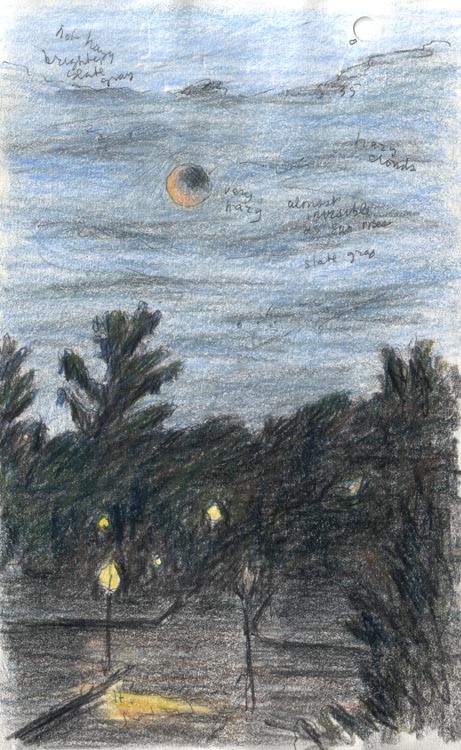
Lunar eclipse
![]() |
| 6:10 a.m. |
![]() |
| 6:35 a.m. |
Monday, June 27, 2011
Fruit, Flower & Berry Report - Pam Johnson Brickell
![]() |
| Click to enlarge - 'tis much easier to read :) |
I did the pen sketching and added watercolor to one flower, Beautyberry leaf, Hickory leaf and nut - enough for reference when I returned home.
More time was spent doing research and the lettering than sketching! I love the thrill of sketching plein air. But, the fun continues when I hit the field guides. After searching all 3 southeast wildflower field guides in my library, I had to consult the internet for the Bigroot morning-glory. I'm a Wikipedia fan!
Labels:
calligraphy,
nature sketching,
Pam Johnson Brickell • Low Country SC,
pen,
plein air,
trees,
wildflowers
Tuesday, February 2, 2010
Learning to sketch birds
I've been just awed by Laureline's sketches of the birds in her yard and thought I'd add some of mine. I've been trying to sketch the birds at our feeder a little bit every day, so I have several pages of bird sketches now. I'm actually feeling a bit more confident sketching quickly and finding it easier than when I began a few weeks ago. It's affected my other sketching, too, which is a pleasant surprise!
I really wasn't paying much attention to our feeder birds before sketching them and have gotten to know them a bit better in the time that I've been at it. I've discovered that the nervous, chatty, bossy house finches are the most numerous but we have quite a few other visitors, including White and Gold crowned sparrows, who mostly hug the ground, but occasionally will jump up on the platform feeder. The California towhees are quite brazen and don't seem as disturbed by my staring presence on the other side of the glass. In fact, they stare back while they eat! Oregon juncos move faster than the speed of light, it seems, and the Mourning doves are true Californians, very mellow and easy going.
I look forward to my bird sketching sessions and find myself listening for the house finch's chatter as I work on other tasks around my house. When they call, I come running whenever I can.
I really wasn't paying much attention to our feeder birds before sketching them and have gotten to know them a bit better in the time that I've been at it. I've discovered that the nervous, chatty, bossy house finches are the most numerous but we have quite a few other visitors, including White and Gold crowned sparrows, who mostly hug the ground, but occasionally will jump up on the platform feeder. The California towhees are quite brazen and don't seem as disturbed by my staring presence on the other side of the glass. In fact, they stare back while they eat! Oregon juncos move faster than the speed of light, it seems, and the Mourning doves are true Californians, very mellow and easy going.
I look forward to my bird sketching sessions and find myself listening for the house finch's chatter as I work on other tasks around my house. When they call, I come running whenever I can.
Monday, February 1, 2010
Helvella
Helvella lacunosa are a fairly common fungus in northern California that seem to fruit longer than most. The fruiting bodies are quite sturdy and persist for a good long while. I'm told that they fruit with conifers but I find them mostly in association with one of our native trees, coast live oak (Quercus agrifolia). Helvella don't have gills or pores. Rather, they produce their spores on the upper surface of the wrinkly cap.
I had collected several of these, with caps in various shades of gray and black, planning to do several watercolor sketches. They languished in the refrigerator for over a week and today, when I finally got around to sketching, they were rather old and funky. Every time I moved one, or opened the container, spores swirled up, up and about the room. It was sort of like a dust storm. Blggghhh! They're still fruiting so tomorrow I'll try to find some that are a bit fresher. Apparently they're edible. I've seen several suggestions of ways to cook and eat them while reading about fungi online lately. Not that I'm going to eat them myself! But I did lay them to rest in my backyard. We have a valley oak (Quercus lobata), which is a poor mushroom host, but maybe I'll get some to fruit in my yard next season! My very own helvella garden! How cool would that be? Oh, the sketch of the black capped fungus was done with ball point pen and the color sketch was done in ball point and watercolor.
Wednesday, January 6, 2010
Fungal baseball bat...with a few wrinkles
Not surprisingly, this fungus is called a club fungus. Although it doesn't have gills it still reproduces by releasing spores and is closely related to mushrooms. Clavariadelphus occidentalis is a western fungus. It's believed to be mycorrhizal, or to have a symbiotic relationship, with conifers. I find it fruiting with Douglas fir, although there are also always oaks around, as well. There's an eastern (Clavaridelphus pistillaris) version which appears to fruit with Beech.
I had hoped to include a drawing showing a club in it's habitat but they seem to have all disappeared or become saggy old things, so this will have to do for now.
I usually find these alone or in small groups of three or four. Once I found a large crowd of them, looking like a small army standing in the woods.
Two websites that have more information about this fungus are Mykoweb and MushroomExpert and there are some wonderful images at MushroomObserver.
I had hoped to include a drawing showing a club in it's habitat but they seem to have all disappeared or become saggy old things, so this will have to do for now.
I usually find these alone or in small groups of three or four. Once I found a large crowd of them, looking like a small army standing in the woods.
Two websites that have more information about this fungus are Mykoweb and MushroomExpert and there are some wonderful images at MushroomObserver.
Monday, January 4, 2010
One of my favorite mushrooms
These pretty little mushrooms appear around Christmas here in northern California and are called Marasmius plicatulus. One rainy December I saw a huge troop of hundreds or more, all in one place. Mostly, where I walk, they appear in smaller groups and you have to look very carefully to find them because they blend so well with the leaves. I drew some a week ago in black and white because I love working in black and white, but I wanted to try to capture the lovely colors, so today I made a little watercolor sketch. It was very cold and I kept waiting for the sun to come out and make it warmer. I finally gave up and packed my things to go home and finish up. As I walked out of the park, the sky cleared.
Subscribe to:
Posts (Atom)