Showing posts with label journal. Show all posts

Friday, May 11, 2012

Journal Sketches from the Midwest...


Of course I had to try my hand at that "SuperMoon."  We hopped in the car in our nightclothes and drove up the hill for a better look!  It just glowed...30% brighter and 14% larger-appearing at its perigee, closest to the earth.

Monday, February 28, 2011

Hi all, just spent a weekend away with my art group, supposed to be a painting week end but as usual it descended into a competition as to who could drink the most red wine. A great weekend all the same and I actually managed to get a couple sketches done, even though the weather was not great. This is the first sketch in my new hand made journal, made by everday member Vicki Holdwick

Saturday, August 7, 2010

The Red Bishop last year - Maree

I get to enjoy the tranquillity and peace of mind that results from watching colourful birds flitter around my lawn or deer grazing in my neighbour's pasture field.
- Rick Rouse, from Why I Love Country Living


In November last year, rather late in the season, I noticed the Red Bishop was back - maybe he never left, it's rather difficult to differentiate him from the Sparrows and similarly brown-coloured birds when he's not wearing his breeding outfit. I also only know when his female is around when I see them together - she's similarly sparrow-like.

With spring breaking through here in South Africa now, the Black-headed Oriole is already enjoying the sweet nectar of the Aloes and I'm looking forward to hearing the Red Bishops bright chatter again!


Saturday, May 29, 2010

Good news, bad news...carpenter bees!

carpenter bees

Here's more info on these little miners, from the University of Kentucky

carpenter bee culprit

And this is the actual culprit! They're big, and the males are aggressive, but they have no stinger. The female does, but seldom stings unless handled. Yeah, right, I'm going to do that...

Wednesday, April 14, 2010

Live and learn--a cricket frog!


We've been really busy lately, so I get in my nature observations where I can.  We attended a meeting of Joseph's submarine vets, and I still had room on the page, so fitted in this tiny frog I found on the limestone rocks by the creek.  MUCH larger than life, in my drawing.

At first I thought he was a spring peeper (Hyla crucifer) but since he was SO warty I thought perhaps a tree toad.  Looked too shiny, though...and had those striped legs.  Later, I compared my sketch and photos to those I found on the 'net, and discovered he's a Blanchard's cricket frog (Acris crepitans blanchardi), common in Missouri but almost endangered in some other places...


They may be only 5/8" long, but can be bigger...up to 1 1/2"--and can even have orange or red markings.  This one had bright spring green. 

The Internet's amazing, isn't it?  I looked in a couple of my field guides and wouldn't have identified him from the pictures there--cricket can be so varied in color, and I was looking for that screaming green.

He's ink and watercolor pencil, with just a touch of gouache on those shiny little warts.

Monday, April 5, 2010

Easter in the Park...

Easter Sunday was beautiful; overcast but warm, and I decided to get out and sketch and take photos before the promised storm. Bloodroot was EVERYWHERE. I sat by the river to paint in my journal...

Easter Sketching

Here's how it turned out...

Easter Wildflowers

Isley Park Woods is a Missouri Natural Area that boasts an astounding array of wildflowers every spring. I always wish I could paint them all as they bloom, but there's never quite enough time to keep up with them. Yesterday I ran away from home and celebrated Easter in my own way...

Bloodroot is a fascinating flower--the large leaves clasp the stem and protect the flower as it emerges. It's been used as a medicinal, a dye, and a love charm, according to folklore. You can read more about it HERE.

Wednesday, January 20, 2010

The 'Ol stump on 84 - Maree

People in suburbia see trees differently than foresters do. They cherish every one. It is useless to speak of the probability that a certain tree will die when the tree is in someone's backyard .... You are talking about a personal asset, a friend, a monument, not about board feet of lumber.
- Roger Swain


This old stump is a relic from one of the blue Gums on our property (Plot 84) sawn down many years ago, and now plays host to some moss and a lonely fern leaf. Was wondering if I should add a bit of soil, and maybe some compost? Would that be interfering with Mother Nature?

Monday, December 28, 2009

Grass Aloes in Tarlton - Maree

I only went out for a walk, and finally concluded to stay out till sundown, for going out, I found, was really going in.
- John Muir (1838 - 1914)


I found a large clump of Grass Aloes not far from home on the road to Magaliesburg, flowering profusely after all the veld fires we have had this winter, spread out over the charred landscape, providing bursts of red colour.

Grass Aloes are an appealing group of deciduous aloes. As the name implies, they grow mainly in grasslands subject to winter fires. Their leaves and colours resemble their habitat, making them difficult to find when not in flower. These largely miniature aloes have very attractive flowers, making them desirable, if difficult, plants to cultivate. Their growing pattern is closely related to the winter fire cycles of the veld, some species responding directly to burning and producing leaves, flowers and later seed after such events.

This interesting aloe belongs to a group of deciduous aloes known as the "Grass Aloes" which are adapted to grassland habitat and are able to survive both fire and frost during the cold dry months. They are often burned during winter by our veld fires and then re-sprout with the onset of spring. Fires are essential ecological processes in grass aloe autecology.

This well known grass aloe is commonly found along rocky ridges and rocky slopes on the Witwatersrand and Magaliesberg as well as in mountainous areas of the Northern Province and Mpumalanga. In years gone by it was even more prolific, but numbers have been greatly reduced due to development on the ridges and from harvesting by succulent collectors. A number of different forms are found throughout its distribution range.


FIRE AND BURNING, THE ESSENTIAL ELEMENTS IN THE LIFE CYCLE OF GRASS ALOES.
Grass fires used to be less frequent in earlier centuries. They were initiated by lightning strikes, on the whole, at the beginning of the rainy season in September and October. These fires were ideal in that they cleared the habitat of moribund grass and other vegetation just before grass aloe species initiated their growth cycles.

Fires are more frequent nowadays and may occur at any time during the dry winter months from May until late spring, October. Plants are as a result, left exposed to harsh conditions for many months before they start to grow. Some species are even starting to appear on the endangered species list.

Info from Succulents.net


Thursday, November 12, 2009

A lazy Art Sunday - Maree

Inspiration does not come like a bolt, nor is it kinetic energy striving, but it comes to us slowly and quietly and all the time.

- Brenda Ueland


My art table last Sunday

A lazy Sunday - spent the whole day sketching and journaling on Sunday - also scanning previous sketches that I hadn't had time to do yet and filing them on my MAC.


My Feint 6-Quire Daily Journal. I mostly use it as my daily thoughts journal, but also do some accompanying sketches.

The above journal entry reads :

"Sunday 08 November 2009
The Red Bishop is back, dear Journal, and covered in all his breeding finery! On Friday I thought I caught a glimpse of him, but wasn't sure.

"Red Bishop" - 'Euplectus orix nigrifrons Linnaeus'

He was sitting on the Tiger Grass under the Acacia Karroo eyeing the bird bath. Hoped to catch him bathing, but he decided the feeding table was a better option."


Southern Red Bishop

Tuesday, November 10, 2009

Sketch in Agenda Art Journal - Maree


"Exploring space and colour"

I have this old, leather bound, 1997 Agenda Planner that is now filled with various grades of watercolour paper cut to size and some old note paper, which I use as an art journal. I did the above sketch on one of the note papers to try out a new green I was mixing using Thalo Blue and Burnt Sienna and was quite pleased with how the green turned out. I also experimented with Indigo and Cadmium Yellow on this, which I used on parts of the tree.

I'll use anything I can lay my hands on for sketching and using old diaries and planners is a great, inexpensive way of building up a collection.


Agenda Planner filled with watercolour paper - I used a 6-hole punch to do the holes for the paper.

It seems that sketch-books and Journals are very much in demand at the moment! If you would like to make your own sketch-book in an easy, quick and fun way, go to 'An Artist's Sketchbook to Make'.

Tuesday, November 3, 2009

Journal sketch - Hydrangeas - Maree Clarkson

"The only time I feel alive is when I'm painting."

~Vincent Van Gogh


A sketch in my Feint No. 6 Daily Journal - some Hydrangeas, given to me by a friend, in my Vintage Hollands Pewter water jug standing on my kitchen table.

I didn't know, but Hydrangea, common names Hydrangea and Hortensia, is a genus of about 70-75 species of flowering plants native to southern and eastern Asia (China, Korea, Japan, the Himalayas, and Indonesia) and North and South America.

They grow extensively here in South Africa and flower over the Christmas period and in most species the flowers are white, but in some species (notably H. macrophylla), can be blue, red, pink, light purple, or dark purple. In these species the exact colour often mirrors the pH of the soil; acidic soils produce blue flowers, neutral soils produce very pale cream petals, and alkaline soils results in pink or purple. This is the caused by a color change of the flower pigments in the presence of aluminium ions which can be taken up into hyperaccumulating plants. Due to the high acidity of the soil (caused by lots of Blue Gum trees) on our smallholding, my Hydrangeas are mostly blue, unless I add some alkalinity, then I get the pinks.

Sunday, October 11, 2009

Pappa Goose - Maree Clarkson

“It’s amazing how loose some people become in their sketchbook drawing simply because they have a carefree approach and don’t become locked down in trying to make finished works.”

- Robert Wade


IN MEMORIAM - 1991 - 2009


"Pappa Goose" A sketch in my Daily Journal
(Click on image to read the post)


"Pappa Goose" watercolour in Visual 140gsm sketch book - 05/09/2009

Pappa Goose, an Egyptian Goose, was brought to me to take care of him in 1991 - don't know how old he was - he had one gammy foot as a result of fishing gut being entangled around his leg and severing the tendons and nerves, causing his foot to pull backwards. I was lucky to have the pleasure of his presence in my life for 18 years when, finally on the 5th September 2009, I had to have him euthanized because his legs were riddled with arthritis and he could hardly stand up anymore. If there is a Goose Heaven, I'm sure that's where he is now.

Saturday, October 10, 2009

Garden Journal entry - Maree Clarkson

I value my garden more for being full of blackbirds than of cherries, and very frankly give them fruit for their songs.

- Joseph Addison


An entry and sketch in my Daily Garden Journal

To me, the garden is a doorway to other worlds; one of them, of course, is the world of birds. The garden is their dinner table, bursting with bugs and worms and succulent berries. This is one of my feeding tables and the squabbles are hilarious to watch, with the Finches normally winning as they are quite feisty little characters.

Thursday, September 24, 2009

Tuesday, September 1, 2009

Coreopsis - Cathy Johnson

We headed off to Parkville on Saturday to take advantage of the gorgeous day (and yep, I did put the wrong date on this!)--the field near the tiny town of Mosby was golden with flowers! Joseph stopped the truck and got out to pick one for me to study more closely...

This is the flower my mom used to call Tickseed Coreopsis, but it's not quite like the Coreopsis lanceolata, the petals don't have that serrated leading edge. I can't find one that's exactly like, but I think it's clocer to Coreopsis palmata, according to one of my favorite online flower finders, the Missouri Flora webpage. Neither ONE of these should be blooming still in late August and September, according to Missouri Flora, but then it's been a very strange, cool, damp year...

If anyone has a better I.D., please let me know!

I like the effect of watercolor and ink on this page...and of course yellows are as difficult to capture as ever!

Saturday, August 22, 2009

A State of Mind - an illustrated hand-built book--Pam Johnson Brickell


In May of 2009, Old Town Bluffton was celebrated by plein air artists taking part in the Bravo Event 'Art in the Park. For one week, artists were found around Old Town painting different scenes.

I chose to create an illustrated, hand-built book. The May River was my main theme for this watercolor journal. I was able to paint plein air for two of the spreads. Due to rain, the other two (Boundary Street and Calhoun Street) were created in my studio. I worked from photographs displayed on my computer monitor.

The finished Concertina Book is bound with a hardcover featuring hand-painted paper in the colors and design of water. The inside covers feature the same acrylic ink and pattern used for the cover. Two sets of pages have their edges bound with embroidery floss to match the colors of the cover. For the closure I used hand-painted thread elastic and 2 shell buttons.

While the majority of the book was painted in May, I just finished assembly last week. I wasn't quite sure what to use as a closure. The original plan was to use ribbons but, I knew I'd get the chance to peruse JoAnn fabrics when in NY. I couldn't believe it when I came upon shell buttons that matched my colors!! I'm glad I waited :)

As an extra special touch, I included a pocket in the back of the book that holds a small written journal containing notes I kept while painting plein air.

Tuesday, August 4, 2009

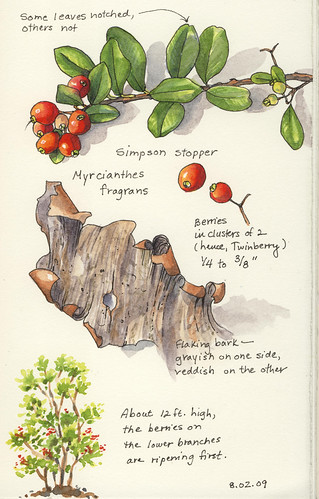
Simpson stopper


Simpson stopper, originally uploaded by Elizabeth Smith.

Simpson’s or Simpson Stopper
Myrcianthes fragrans
Myrtle family

Simpson’s stopper forms a lovely compact small tree or large shrub in (mostly) full sun, which is where mine grows. It’s in fruit right now, heavy branches of berries in all stages from green to orange to red. The berries are said to be edible for humans, as well as favored by wildlife, especially mockingbirds. It’s also a nectar source for butterflies; the long white stamens make the flowers appear like tiny, frothy puffballs. Ethnobotany lore has it that the common name of stopper comes from the “stopping” powers of the leaves used in a treatment for diarrhea.

Simpson’s stopper has two other common names: twinberry and nakedwood. I assume the twinberry refers to the two-berry stems that I noticed on mine, and the nakedwood refers to the exfoliating bark habit. Nakedwood would be my favorite, but there is another Florida tree with the same common name and I dislike confusion. After reading more about the Simpson namesake, though, I’m convinced of its perfection. Charles Torrey Simpson was a self-taught botanist and malacologist (one who studies mollusks), and has been called “the father of all South Florida naturalists.” He first visited Florida in 1881, beginning a love affair with the state that lasted the rest of his life.

My botanical names book states that the genus Myrcianthes refers to the myrtle family. Fragrans is self explanatory: the flowers are quite fragrant and the leaves contain aromatic oils, some say reminiscent of nutmeg. My stopper smells just faintly fragrant, not quite nutmeg-like. It has numerous leathery and glossy medium-green leaves on somewhat stiff stems that range from copper-colored to brownish-gray. The peeling bark is similar to that of ornamental guava. With all of these wonderful traits, you might wonder why I planted it behind the house in a hidden corner. I do. Next time I’ll plant it where I can enjoy it every day!

Click on the image to go to my Flickr site to view larger.

~ Elizabeth Smith
Naples, Florida, USA

Sunday, July 12, 2009

SUNFLOWERS


SUNFLOWERS
Originally uploaded by linfrye
Daily Practice
Journal

Mercy, yesterday was one of those days we expected to do a bit of work and wound up spending the entire day at chores ... productive - but oh my do these ol' bones feel it! LOL

We visited one of our farmer's markets - and again were met with crowds of folks. It truly does my heart good to see so many people taking advantage of the wonderful goods and produce that our local farmers and niche farmers are producing. We picked up more corn, beans, cheese from my favorite goat farmer, tomatoes (mine are just on the cusp of redness!), and these bright, cheerful sunflowers!

I remember the year I grew a field of them -- so tall, filling my plot with shining sun -- until we had a summer squall, and those beautiful flowers, like my corn, had to be STAKED in order to stand straight! Can you imagine staking a FIELD of sunflowers!! LOL I don't think I knew about shorter varieties back then! Anyway, I had to have these pretties to paint.

At home, I sliced tomatoes for the dehydrator - the hum of that machine is a constant summer song in our kitchen. Made bruschetta for lunch (dreaming of Italy), then trimmed all the trees and shrubs in front of the house, and watered. Worked on sunflowers a bit, and as these were drying, made blueberry, banana and pistachio ice box cake for C's jam today, blueberry muffins, and blueberry baskets (like mini coffee cakes). Worked on the sunflowers a bit more, took a much needed 20 minute nap, then worked on dinner, made applesauce from the first apples off our tres, roasted the corn and watched the news. Took a small walk and then hit the bed. Whew ... what a day! Fun and tasty - but a bit too busy! Still, today should be far more relaxing since most all chores are done.

The skies threaten rain, and joints and sinuses would be much at ease if it would just fall ...but with only a 30% chance of it refreshing our thirsty plants, it's unlikely... so I'll be out with the watering buckets this morning.

Hope YOUR day is relaxing! (and mine too-- LOL)!

Lin Frye
North Carolina

Tuesday, June 30, 2009

Taos Rhododendron 1


Taos Rhododendron 1
Originally uploaded by Ricky Holtman
This is one of the sketches I did while on an art trip to my old painting area Taos, New Mexico. The colors always overwhelm me when I go back. The forest and flowers etc are just crazy there. Everyone is probably familiar with these flowers because they grow all over the world basically. I love them with their big bloomy selfs and different greens that cascade from them. I didn't do it justice but I enjoyed it. Done in my little Moleskine in watercolor.
These can grow to 6 feet high over a decade time span. Enjoy

Thursday, June 4, 2009

Red Panda


Red Panda
Originally uploaded by Ricky Holtman
This is the cousin to the GIANT PANDA, big and black and white. The Red Panda is always confused with the Fox or Raccoon family but it's not either. He travels the same bamboo forest as his cousin. You'll find him in the Himalayas and two provinces in China. The zoo is where I find them since I don't go to the Himalayas on a frequent basis. Hopefully this quick ink pen and watercolor sketch will deliver a nice painting some day. Enjoy...Addios
Ricky