Showing posts with label black ink. Show all posts

Thursday, September 19, 2013

An African moon - Maree


Black ink sketch using Pilot Calligraphy Lettering pen and Artline200 black fine-point pen on DaleRowney 220gsm heavy-duty sketching paper

It was full moon last night and when I switched off the garden lights, my garden was bathed in a golden glow… and I could’ve sworn I saw the fairies hiding under the mushrooms... 

One website explains the full moon thus, “The moon and sun are on a line, with Earth in between. It’s as though Earth is the fulcrum of a see-saw, and the moon and sun are sitting on either end of the see-saw. Thus as the sun sets in the west, the full moon rises. When the sun is below our feet at midnight, the full moon is highest in the sky. When the sun rises again at dawn, the full moon is setting.”

::

Thursday, November 22, 2012

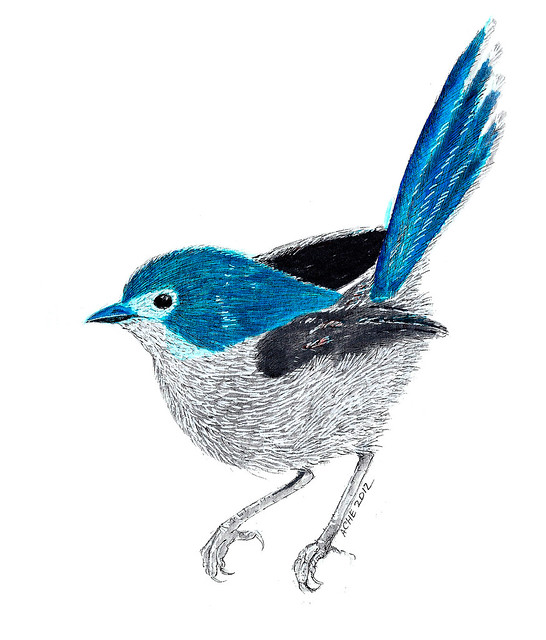
Lovely Fairy-Wren Female

I love Fairy-Wren birds, which are very common species in South Australia. Male birds are very bright colored with all kinds of blue, and female birds come in more gentle and elegant shades of grey and blue. They are truly restless birds, pleasure to watch, but very hard to sketch. I tried many times and always came out with series of spoiled paper instead. Recently I bought a bird bath for my backyard and Fairy-Wrens are regular visitors. At least I can take a picture of them now and use it and the life models as support draw them properly.

Sunday, July 8, 2012

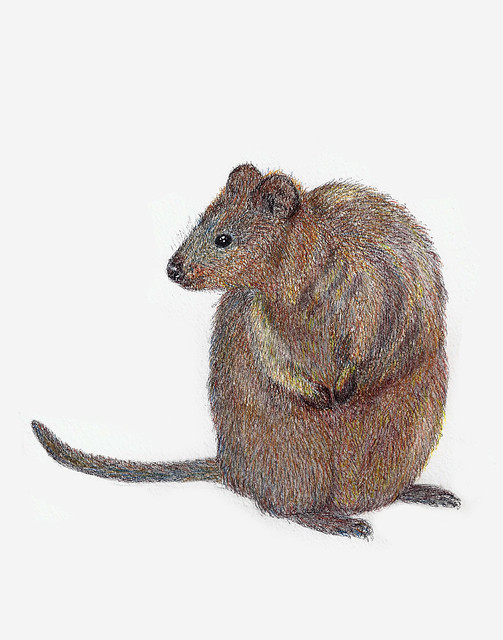
Quokka

Hello everyone!
I have recently been invited to join this wonderful blog, which I am really proud of. As this is my first post, I will say a few words about myself. My name is Anna, I am an illustrator and an artist. Originally I am from Russia but four years ago I moved to Australia, which became my home. I hope you will forgive me making mistakes, as I am not a native speaker of English.
As an artist I love to be experimental with styles and techniques. I love abstract art and cartooning as well as drawing from life and my materials range from charcoal to color pencils, from watercolors to digital painting. You can see examples of my art on my website.
One of the greatest sources of inspiration for me is animal life and marine creatures.
In my free time I volunteer at my city's zoo, and almost all holidays I spend snorkeling, diving and drawing sea dwellers.
Today I would like to present my drawing of a Quokka, small and very cute Australian marsupial. It has a baby in a pouch, that's why it is a bit lopsided.
I made a rough sketch of it in the zoo yesterday and finished it off at home.

If you are interested in my process, here are major steps of my drawing:


Thursday, July 7, 2011

Milkweed Bloom

Milkweed Bloom by Teri DC
Milkweed Bloom, a photo by Teri DC on Flickr.

We were sitting on the swing at the lake and I noticed that the milkweeds were blooming so I went over and sketched them in ink.
Working in ink is one of favorite media right next to watercolor and I like this combination of mostly ink and a little watercolor.
These milkweed plants are quite prolific along the path to the lake, dry and sunny.

However, not a Monarch butterfly in sight. They lay their eggs on these plants so they were either already there or had not found the plants yet.
This is a page from my Wisconsin journal.  I am trying to paint a lot of what I see around me in Wisconsin.

Friday, June 10, 2011

Cephalopods


There are times when sketching from life is impossible, as when you want to portray underwater life.
I love
octopuses, squids and cuttlefish, enigmatic masters of camouflage. Vulnerable due to their soft bodies, they can mimic almost any kind of background, or imitate other marine life forms, to escape predators. However, they use their capacity to change colour also to communicate. On the right is a common cuttlefish showing a threat display. This ink drawing is an adaptation from an illustration I saw in a book, but the following are quick sketches I realized while watching Underwater astonishments by David Gallo (an absolute must see!) on TED Talks, Octopus camouflage, a clip from one of David Attenborough’s documentaries on You tube, and Queen of camouflage, cuttlefish mating, a video by Annie Crawley, on You Tube. Sepias mate face to face; the male uses its hectocotylus to place sperm in a pouch positioned below the female’s mouth. Once fertilized the female lays a large number of eggs among the clumps of algae seen in the background.
At the top here on the left you can see a male cuttlefish courting a female, at the bottom a cuttlefish displaying arythmic pulsing. In the next sketch, the blue ringed octopus at the top changes colour when startled and turns yellow with blue and black rings. It's a small and very pretty octopus found in Australia, but it is so poisonous it can kill a human being. At the bottom, male squids progressively turn white when fighting other males. They can control their pigmentation and split into a whitish side, that being shown to another male, and a darker, more natural side, shown to a female. The female is above, and the male on the bottom is keeping an eye and half side of his body whitish to keep in check another male not appearing in the sketch. For this kind of faster and less detailed sketches I use watercolour pencils. I leave the whole drawing very approximate, and add some details and water later... hope you enjoy.

Monday, January 24, 2011

Cactus Monday - Saguaro Seed Pod

When we return to Arizona in the fall I find lots of these seed pods under our big Saguaro. I examined one and then sketched it.

Wednesday, October 20, 2010

A butterfly


I find myself drawn more and more to drawing insects. They are so alien, colorful, and incredible. This is a scarce swallowtail, it's quite common in central and Southern Europe, even in cities as busy as Rome. It died in my courtyard and I coloured it with ink and Tombow markers, then partly cut it to set it free.

Wednesday, September 1, 2010

Ink montage


It's been lovely watching our cardinal family next to the shed this summer...I'm worried that I haven't seen the mother or the babies peeping up from the edge of the nest, though.  Here you see dad, perched nearby and popping in to feed them from time to time.

Normally I'd add color to an ink sketch like this--but cardinals are SO colorful, and I like the subtlety...

Friday, June 11, 2010

Norway lobsters

I find nature and its creations utterly fascinating, and more astonishing than the creatures our best science fiction writers ever invented. On a trip to a local fishery I bought a few Norway lobsters, Nephrops norvegicus, and ended up sketching one. The Norway lobster is widely distributed in the Atlantic of northern Europe, but I guess most people, just like myself until two days ago, know little about it. These alien creatures have the ability to discard a limb to escape danger, and regrow it later. They don't reach their full body lenghth of 25 cm by growing gradually, instead they periodically shed their outer shell and absorb water to expand. Exposure to calcium salts present in the water hardens the new soft shell and they won't grow again until the next molt.
Females reach sexual maturity at 2 1/2 years of age, males at 3. After mating, a large female lobster can produce thousands of eggs, which she will carry around for up to 9 months. The eggs are attached to the hairs of the pleopods (illustration, a), the swimming legs found on the abdomen. The four pairs of front legs are used for walking, cleaning, excavating, catching prey, etc. While being carried around on the pleopods, the eggs hatch into prelarvae, and the female eventually releases them into the currents. Free swimming larvae, called zoeas, undergo various stages (illustration, I, II, III, IV), molting between each one, to turn into tiny replicas of adult lobsters (illustration, b). During the IV stage, zoeas start settling on the bottom and occupy burrows previously excavated by adults. They'll remain inside them for about a year to escape predators.

Monday, May 31, 2010

Common house geckos

The Common house gecko, Hemidactylus frenatus, originates in South Asia and North Africa, but has "colonized" most of the world, traveling aboard ships! In Rome, it is very common, with 50 or more individuals per building. I believe there are more, but then, of course, I keep a fresh reserve of earthworms for them on my balcony. However, here geckos never grow as large nor as numerous as I've seen them in places such as Thailand. During a summer vacation, years ago, I used to enjoy watching their territorial fights punctuated by their calls, which sound so much like their names repeated twice: gecko, gecko!
This little guy is a Mediterranean House Gecko, Hemidactylus turcicus, and like all geckos is excellent at camouflage. He had made himself look like the wall he was sitting upon so well it took me a while to actually see him.

Saturday, March 13, 2010

Livestock market


The first Sunday of every month, a livestock fair is held in Osteria Nuova, a small town near Rome.
I don't like places where live animals are traded, but am drawn to them... It was packed with people, and quite cold, so I realized a few quick sketches to which I added a splash of colour later at home.
On the right are black pigs from Rieti, a town north of Rome. It's an ancient breed of pigs that used to be bred in the wild and almost became extinct around the 1950s. They have now recovered.


Here on the left, is another endangered breed, the Amiata donkey, from Tuscany. These gentle creatures are now the subject of many scientific studies aiming to gain enough knowledge to preserve and protect them.