Saturday, October 15, 2011
Apple Picking Time

In Nature everything is perfect - Maree
- Alice Walker
Ink sketch with W&N watercolours on Visual 110gsm sketching paper – a beautifully weird and bent tree I spotted next to the road at Kromdraai on my way to the airport to fetch my grand-daughter.
Friday, October 14, 2011
Inspired by Fall Berries - Lin Frye
9" x 12"
Arches 140#CP
The culmination of a plant's lifecycle is the return to the fruit/seed stage of its life - coming full circle from seed, to plant, to flower, to seed again. Fall seems to be the berry-ist time of the year as trees, shrubs, perennials and annuals give the next generation of plant material the virtual 'push out of the nest.' From the fruits that are eaten and the seeds deposited by the consumer, to the wind-borne traveling seeds, to those buried for consumption and later forgotten, nature is preparing for next year's crop ...
Berries of all shapes, sizes, colors make this season even brighter ....Grapes, hawthorne, holly and dozens of others are all a fall delight ... and I love them all!
The cool weather is returning, but before the rains distribute seeds around the landscape, I hope to find more inspirational 'berry' materials to celebrate the season! Hope you do too!
Happy berrying!
Lin Frye
North Carolina
Wednesday, October 12, 2011
Japanese Anemone and roses
Tuesday, October 11, 2011
Mother Nature At Work

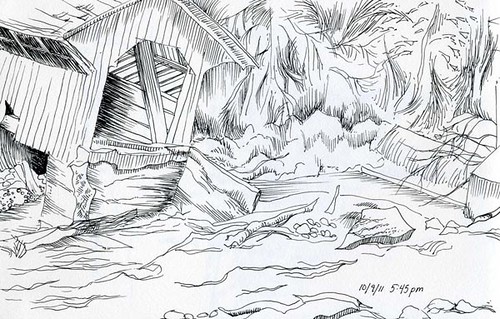
©2011 Carolyn A. Pappas, 10-9-11 (Covered Bridge). Pen and ink in large handbook sketchbook.
Although I didn't have much to talk about after Hurricane Irene, I did get out to Greenfield, MA the next week and take some photos of the damage there. I was a bit rushed, however, and didn't get a chance to sketch anything until this past weekend. The whole area looks pretty much the same as it did then, although they did have earth moving equipment bringing in rocks to try to repair the riverbank. It's too bad that they are going to have to tear down the covered bridge.
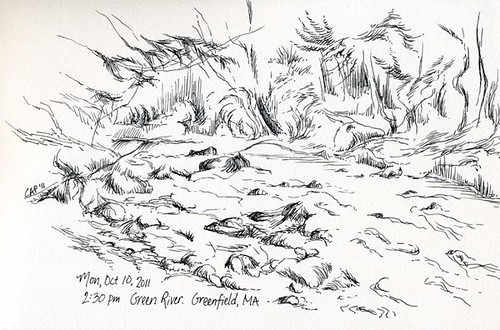
The next day I went a few miles upriver and made another sketch. Here, the river looks more like it did before, except that it is wider now in most places. Sections of road were washed out and there is still some debris from a house that was carried off its foundation.

©2011 Carolyn A. Pappas, 10-10-11 (Green River). Pen and ink in large handbook sketchbook.
More Australian Native Flowers

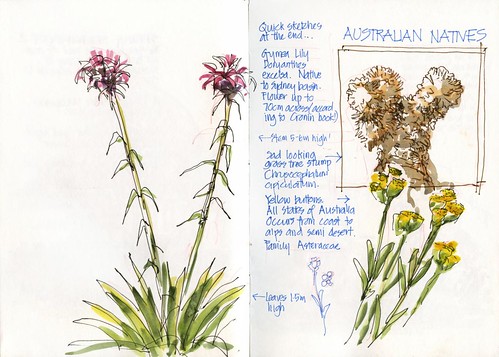
Following on from Alissa's great sketches... here are my ultra quick sketches form Saturdays Spring Sketchabout.(I am afraid that I spend too much time socialising at these events to do a serious sketch!)
I choose two flowers contrasting in size... the gymea lily(as drawn by Alissa) which is approx 30cm/1 foot wide (not 70cm as incorrectly noted in my sketchbook from a field guide that I have) and the other tiny tiny yellow button (only a few millimetres in size)
I also, like Alissa, drew a grass tree...but mine was a 'dead' stump.
I look at my wildflower guide book all the time and what often strikes me when I find them in real life, is how small many of the native flowers in Australia are.
Nature, Nature, please don't go away... Maree
Nature has so much beauty, so much to teach us. Mother Nature has inspired the greatest poets of all time to write unbelievable prose.
Nature, Nature,
Please don't go away...
We over polluted and any day, now, any day
It might die forever
And just go away
We are transmitting from the future
2115, I think
We lost count at 2079
When the world was on the brink
Look Larry
Look Sue
Look Harry
It’s 2011 according to the machine…
Those trees are green!
The sky is blue!
The fields are beautiful
And even the people are, too!
Look everyone!
Look at the screen!
Look at when nature, nature
Was such a fragile creature
With such delicate green features
By John Murray
Monday, October 10, 2011
Otter 501 - by Gay Kraeger


Otter 501 is a feature film soon to be released. Sea Studios, the organization creating the film, believes the film will draw a lot of attention to the otters at Moss Landing State Beach in central California. So they decided to raise money to put an interpretive panel at the beach.
Holly and I eat at the restaurant across the inlet here all the time when we have meetings in this part of the world. We love sitting at the window and looking out at all the wildlife. The otter raft is one of the very cool things to watch while we eat, so we were delighted to be contacted by Sea Studios.
We met with an amazing woman from the film company to talk about creating a panel about the otters. She told us the group at Moss Landing Beach are almost all males. They come here to eat yummy fat innkeeper worms, (something they don't serve in the restaurant across the bay) clams, (something the restaurant does serve.) The otters also shelter from the rougher weather in Monterey Bay.
I did some rough sketches on the spot as Holly and Arlene talked, but most of these pages I did back at the studio. I could not find much in underwater still photography of the southern sea otter, so I looked at underwater videos of swimming sea otters. I would pause the video and sketch as fast as I could.
Tradescantia - Lin Frye
9" x 12"
Arches 140#CP
The delicate blossoms of the spiderwort, Tradescantia, called for a soft, less defined painting treatment. Their delicate hues, tiny flowers, and soft blue-purple are in bloom now, and these were captured at Montrose Gardens last week.
These are common perennials here, and are not quite as upright as I've painted. These tiny flowers were being used as a border in the historic gardens we visited, but they also can be found growing wild.
It's the start of another busy week - classes and trips again - with rain in the forecast. Though we've finally caught up from our water deficient, the air feels so dry, that we are welcoming the showers.
More and more trees are turning golden and red. Our walk in the park yesterday seemed to show even more color that the day before ... Leaf fall has amplified, and I enjoy hearing their crunch underfoot as we walk.
Hope your week is terrific!
Lin Frye
North Carolina
Australian Rockery plants at Sydney Royal Botanic Gardens
I drew Xanthorrhoea (grass trees) which are a unique Australian plant. They have a large base of grassy leaves and a long flower spike. As with many Australian native plants these plants can quickly regenerate after a bushfire, with new leaves sprouting from the blackened stump. The indigenous aboriginies used the spear shafts and also resin from the plant for tools.
As I drew this, I made notes on my page of all the sounds I could hear around me. Kookaburras, children playing and fighting, the tourist train, party boats on the Harbour, a helicopter, jetboats, tourists. sketchers chatting.. and in the moments of quietness I could hear leaves falling or the water lapping against the sea wall.
I then drew Gymea lilies

Kerry ( RBG staff) told me of the signifigance of everything in my drawing.
In the background, beyond Sydney Harbour are the headlands, where the ships carrying the First Fleet of European settlers arrived in Sydney in 1788.
In the mid-ground is the sea wall, a sandstone wall built in 1848 as about 3 acres of tidal land at the edge of the Gardens was reclaimed at Farm Cove.
In the foreground are Gymea Lilies, which are a plant of the Sydney region. They have a flower spike of about 6 meters, which flowers in Spring and Summer. They were used as a source of food for the indigenous Eora pople. They are now being used as indicator as part of climate change project as their flowering time is so precise.
Sunday, October 9, 2011
Rainbow Lorikeets
Sipping Sapsucker
My husband and I were at Lake in the Woods, a favorite pond. We purposely came up on an overcast day to try and photograph otter in a softer light. The otter had fed and disappeared so I went for a walk. Got back to the car just as a light shower passed through. While sitting in the car waiting I realized a red-breasted sapsucker was feeding on an alder just in front of the car. He had obviously developed the holes over a period of several days. The lower holes were light-colored and dry. The upper holes were damp with sap and stained a burnt orange.
The sapsucker appeared to have accepted my car. He sipped, waited for more sap to fill his 'well' and then would sip some more. Only rarely he tapped at the edge of his hole, removing a little more bark. It was very pleasant sitting so close to the sapsucker while I waited for the weather to clear.
Sketched with a fountain pen and Platinum Carbon Ink. Fortunately I had my watercolors within reach too. When I'm prepared I have a small set of watercolors in my dash compartment, a old anchovie jar full of water strapped to my door handle with a napkin to blot excess water on, and three brushes tucked in my visor over the windshield. Whenever I let someone else sit in my seat, I have to admit they eye that jar of dirty water rather suspiciously.