Saturday, October 24, 2009

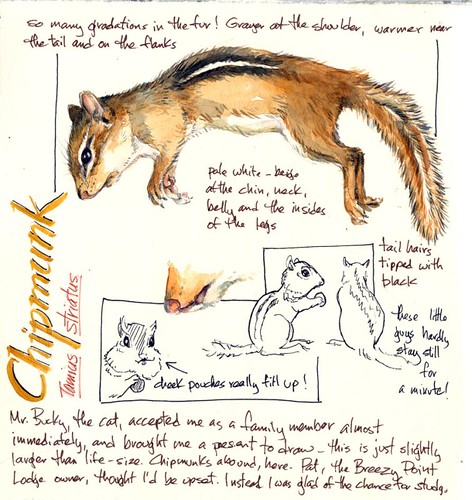
chipmunk study

chipmunk study

The resort owner where we stayed Wednesday night at the Lake of the Ozarks was amazed their cat accepted me so quickly and brought something for me to draw. I made us late for dinner sketching it--I was so enthralled by the subtleties of the coloring. And of course I'd been frustrated earlier because I couldn't get close enough to really SEE the little creatures, which were everywhere--problem solved!

Tamius striatus
makes a nuisance of himself in many areas--when I looked online for more information, I found dozens of sites telling how to deal with that! I guess the cat figured out one of them...

You'll find some lovely photos HERE and a Wikipedia entry HERE

...or explore more about chipmunks and far, far more in my old mentor, Charles W. Schwartz's wonderful book, below!


Charles was wonderfully talented, encouraging and helpful--I've loved his work since I was a kid! (Who knew there was a new edition of his book? The original one is one of the treasures of my personal library...)

Fall Leaves - Lin Frye


Daily Practice

Journal


We're having some family illness issues, so my sketching time has been limited. But I did pluck a few wonderfully colored leaves from the hospital parking lot to practice. I LOVE the colors - bits of orange, green, red, gold. Makes it fun to splash paint around!


From left to right - pear (from our fruit tree), dogwood, and maple. It's interesting to me how the same species of trees, located in different areas, can turn different colors. This maple, on one side of the parking lot, was bright orange/red; across the lot - a wine colored burgundy ....


It's finally raining a bit here. The foliage colors are coming to their climax - and it's absolutely dazzling.
Lin Frye
North Carolina

Magalies River - Maree Clarkson

God has cared for these trees, saved them from drought, disease,

avalanches, and a thousand tempests and floods.

But he cannot save them from fools.

- John Muir


"Magalies River at Wicker" pencil sketch and watercolour in Moleskine Watercolour Notebook

One of our favourite Sunday outings is to go to Wicker Tea Garden on the banks of the Magalies River in Magaliesburg (Gauteng, South Africa), surrounded by the Magaliesberg Mountains. We normally choose a table right on the riverbank from where we watch the Malachite Kingfisher diving for fish. Afterward he preens and suns himself on one of the branches overhanging the Stream.

On the other side of the river is an open-air wedding chapel which one can also access by crossing the rapids via some stepping stones when the river is not in flood.

Friday, October 23, 2009

Old Bugs - Laura Gillis


When I was recently cleaning up my drawing table I found these bugs I had drawn... I can't remember how old they are but I still liked them. The Yellow Jacket and the butterfly are ink & watercolor, the mud dauber wasp is just ink. All were done on Arches 140# hot press watercolor paper that I had soaked in tea and dried for the color.

Thursday, October 22, 2009

Sketch a Hedgehog - Maree Clarkson

"Some of the advantages of the camera are that it is compact and light and you can gather a lot of material in a short space of time. It can record constantly changing light patterns... rapid weather changes, and you can take photographs in atrocious conditions, such as pouring rain and snowstorms."
- Ron Ranson


"Hedgie" pencil sketch and watercolour in large Moleskine sketch-book

If you've ever tried to photograph a Hedgehog, you'll know how difficult that is, never mind trying to sketch him while he's scurrying to and fro, and then ducking from sight as you approach. I gave up trying to make a sketch of him as he was hurrying around and decided to take a photograph in stead for reference and even then it took ages before he settled down long enough for me to get a couple of shots.

I completed this sketch in about half-an-hour, after spending almost 2 hours trying to get him to be co-operative! But I got a couple of nice photographs and will be doing some more sketches of him.

And oh yes, his name is Hedgie, and him and his lady friend recently produced 5 of the most beautiful little off-spring - tiny replicas of their prickly parents. Lucky for daddy, he is free from all parental duties and merrily goes on his way while mommy looks after them until they are about 7 - 9 weeks old, when they start foraging for their own food.

Lively October--Vickie Henderson

October is so lively, so full of change and energy. Weather is changing. Leaves are changing. And almost daily, new migrants are visiting the trees in my yard. I can't keep up with them all. I want to paint each and every one of them.I love the chance to meet a new bird, read about where it nests, see where it travels, where it will spend its winter. I marvel when we have a chance meeting, that the wonderful oak tree in the front yard provides rest and foraging along his journey.

This is my sketch of one of these birds, the Magnolia Warbler (probably a male) created in my new Brenda Books sketching journal. It's a beautiful new journal with real rag watercolor paper. I'm finding it intially a bit intimidating--so brand new and inviting. You know, the feeling. You don't want to mess it up.
But that's watercolor and journaling. You plunge in. You make a mess. And altogether, it doesn't turn out so badly. And on top of that you have this wonderfully intimate experience, with a bird, with its lifestyle, with the magic of October.

This is the second page of my new sketchbook. The first can be found here. You will also enjoy reading about my first encounter with warblers. Nature has a way of healing and keeping you nurtured along life's journey.

Mai the Mynah - Maree Clarkson

"The creative is the place where no one else has ever been. You have to leave the city of your comfort and go into the wilderness of your intuition. What you'll discover will be wonderful. What you'll discover is yourself."


"Mai" pencil sketch and watercolour in Moleskine watercolour Notebook

We found a tiny Mynah on the pavement and couldn't see the nest anywhere, so took we took her home and over a couple of weeks watched her grow into a full-fledged Mynah. This sketch was done before she developed the fully black head and glossy brown plumage on the shoulders or the yellow around the eye. She spends most of her time outside hunting insects, but pops in every couple of hours for a snack of bread or some fruit and cheese.

She spent 5 beautiful months with us before mysteriously disappearing one Friday morning. My heart was broken, she was the most wonderful and intelligent pet anybody could wish for.

I know Mynahs are considered pests world wide, but for anybody out there that knows what an intelligent and loving little animal this is with a character that far surpasses that of any parrot, they will understand the feeling of attachment one forms with one of nature's little miracles.


Mai eyeing the birdbath before taking the plunge...


Mai taking a bath.


Fully grown Common Mynah

Wednesday, October 21, 2009

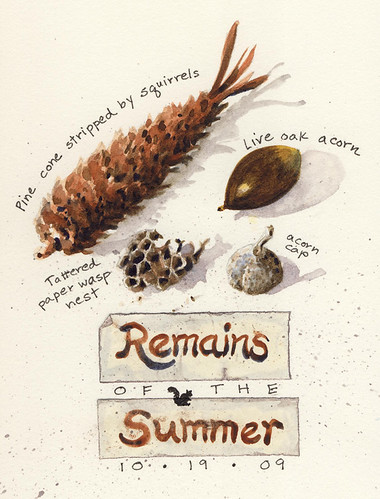
Remains of summer - Elizabeth Smith


Remains of summer, originally uploaded by Elizabeth Smith.

Well, I guess I should say that these are remains of a southwest Florida summer. Our few deciduous trees don’t usually lose their leaves until sometime in November or December, and we don’t have the grand color change of more northern areas. Instead, our changes are subtle.

The Live Oak trees in our neighborhood are producing a healthy crop of acorns, and soon we’ll be seeing pockmarks in the dirt as the squirrels stock up for lean times. They’ve been tearing off the scales of the Slash Pine cones to get at the seeds, leaving a bristly inner core of a rich burnt sienna color.

More and more bird flocks are traveling in the skies, the goldenrod is blooming on the roadsides, and the wheel turns once more.

You can click on the image above to see it larger on my Flickr photostream.

~ Elizabeth Smith, Naples, FL, USA

Giraffes at the San Fransisco Zoo: Judy Butler

I have been reminiscing about my trip to San Francisco in 2005. After working hard presenting at an educational conference it was time to play. I set out for an adventure by myself on a beautiful California Saturday morning to explore the “Nature Trail” in San Francisco. After taking the ferry across the bay from Alameda, I boarded a trolley then transferred to a bus. Finally an hour later I arrived at the Pacific Ocean. The trip with all these forms of transportation let me see a lot of the city with the iconic up hill and down. Along with beautiful vistas of city views the trip was lined with row houses of every imaginable color, people in wetsuits with surfboards tucked under their arms and other unexpected & unusual sites you might find in this unique city.

Once at the ocean the Sea Gulls were everywhere, really big Sea Gulls, the size of small dogs. I bought lunch at a deli inside the grocery store across from the beach. The Sea Gulls patrolled the grocery store parking lot, sat on light poles, and blanketed the beach. I sat ate my sandwich on the beach frequently protecting my morsels from the marauding birds. While enjoying the spectacular waves crashing on the beach and surrounding rocks and watching the surfers, I took bunches of photos and sketched the gulls.

It was difficult to tear myself away from the beach but I jumped on yet another bus and traveled down the highway to the Zoological Park. The Zoo is a lovely place, small compared to many zoos I have visited. Most exhibits are large enough for the animals to move around freely in quasi-natural settings. Of course lots of amazing west cost plants and blooming foliage. As I moved around the park I found comfortable spots to draw. My experience is that when you sketch in public you attract attention from children who always want to see what you are doing. That is a fun part of drawing in public. Young children always think your stuff is good even if it is not.

Zoos are a wonderful place to sketch. They usually have common and local animals along with exotic animals we might never have a chance to see. I spent a lot of time with the giraffes that were in a savanna-type setting with lots of other grazing animals.

I realized how obsessed I am with giraffes when looking back through my photos and journal entries during my trip to the San Francisco Zoo and trips to other zoos. See my giraffe post on June 12, 2008, “Giraffes: What is it about those long necks?” In that post I feature photos by friends from all over the world that are worth giving a look.


Tuesday, October 20, 2009

Sketching Farm Animals - Maree

Sketching farm animals has always been a passion of mine. Each animal has it's own interesting character, like the Silky below - they are very calm and placid chickens, unable to fly, with pure, white silky-to-the-touch feathers. As I was sketching this hen, she would calmly survey me, moving one, gentle step at a time, seemingly keeping her pose as if she knew I was trying to capture her beauty.


"Silky Hen" pencil sketch and a touch of watercolour in Moleskine notebook

Kentucky was a Bantam rooster, cocky and sure of himself. I raised him straight from the egg as he was the runt of the chicks and actually didn't look like he was going to make it. With tender loving care and great spoiling going on (he was allowed full access to the house), he turned into the King of the farm yard, ruling his roost with an iron claw.

He had this peculiar habit of falling into a trance when you circled your finger in front of his face and that was how I managed to do this sketch. You could even turn him over on his side or back and he would just lay there, fascinated by the moving finger.

Sadly, Kentucky fell prey to a Genet because he refused to go into the chicken coop and insisted in sleeping in the Pin Oak just outside our bedroom window.


"Kentucky"

Stargazer Lilies- Jane LaFazio

I took a 3 hour workshop on Sunday and the teacher got me all excited about direct with pen continous line drawings. I've done them before, of course, but now I really can see the potential and beauty of the fresh and wonky quality that type of drawing. I drew these stargazer lilies in many variations, and I'm having fun layering, printing, stitching them. 5x7 Moleskine Watercolor journal.

Autumn Leaves - Teri Casper


These autumn leaves are all ATC sized for a swap I was involved in.
However, my models were the trees/leaves I found in Wisconsin.

I just love doing autumn leaves with their lucious colors and small imperfections.

Flowered Roadside - Lin Frye


Flowered Roadside
Originally uploaded by linfrye
This is the view of one of the roadsides near my home. The photo reference I worked from was taken a couple of weeks ago, but I wanted to paint one last celebration of the profusion of Rudbeckias that blanketed the side of the road. There are some still in bloom, but with the deep dip in temperatures we've had over the last week, many more of them have already withered.

We took our landscape students to the NC State Fair yesterday - and it was wonderful! Though we started out cold, by afternoon, we were able to take off our coats and enjoy the 70F weather! Sun was shining, the garden and plant displays were incredibly imaginative and informative, and we've even more ideas to implement. Somehow, their annuals and rudbeckias remained as perky as this picture!

Fall really is the best time for planting, and we've installed a number of new trees in the Southern Garden we're creating. I hope to get the opportunity to sketch some of them over the next few weeks. With sundown coming before I leave the office for the night - I've my fingers crossed!

Lin Frye
North Carolina

Road to Harties - Maree Clarkson


"Road to Hartebeespoort Dam" in Moleskine Watercolour Notebook


Notes for 'Road to Hartebeespoort Dam' in Moleskine Watercolour Notebook

We often take a drive out to Hartebeespoort Dam in the North-West Province (South Africa), which borders Gauteng, just under an hour's drive from us. We prefer to take the scenic route, staying away from the main roads and all the traffic, using a gravel road crossing over a mountain, reveling in all the wild life we spot on the way.

The once sleepy village of Schoemansville, which has always been one of the major tourist attractions in the area, is now buzzing with activity and new developments, but has still managed to maintain most of it's original charm.

Monday, October 19, 2009

Cactus Monday - Cactus Spine - Teri Casper


You often see the spines I put all over my cacti so I thought it was time to bring this sketch back.
When I first got interested in cactus I wondered just how the spines grew so I got up close and personal.
This is what a fish hook barrel cactus spine looks like.
Yikes! Looks deadly.

S.A. Grasses 1 - Maree Clarkson

We need the tonic of wildnessWe can never have enough of nature…We need to witness our own limits transgressed, and some life pasturing freely where we never wander.

- Henry David Thoreau


South African Grasses
"Restio - Thamnochortus sp" - watercolour in Moleskine Watercolour Notebook

The first impression is one of sombreness. But as the breeze moves, the Restio plant's colours flash through the blades - khaki, terracotta, chocolate. Gardeners world-wide are captivated.

Sunday, October 18, 2009

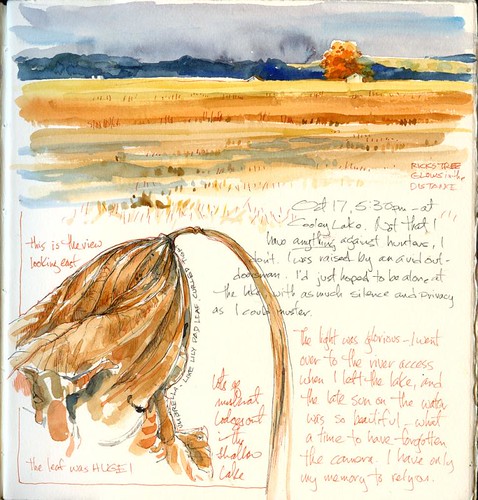
Late afternoon, October

Late Afternoon at the Lake

The colors are beginning to really glow, in mid-October. The loess bluffs are their usual mosaic of greens, oranges, reds and yellows, but this time my eye was caught by the long shadows cast by the broken clouds and that intense light! We'd had clouds for days, so when they began to break up and I saw the trees light up, I needed to be out there.

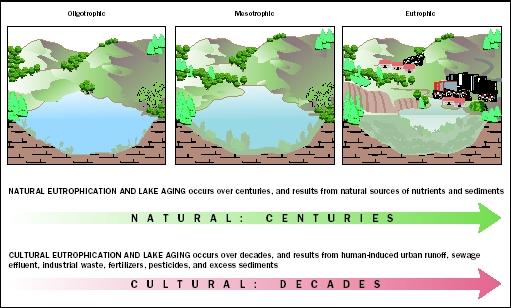
The huge leaf is from one of the waterlilies that now choke the old oxbow lake, once part of the Missouri River. It's succumbing to the natural progression of eutrophication. Here's more on the process whereby lakes eventually become land. And HERE is a graphic that shows that process clearly.

The rich farmland of the Missouri River bottoms is an agricultural treasure, worth its weight in gold--or almost! There are fewer homes here now, due to flooding in recent years, and more land is given over to flood control, public use, and farming. This area was under water in the flood of 1993, but in the natural pattern of things, the resulting silt and mud that was deposited serves to enrich the soil. (At least if there's not too much pollution and heavy metals involved.)

This image is from Jefferson City, a bit downstream, but the area I frequent near Cooley Lake was as inundated. It was a sobering sight to see this vast inland sea where the state highway used to be!

I've drawn and sketched at this wildlife area many, many times--now owned by the Missouri Department of Conservation, it's an amazing place to explore.

From the MDC's information page: "Cooley Lake CA in Clay County covers 1,348 acres, including 335-acre Cooley Lake. Riverlands purchases added 310 acres to this area. It has 6.4 miles of hikeable river levee and a half-mile hiking trail. Walk-in fishing is available along a mile of river frontage. The area's boat ramp and privies are handicapped-accessible. Waterfowl, shorebirds, songbirds and birds of prey can be viewed from the area's four parking lots."

If you're anyplace in the area of Excelsior Springs, Missouri, I recommend a visit!

White Eye - Maree Clarkson

"There is a vitality, a life force, an energy, a quickening that is translated through you into action, and because there is only one of you in all of time, this expression is unique. And if you block it, it will never exist through any other medium and be lost."

~ Martha Graham


"White-eye" sketch with watercolour in Moleskine Watercolour Notebook

The White-Eyes are regular visitors to my garden. They normally flit around furiously catching the tiniest insects hardly visible to the eye and never sit still for long. Did a quick out-line sketch of this chappie as he gave me the cocky eye and finished it off once they had moved on, taking reference for colour from one of my bird books.

I did this sketch almost 20 years ago and I'm still as fascinated with the White Eyes as the first time they visited my garden.

Roadsides Turning - Lin Frye


Roadsides Turning
Originally uploaded by linfrye
Daily Practice
Journal

The tour of the zoo yesterday was fascianting! Our students were priviledged to the 'behind the scenes' operation of the NC Zoo (http://www.nczoo.org/) an incredible, first-class establishment that sets animals in native habitat. We walked and walked and walked over the grounds, learning how the landscape designs were created, the plants and their upkeep, the staff and their education, their propagation and restoration methods, oh yes, and a bit about the animals too. Not only was the trip exceedingly informative, it was FUN, and provided our own horticulture students with an opportunity to think beyond of the typical employment opportunities.

To say we were a bit 'chilled' yesterday morning would be an understatement. The day did warm up, but when we arrived, ALL of us, including those who claim to be 'warm-natured' were wishing for heavier coats. The weather is indeed turning .... Yes, we'll get another visit or two by summer's breath, but those will be short-lived and fleeting. We're expecting our first frost next week.

Which leads me to painting. I revisited the roadside I painted earlier this month. Those bright yellow rudbeckias have turned more golden-brown, and the trees, a brilliant yellow, now moving to red. Our foliage display, with the current rains and cold, is moving toward its own climax ... and it's wondrous to behold.

It wouldn't be fall without the state fair, and our students will be visiting the fair this Monday to see additional horticulural displays. Landscape design, plant choices are all part of this next visit, along with seeing the blue-ribbon winners of specific plants to emphasize plant production and care.

It's a busy, but really wonderful time of the year. Hmm... do I smell fair popcorn and candy apples?

Lin Frye
North Carolina