Daily Practice
Busy times continue -- This sketch was done from a photo reference, and looks far brighter in person than on my screen this morning.
We missed getting out to the water this weekend, so I had to substitute a couple of reference photos to bring me to those quiet, serene waters ...
The JCC Earthfest is today, so we'll be sharing information about square foot and container gardens. We inspired several 'new growers' into trying lettuce and tomatoes in large pots .. so we hope to 'convert' a few others about the joy and ease of this type of gardening. More information, if you're interested, can be found here: www.johnstoncc.edu/arboretum.
Hope YOU have fun planting!!
Lin Frye
North Carolina

Wednesday, April 29, 2009


Tuesday, April 28, 2009
Coral Tree

Sorry all- I'm still learning how to post and showing the actual photo eludes me.
Note from Kate: Piece of cake, girl, there are a couple of ways to do it. I added this, and will give you some tips offlist!
Thomas Bewick on Making a Mark--and here!
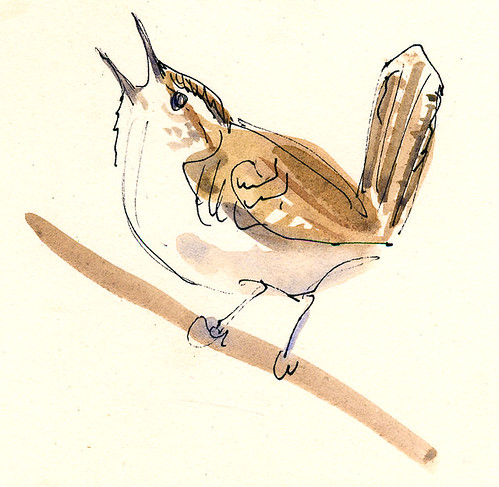
This quick gesture sketch captures the pose and approximate markings, though the outer edges of the wren's tail are white--I missed that!
If you've ever heard of Thomas Bewick, artist/naturalist and wood engraver (and if you're a birder you'll remember Bewick's Wren and perhaps Bewick's Swan, though he also illustrated a book on quadrupeds and did a great many humorous illustrations as well), you'll enjoy this post by Katherine Tyrrell on her terrifically helpful blog, "Making a Mark."
Here's a direct link to today's post--you'll enjoy it!
More on the artist from the Bewick Society, http://www.bewicksociety.org/
Bewick’s Wren, known scientifically as Thryomanes bewickii, was collected by John James Audubon on its winter quarters in Louisiana in 1821. Audubon reportedly described this tiny bird and named for his friend, Thomas Bewick, a British engraver. It occurs in Great Britain and elsewhere, as well. Its range on the North American Continent ranged from southern Canada to Mexico, largely in the East to Midwest--we have them here in Missouri, but they're not as common as house wrens or winter wrens.
Red-shouldered Hawk Nestling!
Spring is one of those times when things change rapidly. In the case of my visits to red-shouldered hawk territory, it had been nine days since my previous visit. What a difference a few days make!
 The warmer temperatures and rain caused the leaves to jump out and almost obscure my view. But through my binoculars I could see one fuzzy-white nestling peeping over the edge of the nest.
 I wrote in my sketchbook: "The sun was shining through the canopy making everything glow with yellow-green. The shading is perfectly timed to keep the nestling and parents cool as the temperatures rise." Ap 26, 2009. On the day of this observation, the afternoon temp hit 93 degrees F.
 In every aspect, nature's timing is full of wisdom!
To see more images and details of this visit, click here. To see the entire series of my visits with these red-shouldered hawks visit Vickie Henderson Art.
The warmer temperatures and rain caused the leaves to jump out and almost obscure my view. But through my binoculars I could see one fuzzy-white nestling peeping over the edge of the nest.I wrote in my sketchbook: "The sun was shining through the canopy making everything glow with yellow-green. The shading is perfectly timed to keep the nestling and parents cool as the temperatures rise." Ap 26, 2009. On the day of this observation, the afternoon temp hit 93 degrees F. In every aspect, nature's timing is full of wisdom!To see more images and details of this visit, click here. To see the entire series of my visits with these red-shouldered hawks visit Vickie Henderson Art.
Gaura
Daily Practice
Plein Air
Our Internet connection at the office has been down since yesterday afternoon, so I'm posting this in transit. Until we get our servers back, I'll be scarce ...sigh.
This is one of the flowering perennials we planted in our new garden this weekend. Those pretty pink spikes of flowers will continue to open up the spike as the maroon buds open over time. I love how airy this looks when the wind blows!
It's going to be in the 90s again today -- pretty hot this early in the season ... It seems summer is almost here ... and to tell the truth, I'm still thinking spring!
Lin Frye
North Carolina

Plein Air
Our Internet connection at the office has been down since yesterday afternoon, so I'm posting this in transit. Until we get our servers back, I'll be scarce ...sigh.
This is one of the flowering perennials we planted in our new garden this weekend. Those pretty pink spikes of flowers will continue to open up the spike as the maroon buds open over time. I love how airy this looks when the wind blows!
It's going to be in the 90s again today -- pretty hot this early in the season ... It seems summer is almost here ... and to tell the truth, I'm still thinking spring!
Lin Frye
North Carolina
Subscribe to:
Posts (Atom)