Saturday, August 20, 2011

insects and friends


An evolving sketch over days--I started over a week ago.  All of these were on my deck at the shed at one time...so I did the rough sketch below with a Prismacolor Verithin black colored pencil, then took photos to refine them.

These are not much more than quick gesture sketches...I was standing up, the butterfly might move at any time, and the katydid, DID!  Sort of a slow-motion sloth effect...
 
I increased contrast so you could see the lines better...really, mostly just going for shapes and poses here, not detail.

slow-moving but definitely MOVING bush katydid...


My reference photos were really helpful in getting at the details I'd missed, although I never COULD get my camera to focus properly on the walking stick. 

I love the cricket-like sound of katydids on a summer night...

I waited a few days to add color, until my new open-stock Verithin pencils arrived from Dick Blick--and then decided to add some watercolor after all! 

 I couldn't resist adding the daddy longlegs or harvestman, which strolled up later...and before you say "ick, I hate spiders," these aren't spiders at all!  They have their own order, they are non-poisonous, and they eat other small insects.  They're very beautiful, up close, like a jeweled mosaic box.

Colored pencil and watercolor.

Friday, August 19, 2011

A life bird at the feeder. Whooee!

This morning I sat in our kitchen to try and decide where I was going to walk when the fog lifted. It was 8:30 and there was no sign of sun so I had plenty of time to decide. I looked up at the bird feeder and noticed what I thought was a very large pigeon on it. When I looked closer I saw that it wasn't a rock pigeon (Columba livia). It was bigger, had yellow feet and a yellow and black beak. There was a very faint white bar on the back of her neck with a few iridescent green feathers underneath, which I would have missed if I didn't know to look for them (after consulting David Sibley's Guide to Birds) I got out some paper and began sketching, thinking she would be leaving sooner than later. As I sketched, I noticed how unhealthy she looked and the way she moved her beak as she ate, as though something was caught in her throat. Not to mention the fact that she stayed at the feeder even though I was only 2 feet (61 cm) away from her. An hour later I stopped to walk to the bank with my dog. Still no sun. When I returned at 11 am the sun was finally beginning to show and several birds were lined up on the phone wire above the bird feeder looking down at the mystery bird, who had fallen asleep, preventing them from getting to their morning meal. I went inside and was pleased to see that she had perked up a bit and ate some more seed before flying off at 11:30. I'd already discovered that she was a Band-tailed Pigeon (Columba fasciata), a native to the western United States. Having never seen one before I wasn't surprised to find that these birds are normally found in coastal woodlands here in northern
California. I'll bet that there's a good story about how she ended up at a feeder in Santa Rosa, a good 35 miles from the coast and I hope that whatever ails her is temporary and that she'll be winging her way south for the winter.

As I wrote this post in the late afternoon my husband came to my studio to tell me that she's back at the feeder so maybe she'll stick around for a while.

More information about Band-tailed pigeons:

All About Birds
Wikepedia
Audubon
Whatbird

Sunflower Study--Vickie Henderson

In early July I paid a visit to one of my favorite local refuges in east Tennessee to assist with a bird-banding session.  The added bonus was discovering fields of sunflowers in full bloom that had been planted as food patches for wildlife.
I find sunflowers magical for many reasons.  First of all they are artsy, and full of character with all those unruly petals framing a head full of tiny blossoms.  What we normally consider the bloom on this plant is really an inflorescence or head with from 1,000 to 2,000 blooms attached to its base.
Strolling through sunflowers and seeing all the different stages and shapes is magical. But there is the practical aspect of a July stroll, as well.  The temps rise very quickly in a sunny field and there are plenty of biting and stinging insects.  Amazingly, I left this visit with only one crawling tick, but plenty of contentment and reference images!

Links and references:
Visit my post "Sunflower Study" at Vickie's Sketchbook to see more about this study.
Sunflowers (Helianthus annuus)
The butterfly in the image is an American Lady, most easily identified by the two prominent spots on the lower under wing.

Thursday, August 18, 2011

Sacred Datura


This is a sketch I did yesterday of the Datura plant in my front yard. I counted 40 buds on it! It blooms at night and smells like vanilla. The seed pods it's name for have not developed yet but I will add them to this sketch when they do. The Latin name is Datura inoxia and is sometimes called downy thorn apply (from the Hindi dhatura), Indian apple, and sacred Datura. I did it in pencil but made it darker in PhotoShop so you could see it. Paula in Virginia

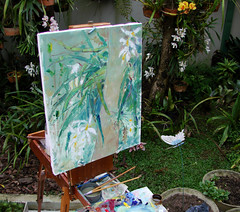
Orquídeas Brancas na Sarasvati


Orquídeas Brancas na Sarasvati
Upload feito originalmente por Renê Tomczak

Monday, August 15, 2011

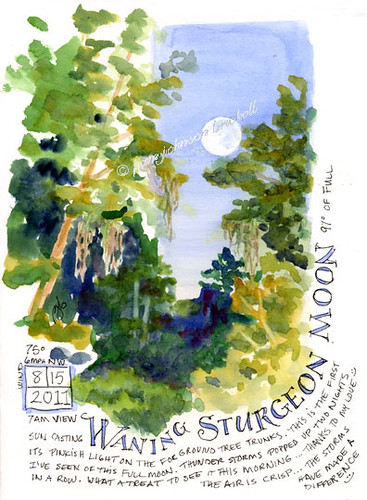
Waning Sturgeon Moon - Pam Johnson Brickell

Waning Sturgeon Moon by PJBee
Waning Sturgeon Moon, a photo by PJBee on Flickr.
Thunderstorms prevented an evening painting of this months Full Moon, but I sure enjoyed seeing it this morning - 97% full is okay with me. I ran back in the house for my journal and paints. A great way to start the day!

Sunday, August 14, 2011

Pale-headed Rosellas


Thank you for the warm welcome..This time I wanted to show a page from the 'Design Book', the sketchbook I use to plan and design what's in my mind before the actual painting. I developed this one from a few sketches (http://matteogrilli.blogspot.com/2011/04/pale-headed-rosellas.html) and a couple of photos collected from a walk at Toohey Forest, south Brisbane. Although these birds, now a favourite of mine, are so colourful, in some conditions of light they can camouflage extremely well within their environment.Until next time!   Matteo http://matteogrilli.blogspot.com/


A Day at the Beach and Whitelines Paper

Why does a day at the beach go so quickly? It felt good to kick back and record the day :)

On the technical side...
I made this journal entry in a new journal by WHITELINES. This is a Swedish company that makes a toned paper using white for lines. They also offer paper with grids (squared), isometric lined notepads and perspective lined notepads. There are many choices of binding: hard covered spiral, soft covered flexible and glued pads.

The paper has a nice feel. I estimate it to be about 24# in weight. I've been using Pentel energel and Signo uniball ballpoint pens on it and have experienced no smudging. The ink in these pens is water soluble. Micron pens remain waterproof on it's surface.

I used watercolor pencils on the page above with minimal water using a Niji waterbrush. The paper did buckle but, that was no surprise. I think colored pencils would really work well on this surface, perhaps even pan pastels. When you turn the page over you can see a little bleed through, but not nearly as much as you do with Moleskine's regular journal paper.
WHITELINES claims that when pages are copied or scanned the white lines and toned background will disappear.
Click to enlarge
As you can see above, that was not the case when I scanned the page at my scanners normal settings. I had to lighten the overall exposure of the original scan, lost some subtle tones, but the page on the right is a lot cleaner looking.

I do like how the ink really stands out on the paper. And the toned surface is easier on your eyes versus looking at dark lines on a white surface. I liked working on a paper with grids. My type lines remained square to the page :)


Wild Turkey Feather

Umpqua National Forest, Oregon, USA

Western Oregon is a mix of fairly open valleys and deep forest at higher elevations. When we first moved here a wild turkey was a rare sight … and a little suspect as to whether it really qualified as a wild one or a domestic that had gone wandering. There were meager results from early attempts to introduce birds. But then the Fish and Wildlife Department learned how to successfully transport wild turkeys for a successful introduction. Earlier attempts had penned the birds for awhile. Biologists found that the birds needed to be caught quickly, immediately flown to the new location, and released. Now the lower elevations have plenty of turkeys, perhaps too many. Often a flock becomes quite tame and becomes a yard nuisance. A strutting tom is a formidable force if he thinks your front porch is his territory.

The turkeys that have established themselves on National Forest land are much wilder. Food is scarcer and their numbers are much lower. Their wariness is reinforced by a hunting season. Once in awhile we see one quickly slipping into the undergrowth. Just finding a feather of one of these wilder ones is a treat. This feather is about five inches long and comes from underneath its beautiful tail feathers. I found it a few feet from a water source at about 3200 feet in elevation – a little higher than I expect to find them. I brought the feather back to the car and painted it quickly.