Showing posts with label watercolor pencils. Show all posts

Tuesday, March 18, 2014

Sketching in the Field.... or Forest

Last Friday, my co-worker/naturalist, Kristen Marshall Mattson and I led a nature journaling workshop for members of Spring Island, South Carolina.  What a great way to start the day!   Walking through the woods, examining plants, sketching our finds, adding details, learning new things both art and nature related.  YUM! None of us wanted it to end :)

Did you know.....
White flowers are pollinated by moths? (the flowers show up better at night)
The purple flowers of wild ginger is pollinated by beetles?
That a hollow tree can still live and thrive as long as the outer 'living shell' is not compromised?

Wednesday, October 16, 2013

Bird Feeder Sketching

I'm so excited!  Our feeders are once again in place and the birds have found them. We are coming up on our second winter in this house.  I didn't want one more to go by without the joy of watching birds right outside of our window.

I've designated a Stillman and Birn Gamma Series Journal to record feeder notes and sketches.  I'm in heaven :)  Every spare moment I have on the weekends is spent at the kitchen table, looking out the window observing bird antics and sketching.  Sketching supplies include a pencil, Micron pen, waterbrush, watercolor pencils, a Sibley bird guide and binoculars. 
To read my notes, please click image to enlarge - this will work for all of them.
 So much nature happening at my window.  All I have to do is sit back and watch :)
Our neighborhood has a flock of turkeys.  Actually, the flock consists of a hen and 17 poults.  They visited the back yard off and on over the summer.  The poults are as big as the hen now and they, too, have discovered the feeders. They can certainly make a mess out of the mulch. 

Today, I was able to sketch while standing right at the window.  This requires patience as the birds are always moving.  Up to this point in my life I haven't had many dealings with wild turkeys, especially this close.  As I sketched, I noticed that they have a protrusion on their head between the eyes.  What's that called?  What is loose skin on their neck called?  Why do some have more feathers (very short but there) on their heads and necks?  I so love questions raised by looking close at a subject when sketching.  Off I went to my collection of bird books.  Please click on my journal pages to get the answers :)

I do have one correction to make.  The book I looked at said the loose skin on their necks is called a dewlap.  Friends in the know have told me it's more often called a wattle. 
I urge you to get your sketch books out and sit close to a feeder.  You'll come away quite refreshed and peaceful.  Great food for the soul.  And, remember.... this is your journal.  This is where you practice observation and trying to recreate what you see.  Accurate sketches may not happen right away, but over time you will see your progress.  One of my goals is to practice the camera technique.  That's when you view a bird pose, close your eyes and don't open them up until you turn your head to face your sketch book.  Then sketch what you saw from memory.  I'm having a bit of trouble with this.  Most of my trouble comes from not trusting myself.  The tufted titmouse on the first image is sketched using this technique.  'Oh well!'  Next time I might remember more :)


Friday, March 1, 2013

A Fairy Clothesline

Recent winds rearranged a clump of hanging Spanish Moss into a clothesline.

Can't you just imagine little fairies hanging out their skivvies to dry?

Happy March!

Thursday, September 22, 2011

Hello to Autumn - Pam Johnson Brickell

Spartina alterniflora
Here in the low country of South Carolina, our trees do not rush to change their leaves to the colors of orange, yellow, red, burgundy and purple we so love in Autumn. For that matter, Mother Nature doesn't abruptly turn the temperature down either!

Telltale signs that the hot, humid days of summer are finally going to come to a close revolve around the shortening of daylight, the observation of Hickory and Oak tree's bounty of fruit, Beautyberry and Sparkleberry bush's berry colors changing from green to magenta and black respectively, Devil's Walking Stick tree and Poke Weed fruit formation, and best of all, the color change of the cord grass in the salt marsh.

It seem's like just yesterday the smooth cord grass, Spartina alterniflora, turned it's beautiful, almost electric green. Over the last couple of weeks I've begun to note a plethora of greens and both raw and burnt sienna tones evolving. Altogether a feast for the eyes :)

Now that the Autumnal Equinox is upon us, what changes are you noticing in your neck of the woods?

In the above plein air sketch, I used Derwent watercolor pencils in an AquaBee Super Deluxe Sketchbook. It may have taken all of 10 minutes, but as I painted the below canvas in my studio, I could still feel the warm morning air and recall the smell of the pluff mud where the Great Egrets, Wood Storks and Ibis love to dine.

What's for Breakfast?


Sunday, August 14, 2011

A Day at the Beach and Whitelines Paper

Why does a day at the beach go so quickly? It felt good to kick back and record the day :)

On the technical side...
I made this journal entry in a new journal by WHITELINES. This is a Swedish company that makes a toned paper using white for lines. They also offer paper with grids (squared), isometric lined notepads and perspective lined notepads. There are many choices of binding: hard covered spiral, soft covered flexible and glued pads.

The paper has a nice feel. I estimate it to be about 24# in weight. I've been using Pentel energel and Signo uniball ballpoint pens on it and have experienced no smudging. The ink in these pens is water soluble. Micron pens remain waterproof on it's surface.

I used watercolor pencils on the page above with minimal water using a Niji waterbrush. The paper did buckle but, that was no surprise. I think colored pencils would really work well on this surface, perhaps even pan pastels. When you turn the page over you can see a little bleed through, but not nearly as much as you do with Moleskine's regular journal paper.
WHITELINES claims that when pages are copied or scanned the white lines and toned background will disappear.
Click to enlarge
As you can see above, that was not the case when I scanned the page at my scanners normal settings. I had to lighten the overall exposure of the original scan, lost some subtle tones, but the page on the right is a lot cleaner looking.

I do like how the ink really stands out on the paper. And the toned surface is easier on your eyes versus looking at dark lines on a white surface. I liked working on a paper with grids. My type lines remained square to the page :)


Saturday, June 11, 2011

Sketching Water Birds at Pinckney Island WMA

I had the good fortune to meet and bird with Kelly, of Red and the Peanut blog this week. I sooo love meeting blogging friends :)

Our destination was Pinckney Island Wildlife Management Area, Hilton Head Island, SC. This wonderful place is just about 6  miles from my house and I'm ashamed to say I just don't get a chance to go there that often. We walked to Ibis Pond. Kelly has a keen eye and pointed out many a bird treat.  The first was a Boat-tailed Grackle, Quiscalus major, nest built within the cattail reeds - a beautiful, deep structure constructed from dead cattail reeds and woven into living cattails.

Kelly captured this sketching moment for me :) My scope is just in front of me. I love sketching with a scope. My sketching combines both blind and modified contour techniques.

The Grackles were flying above us, sounding like helicopters. Just as I was about to move on, I saw a Grackles beak rise above the side of the nest!

I moved a bit more to the left and started to draw a pair of Ibis. The Funky Ibis on the left side of the page was totally blind contour.... thus it's beak is a bit on the funky side :) This one was perched above and to the left of a nest, the other laying on the nest. Just when I was going to start sketching the Ibis on the nest, they traded places. Dang... But, it was fun to see the changing of the guard :)

Then I spotted two juvi Tricolored Herons, Egretta tricolor, with fantastic 'bad hair' heads. Oooo they are so fun!

We moved around to see the more densely populated trees. Just amazing. Kelly said the bird numbers are actually down from her visit here last year.  We are in the midst of a drought which directly affects nesting. I can't believe how much the cattails have filled in the pond since my visit in 2009.  It's a wonder there's any open water. 

Here's a taste of what we were viewing...
White Ibis, Eudocimus albus, in rookery


This short video of Little Blue Herons, Egretta caerulea, shows adults flying in to feed their babies.  Immature Little Blues are always white. Their feathers will start to darken after their first spring. You can distinguish them from Snowy Egrets, Egretta thula, by noting coloration of their beak (pale grayish green) and legs (pale dull green). I shot this with my little Nikon Coolpix.  I so love this camera :) Kelly's doing most of the narrative. She's so funny!

And, the completed journal page... I added color at home.
It was so good to finally meet you, Kelly!! Let's do this again :)

Friday, June 10, 2011

Cephalopods


There are times when sketching from life is impossible, as when you want to portray underwater life.
I love
octopuses, squids and cuttlefish, enigmatic masters of camouflage. Vulnerable due to their soft bodies, they can mimic almost any kind of background, or imitate other marine life forms, to escape predators. However, they use their capacity to change colour also to communicate. On the right is a common cuttlefish showing a threat display. This ink drawing is an adaptation from an illustration I saw in a book, but the following are quick sketches I realized while watching Underwater astonishments by David Gallo (an absolute must see!) on TED Talks, Octopus camouflage, a clip from one of David Attenborough’s documentaries on You tube, and Queen of camouflage, cuttlefish mating, a video by Annie Crawley, on You Tube. Sepias mate face to face; the male uses its hectocotylus to place sperm in a pouch positioned below the female’s mouth. Once fertilized the female lays a large number of eggs among the clumps of algae seen in the background.
At the top here on the left you can see a male cuttlefish courting a female, at the bottom a cuttlefish displaying arythmic pulsing. In the next sketch, the blue ringed octopus at the top changes colour when startled and turns yellow with blue and black rings. It's a small and very pretty octopus found in Australia, but it is so poisonous it can kill a human being. At the bottom, male squids progressively turn white when fighting other males. They can control their pigmentation and split into a whitish side, that being shown to another male, and a darker, more natural side, shown to a female. The female is above, and the male on the bottom is keeping an eye and half side of his body whitish to keep in check another male not appearing in the sketch. For this kind of faster and less detailed sketches I use watercolour pencils. I leave the whole drawing very approximate, and add some details and water later... hope you enjoy.

Monday, June 6, 2011

Buttonbush ~ Elizabeth Smith

A curiously flowered shrub, the buttonbush takes its name from the round button-like fruits. The flowers are described as looking like pincushions, puffballs, or ping-pong balls, and are about 1 to 1-1/2 inches in diameter. Buttonbush enjoys damp areas and thrives in swamps, marshes, and along water edges throughout most of the eastern United States. It ventures into the Midwest just past the Mississippi River and grows in selected moist pockets in Arizona and California.

The creamy white flower balls have a sweet scent and attract bees, hummingbirds, and butterflies. The fruit ball is composed of small nutlets, which serve as a food source for ducks and other birds. The bushy growth provides cover for birds and other small animals. The leaves on this buttonbush are whorled in groups of three, but they also grow in opposite pairs. buttonbush is deciduous, which means that it drops its leaves in the fall or winter. The new growth on this shrub is tinged with red on the petioles (leaf stems) and the tips of the leaves.

Although considered inedible for humans and horses, deer are reported to enjoy the foliage and young twigs. Buttonbush leaves, bark, and roots had wide uses as a decoction, a gargle, and poultice and were used by Native Americans and European settlers to cure ailments from dysentery to toothache. However, the plant contains toxins that often had worse effects than the illness it treated, and eventually fell out of favor.

I often draw directly in ink in the field with a bit of preliminary color, adding more color and calligraphy labels later.  I used a Sepia Micron Pigma pen and a combination of Kimberly and Derwent watercolor pencils with a Niji Aquabrush.  Late May and early June days in southwest Florida can be extremely HOT until our summer rains start.  This is a buttonbush growing along the boardwalk at Freedom Park here in Naples.  It was a nice shady spot, and the boardwalk has a convenient rail, perfect for resting a sketchpad!

If you’d like to read more about buttonbush, please visit the following links:

Wikipedia
Floridata
Florida’s Nature

~  Elizabeth Smith,  Naples, Florida, USA

Friday, June 3, 2011

Leafroller Moth - Pam Johnson Brickell

I had to search back in my journals to see if I could shed some light on Kate's question of what type of insect will roll/fold leaves in here previous post here?

In the low country of South Carolina, I came across a Marsh Fern whose top leaves were rolled into a ball like shape.  I remember asking a naturalist friend of mine what insect would do this.  His reply... "A Leafroller Moth" - I remember thinking how funny. With all the huge scientific and hard to pronounce Latin names out there... how quaint to call a moth by what it does!  Ha Ha!

My insect book, Kaufman Field Guide to Insects of North America, says leafrollers are in the family Tortricidae and that there are over 1,100 species in North America!

So, perhaps this is what you found, Kate?

Wednesday, November 24, 2010

Dahoon Holly Sprig - Pam Johnson Brickell


Dahoon Holly Sprig
Originally uploaded by PJBee
I love this time of year when the Holly trees sport their fruit. I discovered this variety of Ilex right outside my door, after I read Elizabeth Smith's Dahoon post.

The pen illustration with watercolor shadows of the sprig was done as a demo for my last workshop at Coastal Art Supply.  I used Canson Edition paper. It's become a favorite of mine.

I let the illustration hang around in my studio for a couple of weeks. I like the meditative process of finishing a page. I find, after a fashion, a line of communication opens between me and the initial sketch. Last Sunday, I laid in the watercolor on the leaves and berries. Monday, I played with the lettering for Dahoon on a tracing paper overlay. I used watercolor pencils for the calligraphy. Yesterday the final piece of the design puzzle came into place..... I added information about the tree and treated it as a border. Done!

The joy of discovery is captured forever in my heart :)


Wednesday, November 10, 2010

Chechessee Creek Marsh - Pam Johnson Brickell


Chechessee Creek Marsh
Originally uploaded by PJBee
This is a view from Spring Island's north end. I deleted utility lines that run near the top marsh grass and Rt 170 traffic that runs along the treeline. I love not being a camera :)

Monday, November 8, 2010

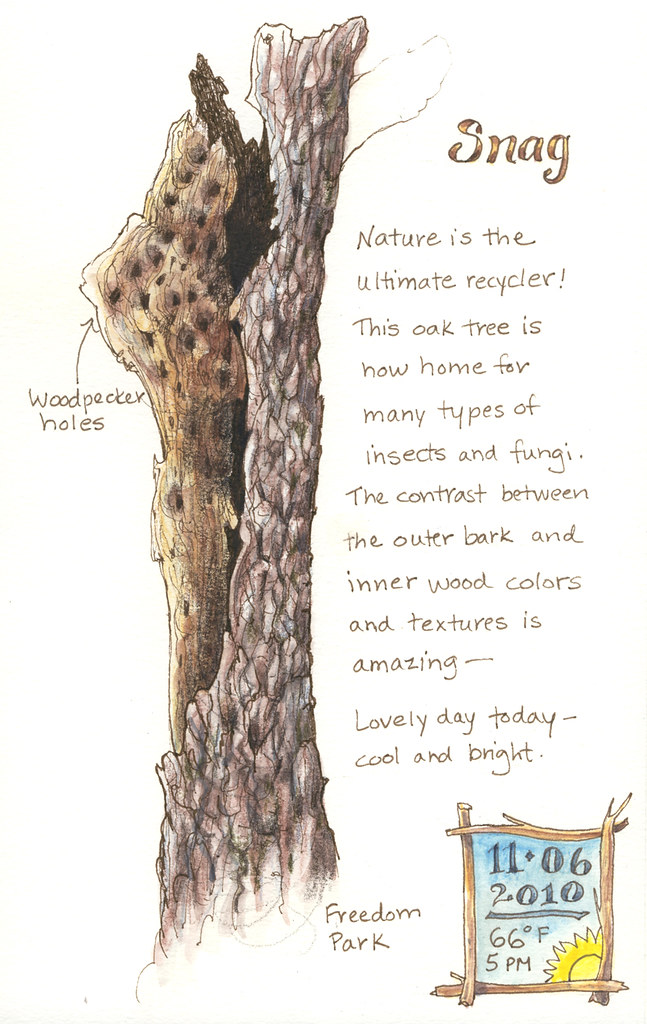
Tree snag ~ Elizabeth Smith


I confess to a fascination with dead wood, perhaps related to childhood memories of exploring woodpiles and decomposing logs. The echo of life is still there –I can imagine the seedling reaching for the sun, the unfurling of bud and leaf and inflorescence, the ripening of fruit or nut.

After death, another cycle of life begins – that of detritivores. On the microscopic level, bacteria and fungi colonize and start the breakdown process.

Invertebrates such as beetles, borers, and termites process wood nutrients or feast on fungi, and are feasted on in turn by vertebrates such as woodpeckers, anoles, and armadillos. Dead trees are used as homes by many species, including birds, bats, and squirrels.

This particular tree was an oak, probably a laurel oak. Something damaged it (lightning, a falling tree?), and the bark shows signs of regrowth round the split. The exterior bark and interior wood seemed to mirror each other, a glimpse of the past and present.

While nature may be extravagant, nothing goes to waste; all is consumed, refashioned, and repurposed – nature is the ultimate recycler.

You can click on the image to view it larger on my Flickr photostream.

~ Elizabeth Smith, Naples, Florida USA

Monday, April 12, 2010

Iris ~ Elizabeth Smith


Iris, originally uploaded by Elizabeth Smith.

Sunday – rainy and stormy – a perfect day to get out my reference photos of this native iris. I took these on Easter Sunday as we meandered through the Corkscrew Sanctuary Boardwalk. These are also blooming at Freedom Park in Naples, dotting the wet ground in subtle bursts of color.

I’m trying out my new Kimberly watercolor pencils in the Aquabee sketchbook. So far, so good!

You can click on the image above to view it larger on my Flickr photostream.

Friday, February 5, 2010

Spring Signs Chasing Away Blahs - Pam Johnson Brickell


Spring Signs Chasing Away Blahs
Originally uploaded by PJBee
Did you ever look forward to waiting? I've been doing this all week. Today (Friday) is the day I knew I'd be spending 45 minutes at the car dealer, getting my car's oil changed and all week I've been seeing spring signs that needed to be recorded :)

At last, time to journal :)

Wednesday, January 27, 2010

Cardinal - Elizabeth Smith


Cardinal, originally uploaded by Elizabeth Smith.

This was right after a rainy morning, when the sun is just coming out and the colors seem to glow with an inner intensity. A male cardinal flashed by and landed on a nearby car, trying to bully his own reflection into leaving!

You can click on the image above to view it larger on my Flickr photostream.

~Elizabeth Smith, Naples, FL, USA

Monday, January 18, 2010

Sketching at the Bergen History Museum


During a recent visit to Bergen, in Norway, I visited the Natural History Museum and had a wonderful time looking at their fascinating collection and sketching the animals. I spent some time with the marine birds, mysterious creatures capable of adapting to extreme weather conditions.
First, a male Eider duck. Eider ducks are well known for their down and its valuable insulation properties. Female ducks line their nest with this down and farmers collect the first lining; the duck will reline her nest before laying her eggs.
Then, I sketched a male long-tailed duck, which used to be called Oldsquaw in North America. Males are very vocal and produce a melodious repeated call.
Fulmars are seabirds who come ashore only for breeding. They are tube-nosed, and like all the other members of the order Procellariformes possess two tubular nostrils on top of the bill and an extraordinary sense of smell.
The Common Guillemots, or Common Murres, at the top of the page, are good flyers but far better divers. They catch their prey by pursuit diving, and use their wings underwater to propel themselves. They can reach depths of 600 feet (180 m) and remain underwater for up to two minutes.
Barbara Bacci,
Rome

Saturday, December 26, 2009

Sphinx moth - Elizabeth Smith


It was quite cold here right before Christmas (about 45 degrees Farenheit) at night. At first I thought this Sphinx moth was just lethargic from the cold; the next day I realized it was dead. I returned to collect it so that I could sketch a quick study, and was surprised to find parts missing within the space of an hour. Many little ants, beetles, and who knows what else were busy with dinner. They did leave me with a bit to draw, though.

You can click on the image above to view it on my Flickr photostream.

~ Elizabeth Smith, Naples, Florida, USA

Saturday, December 19, 2009

Dead Wood - Elizabeth Smith


Just a piece of wood...

You can click on the image to view it larger on my Flickr photostream.

~ Elizabeth Smith, Naples, Florida, USA

Thursday, December 3, 2009

Roccoli, bird-catching towers


I am training to become a bird ringer, or bird bander, as it is called in the States. One of my teachers lives in Piedmont, which lies at the feet of the Alps, and works at the only bird-catching tower existing outside Lombardy. Roccoli, or bird-hunting towers, originated in the XV century in Lombardy, and were used exclusively by hunters. Now, they are used for catching birds for scientific purposes. Here's a view of the Roccolo in November. Bird towers are an art, you have to know which trees and bushes to plant, and where. Someone is always watching from the little window you can see at the top of the three stories tower. When birds alight on the dead branches, he/she will throw a "paura" over the birds. The "paura" is simply a wicker bat, but the birds perceive it as a flying raptor and when they see it they dive down into the thicket, getting caught in the mist nets. That's when you go down and take them out, and all the fun starts.
Sketches have to be super-fast, so as not to stress the birds, so I concentrate on little details. And details are the key to recognizing species, and determining sex and age. I find ringing is a fascinating experience, that takes you deep into the heart of nature.

The mushroom is a Slippery jack, and it's very tasty breaded and fried!


Barbara Bacci, Rome

Monday, November 30, 2009

Cypress at Freedom Park - Elizabeth Smith


Cypress at Freedom Park, originally uploaded by Elizabeth Smith.

Some of you know that I've had big changes in my life, so there hasn't been much time to draw. Thankfully, I can squeeze in some odd minutes here and there - and watercolor pencil is the perfect medium for this!

This is a small swampy area in one of our new parks. I love the way the duckweed carpets the water like apple-green velvet.  A serene spot.

You can click on the image above to view it larger on my Flickr photostream.

~ Elizabeth Smith, Naples, FL USA