Showing posts with label animals. Show all posts
Friday, October 28, 2016
Natural History Illustration
I spent a day at the London Natural History Museum and managed a few quick drawings here and there. Not exactly sketching in nature, but essential to learn about the details and the anatomy of the animals. I learn a little from every single sketch I make, and it makes me that tiny bit faster when I draw animals in action.
If you love science illustration as much as I do, you can now enjoy this great mooc for free: https://www.edx.org/course/drawing-nature-science-culture-natural-newcastlex-nhi101x
Thursday, March 27, 2014
Barn Owl (Tyto alba)
Ghostly pale and (not) strictly nocturnal, Barn Owls (Tyto alba) are silent predators of the night world. Lanky, with a whitish face, chest, and belly, and buffy upperparts, this owl roosts in hidden, quiet places during the day. By night, they hunt on buoyant wingbeats in open fields and meadows. You can find them by listening for their eerie, raspy calls, quite unlike the hoots of other owls. Despite a worldwide distribution, Barn Owls are declining in parts of their range due to habitat loss. I for one do not see them as often as I used to, but a few nights ago I was thrilled to hear one screeching just before dawn.
The Owl Rescue Centre is the only raptor centre in South Africa that primarily focus on owl species. They give all their time and attention to owl species because of the high mortality rate of owls in South Africa, making owls vulnerable to a decreasing population. They rehabilitate and release 200 – 250 Spotted Eagle Owls, 100 – 150 Barn Owls and 80 -100 other owl species each year. SHOULD YOU FIND AN OWL THAT YOU SUSPECT MIGHT BE INJURED, PLEASE CALL THEM ON 082 719 5463 (24/7 emergency line – South Africa)
.
Labels:
animals,
barn owl,
bird painting,
birds,
Maree-Clarkson,
owl,
Owls,
South Africa,
tyto alba
Sunday, March 23, 2014
Amethyst Sunbird female - Maree
W&N watercolour on Bockingford 300gsm
Amethyst Sunbird female feeding on the Kniphofia (Red Hot Poker) flowers in my garden
I'm always utterly thrilled when these little beauties visit my garden. With all the rain we've had, my Red Hot Pokers have been an absolute magnet for insects and birds and when I hear these sunbirds twittering in my garden I always rush out, sketchbook or camera in hand. The male is pitch black with the most gorgeous metallic throat patch and one could easily miss his inconspicuous little wife perched on the flowers.
The Amethyst Sunbird, also called the Black Sunbird (Chalcomitra amethystine) mainly occurs in Africa south of the equator. Its natural habitat is dry savannah but it is extremely fond of gardens.
It goes out of its way to visit a large clump of nectar-bearing plants. Here in my garden, it feeds on nectar from the Aloe, Kniphofia, Halleria lucida (Tree fuchsia) and a nectar mix in one of my bird feeders. It’s diet is supplemented with insects and often hawks flying insects from the trees or bushes, also gleaning them from leaves and branches. Nectar is obtained either from flowers or from garden feeders, which it uses readily (note that in feeding experiments it was found to prefer sucrose rather than sugar).
This Sunbird is not threatened, in fact its range has increased recently due to the spread of wooded gardens.
.
Tuesday, March 4, 2014
Black-headed Oriole - Maree
W&N watercolour on Bockingford 300gsm
The Black-headed Oriole (Oriolus larvatus) is a frequent visitor to my garden (Tarlton, Gauteng, South Africa) and I’m always thrilled to hear his liquid call, upon which I rush out to refill the oranges and apples, which seem to be his favourite fruit.
The Black-headed oriole is common and widespread, occurring throughout sub-Saharan Africa, from East Africa to southern Africa. It is quite adaptable, occupying a variety of habitats, including savannah, woodland, parks, farmland and gardens. It eats a variety of invertebrates, fruit and seeds, often foraging in mixed species flocks in the tree canopy. The nest is a deep cup of woven old-man’s beard strands, moss and grass, placed between stems of a fork in a slender tree branch. It is usually placed between the stems of a fork in a horizontal branch, often far from the main tree trunk, usually 6-9 metres above ground.
Bright yellow in colour with black head and black flight feathers, it has a flesh-coloured beak and grey feet. In the Northern Hemisphere, the Golden Oriole is bright yellow with black wings.
.
Saturday, March 1, 2014
Barn owls - Maree
Ink sketch and W&N watercolour on Bockingford 300gsm
I've been so lucky this past summer in having the barn owls in our blue gum bush again and I've had plenty of sightings during the day and been thrilled by their screeching at night. I've mostly spotted this one particular pair and I was so hoping to see babies but I have no idea where the nest is.
Barn owls are most commonly monogamous, although several reports of polygamy exist. Pairs typically remain together as long as both
individuals live.
Copulation occurs every few minutes during the nest site search. Both sexes crouch down in front of each other to solicit copulation. The male mounts the female, grasps her neck, and balances with spread wings. Copulation continues with decreasing frequency throughout incubation and chick rearing.
.
Labels:
animals,
barn owl,
barn owls,
bird,
birds,
Birds of Prey,
ink sketch,
Maree-Clarkson,
owl,
Owls,
South Africa
Saturday, September 14, 2013
Listen to the Guinea fowl - Maree
Be grateful for nature. Pay the thunder no mind – listen to the Guinea fowl. And don’t hate anybody.
W&N watercolour on DalerRowney 220gsm heavy-duty sketching paper.
The Helmeted Guinea Fowl is an African family of insect and seed-eating, ground-nesting birds resembling partridges, but with featherless heads and spangled grey plumage. They are the ultimate
low-cost, chemical-free pest control and if your garden is already established and can withstand the scratching, you’ll have a healthy and pest-free garden. And be rewarded with some wonderful antics from these lovely birds.
It is interesting to note that they are monogamous, mating for life. The hens have a habit of hiding their nests, and sharing it with other hens until large numbers of eggs have accumulated. Females lay 25-30 tough-skinned, smallish, creamy eggs in a deep, tapering nest and undergo an incubation period of 26-28 days. The chicks are called “keets” and are highly susceptible to damp. In fact, they can die from following the mother through dewy grass. After their first two to six weeks of growth, they can be some of the hardiest domestic land fowl.
They are highly social birds, and hate to be alone. When you see a lone guinea fowl, it usually means trouble, like that the family has been scattered by a predator. Guineas spend most of their days foraging. They work as a team, marching chest to chest and devouring anything they startle as they move through the grass. When they discover a special treat — a rodent, for example, or a small snake — they close ranks, circle their prey, and move in for the feast. All the while, they keep up a steady stream of whistles, chirps, and clicks, a sort of running commentary on the day’s hunt.
::
Thursday, September 5, 2013
African Joy and Sorrow - Maree
"The triumph of life is the joy experienced thereafter."
- Maree
Guinea standing on the wall, forlornly calling his missing wife.
A couple of years ago, one of my guinea fowl sitting on eggs was killed by a dog, leaving 10 eggs, on the point of hatching, without a mother. I gathered all the eggs and put them in a basket with a hot water bottle, trying to keep them warm to see if any of them would hatch. Two days later still nothing, but on the third day I heard a weak peep-peep from one of the eggs. None of the others showed any sign of life, so I decided to take matters into my own hands and open the one that was peeping. I gently peeled away the shell and lifted out a perfectly formed little guinea fowl, and placed him on the warm towel, drying his little body with a soft cloth until he lifted his little head and stared me straight in the eye.
That was the beginning of a beautiful, long relationship with "Guinea", who spent five years following me everywhere and providing us with endless hours of pleasure with his surprising antics. He even lured a wild guinea fowl female from the wild (they used to pass through our property in large flocks, travelling from one field to another) and together they reared 5 clutches of beautiful little guinea fowl, all of whom stayed on our property for many years.
When Guinea's wife disappeared one day, he was inconsolable, standing on the wall and calling for hours in that haunting 'phe-twee, phe-twee, phe-twee' that is so typical of the South African bush. After that, he would often disappear for a day or two until, one day, he didn't come home at all. I hoped and presumed that he had found another family and was happily roaming the fields surrounding our property.
“This life as you live it now and have lived it, you will have to live again and again, times without number, and there will be nothing new in it, but every pain and every joy and every thought and sigh and all the unspeakably small and great in your life must return to you and everything in the same series and sequence -- and in the same way this spider and this moonlight among the trees, and this same way this moment and I myself. The eternal hour glass of existence will be turned again and again -- and you with it, you dust of dust!”
- Friedrich Nietzsche
::
Friday, August 30, 2013
What big teeth you have! - Maree
Derwent graphite pencil sketch in my Moleskine 200gsm Nature Journal
Croc Valley in Ballito (on the North Coast of KwaZulu Natal, South Africa), offers crocodile and snake feedings, bird watching and a swamp forest incorporating a nature walk across the swamp on a wooden board walk. The area is now a nature reserve where crocodiles and other reptiles used to roam freely in this area. Every time I go to the Ballito, I take a drive out to Croc Valley for a cup of tea and a hike through the swamp forest, which takes approximately three-quarters of an hour to complete.
It’s only when you’re up close and personal to these magnificent animals, that their power, strength and size is VERY apparent! Although this chap looks half asleep, the guide assured me that he was fully alert and aware of his surroundings!
This is a Nile Crocodile and they feed mostly on vertebrates like fish, reptiles, and mammals, sometimes on invertebrates like molluscs and crustaceans, depending on species. They are an ancient lineage, and are believed to have changed little since the time of the dinosaurs. They are believed to be 200 million years old whereas dinosaurs became extinct 65 million years ago; crocodiles survived great extinction events.
The swamp forest walk
The croc enclosure
::
Friday, September 28, 2012
The Playful Crow - Maree
“Even the blackest of them all, the crow,
Renders good service as your man-at-arms,
Crushing the beetle in his coat of mail,
And crying havoc on the slug and snail.- Henry Wadsworth Longfellow
Pilot Fineliner Black Ink sketch and watercolour in Moleskine 200gsm Watercolour Sketchbook
Black Crow – Corvus capensis. Found: Africa
Ample press is given to charismatic animals such as dolphins, chimps and the like, but few, when talking of intelligent beings, think to mention the crow or raven. It is, however, easy to understand the natural aversions some people have towards these birds: They’re lacking in any type of floral-like beauty; they have a cacophonous and sometimes incessant caw, and are cunning thieves to boot.
But if you look closer, and get to know these beautiful birds on a more intimate level, you will see not just see ‘plain black’ feathers, but beautiful iridescent colours of purple, blue, green and brown. And discover a great intelligence, and even a sense of humour, not normally associated with birds.
They are smart, ingenious, protective, adventurous, and full of engaging play; I recall my 27yr-old crow, Coco, watching intently as I planted my pansy seedlings, only to up-root them the minute I turned my back, cawing in laughter as she fled my mock chase!
::
Labels:
africa,
animals,
birds,
black crow,
coco,
corvus capensis,
crow,
playful
Sunday, July 8, 2012
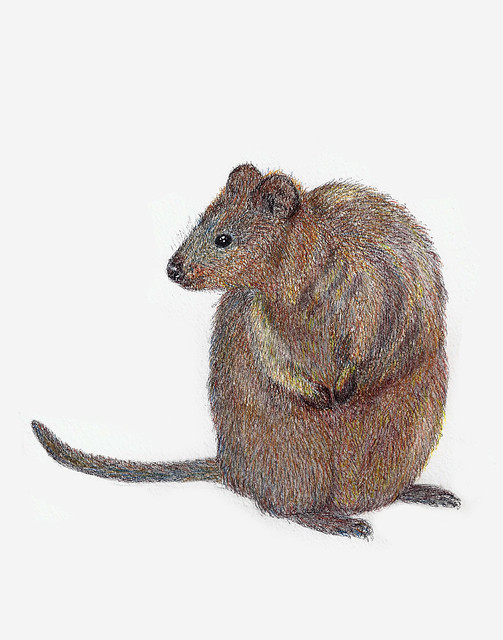
Quokka
Hello everyone!
I have recently been invited to join this wonderful blog, which I am really proud of. As this is my first post, I will say a few words about myself. My name is Anna, I am an illustrator and an artist. Originally I am from Russia but four years ago I moved to Australia, which became my home. I hope you will forgive me making mistakes, as I am not a native speaker of English.
As an artist I love to be experimental with styles and techniques. I love abstract art and cartooning as well as drawing from life and my materials range from charcoal to color pencils, from watercolors to digital painting. You can see examples of my art on my website.
One of the greatest sources of inspiration for me is animal life and marine creatures.
In my free time I volunteer at my city's zoo, and almost all holidays I spend snorkeling, diving and drawing sea dwellers.
Today I would like to present my drawing of a Quokka, small and very cute Australian marsupial. It has a baby in a pouch, that's why it is a bit lopsided.
I made a rough sketch of it in the zoo yesterday and finished it off at home.
If you are interested in my process, here are major steps of my drawing:
I have recently been invited to join this wonderful blog, which I am really proud of. As this is my first post, I will say a few words about myself. My name is Anna, I am an illustrator and an artist. Originally I am from Russia but four years ago I moved to Australia, which became my home. I hope you will forgive me making mistakes, as I am not a native speaker of English.
As an artist I love to be experimental with styles and techniques. I love abstract art and cartooning as well as drawing from life and my materials range from charcoal to color pencils, from watercolors to digital painting. You can see examples of my art on my website.
One of the greatest sources of inspiration for me is animal life and marine creatures.
In my free time I volunteer at my city's zoo, and almost all holidays I spend snorkeling, diving and drawing sea dwellers.
Today I would like to present my drawing of a Quokka, small and very cute Australian marsupial. It has a baby in a pouch, that's why it is a bit lopsided.
I made a rough sketch of it in the zoo yesterday and finished it off at home.
If you are interested in my process, here are major steps of my drawing:
Friday, May 18, 2012
Rhino horn myth - Maree
(Ink sketch and colour wash on Bockingford 300gsm - done from one of my photographs taken at one of our local Game Reserves)
All we ever read in the media is statistics of all the Rhino atrocities, and nothing as to what can actually be done to stop this. Education is and always will be the best tool.
With today’s network of communication tools, such as social media, it is now possible for scientific studies to reach a global audience like never before – and we can move closer to busting these persistent myths about rhino horn, which are indeed the root of the rhino crisis. By raising public awareness and educating others about the truth behind rhino horn, we can make a difference.
As part of continued efforts to set the record straight on rhino horn’s so-called 'curative' properties, three scientific studies were re-introduced, confirming that rhino horn has no medicinal value. The studies were conducted by different teams of researchers at separate institutions. In each case, the results were conclusive: There is no scientific evidence to support claims of rhino horn’s usefulness as a medicine.
The studies “found no evidence that rhino horn has any medicinal effect as an antipyretic and would be ineffective in reducing fever, a common usage in much of Asia.” Testing also confirmed that “rhino horn, like fingernails, is made of agglutinated hair” and “has no analgesic, anti-inflammatory, anti-spasmolytic nor diuretic properties” and “no bactericidal effect could be found against suppuration and intestinal bacteria”. And medically, "it’s the same as if you were chewing your own nails”.
When there were still at least 15,000 Black Rhinos on the African continent, WWF and the IUCN commissioned a pharmacological study of rhino horn, hoping that science would trump cultural myths. Tragically, by 1993, ten years after the study was published, Africa’s Black Rhino population had plummeted to just 2,300.
Saturday, March 3, 2012
Survival in the African Bush
“It is not the strongest of the species that survives, nor the most intelligent that survives. It is the one that is the most adaptable to change.”
- Charles Darwin
- Charles Darwin
New-born antelope calf hiding in the grass in the African Bushveld. Location Krugersdorp Game Reserve, Krugersdorp, South Africa.
The antelope is one of the many medium-sized mammals holding the African food chain together. Unlike deer that renew their horns annually, the antelope has strong permanent horns, that antelope mainly use to defend their herd or to fight other antelopes.
After mating, female antelopes give birth to a single calf or, more rarely, twins, after a gestation period that can last up to eight months. A mother and her newborn calf are vulnerable to predators, and antelopes have had to evolve different strategies for surviving this period. For most antelope species, the female gives birth in dense cover and leaves the calf while she feeds. The calf comes to its mother when she calls it, and once fed, the calf will hide away again. Once in its hiding place, the calf remains completely still, blending into the surrounding landscape becoming almost invisible. It will run away only if it is on the verge of being discovered.
Did you know that small antelope, such as Dik-diks, tend to be monogamous? They live in a forest environment with patchy resources, and a male is unable to monopolize more than one female due to this sparse distribution. Larger forest species often form very small herds of 2–4 females and 1 male.
Friday, December 30, 2011
The Chicken Run - Maree
Ginger: So laying eggs all your life and then getting plucked, stuffed and roasted is good enough for you, is it?
Babs: It's a livin'.
- Extract from the movie "The Chicken Run"
Two of my hens taking refuge on top of the fence surrounding my wildlife pond, trying to get away from the onslaught of The Roosters. I had far too many roosters, seven (for 8 hens) but was lucky enough to find a good home for five of them.
Thursday, December 15, 2011
Pippin, the Bushbaby - Maree
“Very little of the great cruelty shown by men can really be attributed to cruel instinct. Most of it comes from thoughtlessness or inherited habit."
- Albert Schweitzer
Galagos, also known as bushbabies, bush babies or nagapies (meaning "little night monkeys" in Afrikaans), are small, nocturnal primates native to continental Africa and
are almost exclusively seen only at night.
This is Pippin, whom I was lucky enough to have in my life for a few weeks after I rescued him from children who were stoning him, as a result of which he lost the use of his left eye. After nursing him back to health, he spent a couple of weeks living in my indoor garden in my lounge, often bounding onto my shoulder for a snack. When I was satisfied that he had fully recovered, I released him in the thickets on the banks of the Magalies River, which was in the vicinity where I had found him. I just hoped and prayed that he had learnt a lesson about people and would stay out of reach of the children ...
I did this sketch from a photograph I took of him, as he NEVER sits still long enough to be able to sketch him!
- Albert Schweitzer
W&N watercolour in my Moleskine 200gsm Folio (A4) Nature Journal
Galagos, also known as bushbabies, bush babies or nagapies (meaning "little night monkeys" in Afrikaans), are small, nocturnal primates native to continental Africa and
are almost exclusively seen only at night.
This is Pippin, whom I was lucky enough to have in my life for a few weeks after I rescued him from children who were stoning him, as a result of which he lost the use of his left eye. After nursing him back to health, he spent a couple of weeks living in my indoor garden in my lounge, often bounding onto my shoulder for a snack. When I was satisfied that he had fully recovered, I released him in the thickets on the banks of the Magalies River, which was in the vicinity where I had found him. I just hoped and prayed that he had learnt a lesson about people and would stay out of reach of the children ...
I did this sketch from a photograph I took of him, as he NEVER sits still long enough to be able to sketch him!
Wednesday, November 2, 2011
Rhinos at Kromdraai - Maree
The only way to save a rhinoceros is to save the environment in which it lives, because there's a mutual dependency between it and millions of other species of both animals and plants.
- David Attenborough
Sketch in my Moleskine A4 Folio sketch-book
When
taking my grand-children to Lanseria Airport, we pass by a game farm just a
couple of kilometers from where I live (Gauteng, South Africa), and these two
Rhino were grazing right by the fence, so I stopped and did a quick sketch.
They didn't seem bothered by me at all, I was just on the other side of a
rather rickety looking game fence, which I'm sure they could demolish with a
step or two, should they so wish! And I was thrilled to see that they still
have their horns, so many are being removed to thwart poachers in a
conservation effort of these magnificent animals.
Sometimes
we're lucky enough to see the Lions close-by the fence, but I've never left my
car to try and sketch them!
Sunday, October 16, 2011
Canadian wolf

This is a new exhibit at the Natural History Museum. The species is gray wolf, Canis lupus, but I don't know which of the four existing subspecies present in Canada it belongs to. Does anyone? Id' love to know.
The color of wolves' fur varies from white, white and tan, to reddish, gray or brown mixed with black. But does the fur's color serve a camouflage purpose? I found this interesting article on the subject and would like to share it with you: http://www.world-science.net/othernews/090206_wolf.htm
Thursday, June 16, 2011
Kite sketch - Maree
Eagles may soar, but weasels don't get sucked into jet engines!
- John Benfield
Sketching has always been one of my great passions, but of late I've been neglecting it in favour of doing mostly watercolours. I've decided to go back to basics and sketch a lot more. Sketching forces you to look in more detail, and ask yourself what you actually see. You’ll end up seeing a lot more than you would otherwise. There’s something about holding a pen or pencil in your hand that gets your creative juices flowing in a much different way than holding a brush. When you get used to sketching, the movements of your hand become much more fluid and it becomes really easy and natural. The more you practice, the better you will become at sketching.
A Charcoal sketch of a Black-shouldered Kite (Elanus caeruleus), a common, grey and white raptor in South Africa with a black shoulder, done in my Moleskine large sketch-book.These beautiful little birds (they're not much bigger than a pigeon) often sit on the telephone lines outside our property and to watch them hovering over a field when they've seen some dinner is one of my greatest pleasures.
- John Benfield
Sketching has always been one of my great passions, but of late I've been neglecting it in favour of doing mostly watercolours. I've decided to go back to basics and sketch a lot more. Sketching forces you to look in more detail, and ask yourself what you actually see. You’ll end up seeing a lot more than you would otherwise. There’s something about holding a pen or pencil in your hand that gets your creative juices flowing in a much different way than holding a brush. When you get used to sketching, the movements of your hand become much more fluid and it becomes really easy and natural. The more you practice, the better you will become at sketching.
A Charcoal sketch of a Black-shouldered Kite (Elanus caeruleus), a common, grey and white raptor in South Africa with a black shoulder, done in my Moleskine large sketch-book.These beautiful little birds (they're not much bigger than a pigeon) often sit on the telephone lines outside our property and to watch them hovering over a field when they've seen some dinner is one of my greatest pleasures.
Wednesday, April 20, 2011
Wednesday, March 2, 2011
Hippos

There are only two species of hippopotamuses: the common hippo, and a smaller one, the pigmy hippo. I might never see them in the wild, but the zoo of Rome houses both species and sometimes I visit them there. I love watching them in the water, especially the common hippos. They are so graceful, so fast and agile in this medium, it is really not surprising they share the same common ancestor as whales. I've sketched them more or less to scale with some Copic Multiliner sepia pens. I'm really enjoying these pens, they have a nice smooth feel.
Friday, October 29, 2010
Solly's hen and rooster - Maree
All around the barnyard
The animals are fast asleep.
Sleeping cows and horses,
Sleeping pigs and sheep.
Here comes the cocky rooster
To sound his daily alarm.
"Cock-a-doodle-doo!
Wake up sleepy farm!"
- Unknown

This is one of Solly's roosters again, with the mother of the previous little chicks I posted. I did the sketch of her some time ago, and just now decided to add her rooster in watercolour - he was good enough to stroll past a couple of weeks ago, and I managed to get a quick (partial!) sketch of him before he disappeared around the corner! the rest of him was left up to my imagination.
The animals are fast asleep.
Sleeping cows and horses,
Sleeping pigs and sheep.
Here comes the cocky rooster
To sound his daily alarm.
"Cock-a-doodle-doo!
Wake up sleepy farm!"
- Unknown

This is one of Solly's roosters again, with the mother of the previous little chicks I posted. I did the sketch of her some time ago, and just now decided to add her rooster in watercolour - he was good enough to stroll past a couple of weeks ago, and I managed to get a quick (partial!) sketch of him before he disappeared around the corner! the rest of him was left up to my imagination.
Subscribe to:
Posts (Atom)