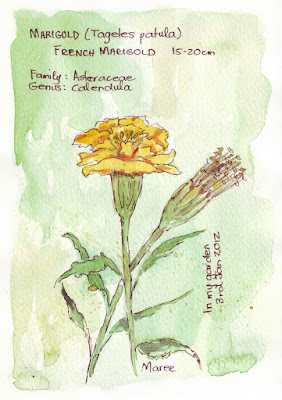
My Marigolds (I have the French Marigold (Tagetes patula) have grown in utter profusion this season. Some I planted in one corner, the rest sprung up from last year's seeds.
Annual Marigolds can be used anywhere to deter beetles and many harmful insects. They are also known to repel harmful root knot nematodes (soil dwelling microscopic white worms) that attack tomatoes, potatoes, roses, and strawberries. The root of the Marigold produces a chemical that kills nematodes as they enter the soil. If a whole area is infested, at the end of the season, turn the Marigolds under so the roots will decay in the soil. You can safely plant there again the following spring. The flowers are hermaphrodite (having both male and female organs) and are pollinated by insects. They are noted for attracting wildlife and the wild hares visiting my garden often eat them. And for some reason, the rats like biting off the flower heads and spreading the petals and seeds all over the ground! The leaves of the marigold are coated with oily glands that produce a pungent scent.
Did You Know? Marigolds, which are from the Aster family and the Calendula genus, were first discovered by the Portuguese in Central America in the 16th century.
Some interesting info :
In addition to colouring foods, yellow dye from the flowers is also used to colour textiles. The whole plant is harvested when in flower and distilled for its essential oil. The oil is used in perfumery; it is blended with sandalwood oil to produce 'attar genda' perfume. About 35 kilograms of oil can be extracted from 1 hectare of the plant (yielding 2,500 kg of flowers and 25,000 kg of herbage). The oil is also being investigated for antifungal activity, including treatment of candidiasis and treating fungal infections in plants
This info from "Wikipedia":http://en.wikipedia.org/wiki/French_marigold


