Showing posts with label Vickie Henderson. Show all posts

Monday, October 12, 2020

Rose-breasted Grosbeaks in October--Vickie Henderson

Rose-breasted Grosbeaks are striking birds, especially the males with their black and white markings mixed with a splash of rose on their breasts.  They visit Tennessee mostly during migration in both spring and fall. The exciting thing about fall is the juveniles are still changing their "paint".  

Like birdy watercolors, each one is unique as their feathers morph from juvenile brown to the brightly colored markings of an adult.  Not a single two of them are alike!  The sketch above was created after observing my feeders for about an hour on my porch.  In the rain!  Full of fun surprises, including a shy juvenile grosbeak.  Being still in nature observing brings so much wonder and inspiration. Naturally that makes me want to sketch and paint!

Visit my blog post:  Rose-breasted Grosbeaks, Red-breasted Nuthatches and a Hairy Woodpecker at Vickie Henderson Art.  

Sunday, August 2, 2020

Revisiting Alaska with Sketches--Vickie Henderson

I recently revisited my photos of Alaska, from a visit in 2012, in particular, my images of the Denali Park grizzly bears.  What a delightful journey back in time.  Looking through the images brought back almost as much awe as I remember feeling when I first viewed it in person.
This was my first sketch, a bear pausing as it foraged for autumn berries.  Autumn in the park was well underway in the tundra the last week of August.  Brought back exciting memories as this was my first experience in the tundra and watching these incredible bears!
Visit my blog post at Vickie's Sketchbook to learn more about this sketching experience.

Thursday, October 6, 2016

Painting at Elkmont in the Smokies

Just across the road from the Elkmont campground in the Great Smoky Mountains National Park you can explore what is often called the "ghost town" of the Smokies--cabin remnants of a vacation community that was built in the early 1900's.
What drew wealthy Knoxvillians to this area for a summer retreat is the very same thing that motivated me and two friends to gather our paint supplies and head for the mountains for a day of painting.  
In the fresh autumn air surrounded by so much visual stimulation, I felt no tension, no pressure, nothing more than the excitement of being there.  That feeling was refreshing, one I would like to recapture whenever and where ever I paint!
Above you see an image of the scene that captured my interest.  I was especially drawn to the play of light and shadows.  Below, is my unfinished sketch.
To see all of our sketches and a glimpse of the historic and natural scenes around us visit:  Elkmont En Plein Air at Vickie's Sketchbook

Wednesday, September 2, 2015

Hummingbird Migration--Vickie Henderson

This is the best time of year to watch hummingbirds!  Migration is in full swing in Tennessee with males migrating from the north and the first nesting juveniles out of the nest making feeder activity in backyards and natural areas very busy.
Juvenile hummingbirds look just like the females before the young males develop their red gorget feathers.  But if you spend time watching, you can identify some of the juveniles by behavior.  
Tentative and slower in flight initially, juveniles investigate everything, including you and every colorful flower.  In only a few days, they show the aggressive temperament that hummingbirds are so noted for.  The chasing and conflict we see in our gardens is practice for survival on wintering grounds in Central America where they will compete for nectar and insects with other hummingbird species. 

Visit Vickie Henderson Art for a fun look at Knoxville's Wonder of Hummingbirds Festival and see how hummingbirds are banded.  At Vickie's Sketchbook find more information about hummingbirds and the above sketches.   

Tuesday, March 3, 2015

Bluebirds and Ice

Eastern Bluebirds in Tennessee do not migrate, but stay with us throughout the winter. They are joined by other bluebirds from neighboring states to form small winter flocks to aid survival.
Finding food became more difficult two weeks ago, when freezing rain coated everything with 1/4 inch of ice and temperatures plunged to single digits for several days.  Though incredibly beautiful, the ice and severe cold created harsh conditions that can use up a bird's fat reserves very rapidly.
Seeing bluebirds plucking tiny ice-coated berries from the burning bush offered some reassurance that they were finding some nutrition.  I instantly wanted to paint this scene, drawn by its delicate beauty and the story of survival it represents.
For more about these sketches and the bluebirds that inspired them visit:
Winter Watercolor--Bluebirds on Ice at Vickie's Sketchbook.
For more about feeding wintering bluebirds visit:  Ice and Bluebirds--a Special Matter at Vickie Henderson Art.  

Monday, January 26, 2015

Winter Sketching

Winter is a great time to watch birds and see species that we don't otherwise get to see. I've had several irruptive species at my feeders lately. Pine Siskins and Purple Finches are known as irruptive species because they only periodically migrate south when the food they need is unavailable in northern climates.  
We had a dusting of snow last Friday with temperatures 34 F degrees.  There is something welcoming about snow that pulls me outside to watch birds when the temperature is tolerable.  They seem to be less shy and come closer.  
While I was trying to sketch Pine Siskins, I heard chipping under the hemlock and turned my binoculars in that direction.  This beautiful Hermit Thrush was cocking his tail and wing twittering while chipping in the shadows.

For more about this sketching experience visit Winter Sketching at Vickie's Sketchbook.

Sunday, January 18, 2015

Polar Bears on the Hudson Bay

When to Use Your Camera:
When there's no time to sketch.  
When the subject is moving so fast that you need to freeze the action  
For intricate features, lighting or details
                      abrieviated from David Rankin's book, Fast Sketching Techniques

In David's book, he includes a few more reasons but I think the above are the ones I relate to the most.  I would add, "when you want to see more than your eye or your binoculars can reveal".
To my naked eye, and even through my binoculars, this beautiful female Polar Bear appeared to be simply walking, wandering through the tundra vegetation sniffing.  To my surprise, when I viewed an image taken with my 400 mm lens and zoomed in to take an even closer look, she was actually pulling and chewing grass. This has become one of my favorite memories for its serenity in contrast to her primary lifestyle of hunting seals on sea ice.
Polar Bears live in a harsh environment.  Females fast during the summer and fall months while they are denning and nursing their cubs.  They live on the layer of blubber that they have stored beneath their dark skin.  The blubber both insulates them from the cold and provides nutrition during months when there is no sea ice.  It also provides the fat-rich milk that nourishes their cubs.
Polar Bears are marine mammals and carnivores, at home in the water as much as on land. They rely heavily on the sea ice ecosystem that nourishes ringed seals which, in turn, provide the nutrition and blubber that Polar Bears require to survive.  Sea ice is vital to bear hunting, resting, warmth and breeding.

For more sketches and information visit Polar Bears on the Hudson Bay at Vickie's Sketchbook.
To learn about my journey to Churchill, visit Journey to Churchill at Vickie Henderson Art.

Sunday, December 21, 2014

Spruce Grouse in Riding Mountain National Park

Spruce Grouse are well camouflaged with disruptive plumage that tricks the eye and causes the bird to disappear when standing still.  The combination of these two characteristics, the broken lines in plumage color and their instinctive freeze response, helps protect this species from predators.
I sketched this male Spruce Grouse from a photo after returning from Manitoba, Canada, adding the rose hips that they were feeding on while I observed.  I was surprised we encountered six, and even more surprised that they settled back into foraging while we were still present!

To see the progression of this sketch, visit:  Spruce Grouse Sketch at Vickie's Sketchbook blog.
To see images of the Spruce Grouse, visit:  Spruce Grouse in Riding Mountain National Park  at Vickie Henderson Art.

Wishing everyone Happy Holidays and some relaxing time for sketching in nature!
Vickie Henderson

Sunday, November 30, 2014

Gray Jays in Manitoba, Canada

Every time I meet a new member of the Corvidae Family I am smitten.  Jays, as a group, are smart resourceful and delightful when you have an opportunity to watch their behavior.  The Gray Jay is even more amazing because of where it lives--in the boreal and subalpine coniferous forests of North America.  It is a year round resident in these unforgiving extreme winter environments!
Several adapative qualities have helped this jay thrive in this environment, including its thick, fluffy plumage and its hoarding behavior.  Gray Jays begin cacheing food--berries, arthropods and mushrooms--in late summer and continue as winter arrives.  They coat the food with copious amounts of sticky saliva and hide it under bark or lichen and in the crevices of trees, sometimes covering it with another piece of bark or lichen.  This food helps sustain the birds through the winter and into their breeding season which begins before winter ends!

For more information, visit my blog post at Vickie Henderson Art:  Gray Jays:  Bold, Smart, Resourceful!

Wednesday, December 25, 2013

Carolina Chickadee in Snowy Holly

In addition to spending time with family and friends, the traditions that bring joy and inspiration to my winter days include making home-made suet for my feathered friends and painting birds in watercolor!
The Carolina Chickadee has a distinctive "chick-a-dee-dee-dee" call as it visits the suet and sunflower seed feeders with mixed flocks of titmice and Downy Woodpeckers.  They are year-round residents wherever they occur.  Tough little birds that survive through the harshest days of winter, they fluff their feathers with thousands of tiny muscles to trap air between feathers and provide insulation from the cold.  Some chickadee species also sleep in sheltered natural cavities and use regulated hypothermia to lower their body temperature and conserve energy.

Visit my blog post on Carolina Chickadee in Snowy Holly at Vickie's Sketchbook.
Click this link to learn more about the spritely Carolina Chickadee  from Cornell.

Sunday, November 10, 2013

Autumn Leaves in Layers

This year our leaves in Tennessee seemed to take forever to turn to autumn colors, but when they did they were brilliant.  Then it seemed cold quickly moved in and the leaves began floating to the ground creating colorful layers.
Creating layers of fallen leaves with watercolor is a fun way to prolong the season.  Go for a walk, gather some colorful leaves and enjoy layering them in watercolor!

For more details on layering, visit my blog post:  Fun with Fall Leaves--Creating Layers

Saturday, November 2, 2013

Autumn Sassafras Leaves

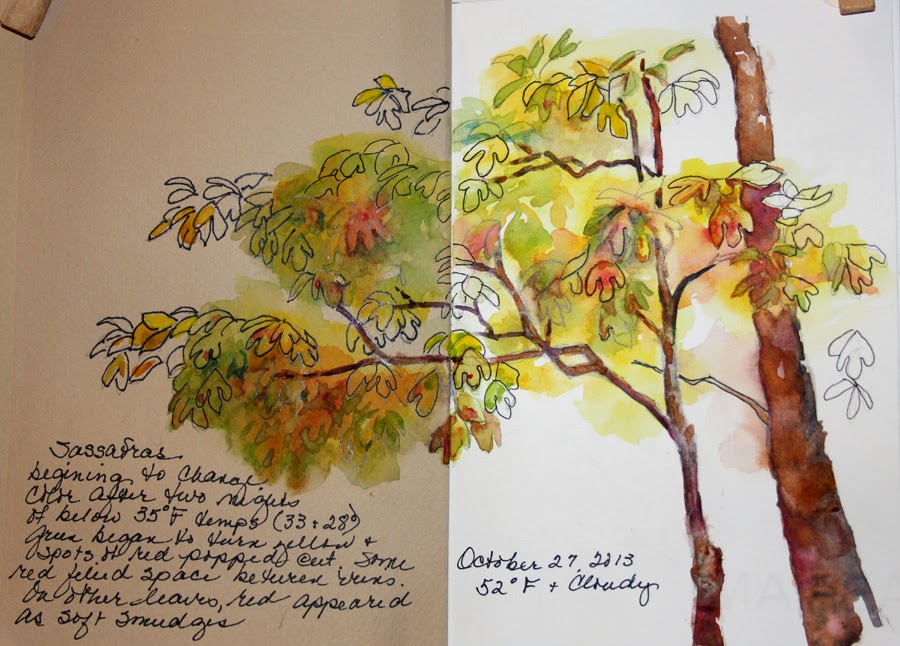
It has been fascinating to watch the gradual change of the leaves on the sassafras sapling that sits near my feeders and the bird bath.
Above is a sketch of the sapling created half on the tan book facing, half on smooth hot press watercolor paper in my sketchbook.

The leaves turned yellow after a couple of freezing nights and then revealed spots of red. On some leaves, red completely filled the space between veins, and on others, the red appeared as random smudges with no particular boundary. Observing the overnight changes was magical.
 
I also realized, I only noticed these details because I was watching for color so I could paint them!  We certainly take in our world differently when we see it through our artist eyes!

Visit my blog post on enjoying movement and surprise in watercolor in my "Fun with Fall Leaves" series at Vickie's Sketchbook.
To learn more about the how and why of autumn color visit:  Why Leaves Change Color 

Saturday, October 26, 2013

Having Fun with Fall Leaves!

There is nothing like the palette that autumn brings to our senses, as leaves turn from shades of green to a wide array of yellows, gold, orange and red.  This spectacular display is due to the interplay of three pigments found in leaves:  chlorophyll (green), carotenoids (yellow-orange) and anthocyanin (red).  
As temperatures drop, trees stop producing chlorophyll, enabling the other color pigments to shine through. Going for a walk this time of year gives your eyes new colors to feast on every day. 
I brought these leaves inside out of the chill to enjoy painting them.  All this color means the chlorophyll in the leaves has been broken down into nitrogen, sugars and starches and moved to storage cells in the twigs in preparation for winter.  Isn't that facinating?  

Visit my blog series Fun with Fall Leaves and enjoy reading about the amazing science behind autumn beauty at this link: Why Leaves Change Color

Thursday, October 3, 2013

Common Yellowthroat

This beautiful yellow warbler was introduced to me at the banding table at Seven Islands Wildlife Refuge, in Knoxville, Tennessee.  You can see one of my sketches of this bird in an earlier post on this blog.
Banding is a scientific study, an effort to record the occurence of birds during a variety of seasons to aid in assessing the health and numbers of a bird population and to learn about bird use of a given habitat. For me, it also represents the opportunity to study a bird species for future art projects.  The common yellowthroat is a busy warbler species that favors shrubby grassland.  
I have enjoyed getting acquainted with this bird's beauty and spunky personality upclose while helping to record data during banding sessions.  The painting you see above was used as a commemorative print to celebrate the refuge's change to Tennessee's first state birding park!  It was a thrill to bring my refuge observations into this painting for the event!

The common yellowthroat spends much of its time foraging for small insects in the dense vegetation of fields. It's beautiful song, "witchety, witchety, witchety", will always bring to mind summer sunrise on the refuge! Listen to the common yellowthroat song at Cornell's site.

To see the progression of this painting visit:  Common Yellowthroat Painting
To see how I used my sketchbook to help make decisions for the painting visit:  Using your sketchbook to jump-start your painting, and to see more about the celebration event visit:  Seven Islands Becomes First State Birding Park.

Thursday, August 29, 2013

Fun with Hummingbirds!

My favorite morning activity this time of year is to take my cup of coffee out on the patio and watch the hummingbird activity.  I added new flowers to my hummingbird garden in the spring and the rewards are plentiful!  More hummingbirds nectaring flowers to photograph and paint!
Above you see one of my most recent hummingbird sketches--a hummer nectaring monarda.  In Knoxville, TN, USA, my bird club hosted its hummingbird festival last Saturday  For the event, I combined this image with "hummer with black and blue salvia", and my "male hummingbird study" into a boxed set of note cards. It is a treat to see my images displayed on art items and talk about art with people who walk up to admire them! At the same time, I get to promote a bird I love--hummingbirds!
Above, a juvenile ruby-throated hummingbird visits black and blue salvia.

For more hummingbird images, visit:  Vickie's Sketchbook.  And for a glimpse of the fun we had at the festival visit:  The Wonder of Hummingbirds Festival.  I enjoyed seeing my hummingbird art as the logo art for this festival!

Monday, August 12, 2013

Hummingbird and Black and Blue Salvia

This is one of my favorite times during the summer months. The first brood juvenile hummingbirds are out of the nest and the hummingbirds at my feeders have increased more than three times.
I planted a hummingbird garden earlier in the summer looking forward to this occasion. It hasn't been easy to maintain. I've also had plenty of other wildlife--voles, chipmunks and moles! They've up-end plants and tunneled beneath them taking away the earth from the roots. As a result, many had to be transferred to containers! The hummingbirds don't care and there are plenty of blooms, so I guess that makes us all happy. 

Visit the Hummingbird Days of Summer at Vickie's Sketchbook to learn more about how we are celebrating hummingbirds in Tennessee.  Also visit Hummingbirds and Pollination to see the relationship between hummers and pollen in action!  

Sunday, June 30, 2013

Peregrine Falcon

The Peregrine Falcon is not an easy bird to observe.  Most of the time in Tennessee we see them migrating through or, occasionally, wintering over on a building where they hunt for pigeons.
The watercolor, "Peregrine Falcon" (below), appears in my article "The Peregrine Falcon in Tennessee" in the July/August issue of the Tennessee Conservationist Magazine published by the TN Dept of Environment and Conservation.  The sketches above in my sketchbook gave me practice in getting my mind wrapped around the shape and expression of this incredible species.  

I had the good fortune to encounter a falconer giving an educational program with his Peregrine while I attended a Sandhill Crane Festival in Fairbanks, AK, last summer.  While my mind was on vacation, and the article forgotten, I found myself attracted to this bird and took photos while I observed his attitude and behavior.  These photos turned out to be great help in refreshing my memory while creating the painting!
The Peregrine Falcon was one of the first species to be added to the Endangered Species List in 1973 with only 324 breeding pairs confirmed in all of North America, a decline attributed to the widespread use of DDT after WWII.  After many years of restorative efforts, the Peregrine was removed from the List in 1999 and in 2012, USFWS reported that between 2000-3000 breeding pairs of Peregrine Falcons were confirmed in the United States, Canada, and Mexico.

Links and resources:
Peregrine Falcon article in TN Conservationist Magazine
More details on the progress of the painting
Cornell with more information on the Peregrine Falcon

Tuesday, February 19, 2013

Yellow-rumped Warblers

Winter is a special time for watching birds.  For one thing, bare limbs make birds easy to see.  And for the second, you often get to see birds that you don't have during the warm breeding season.  In Tennessee, Yellow-rumped Warblers are one of those birds.
They breed in northern states and Canada, so we only get to see them while they're migrating or if you're lucky, when they chose your yard for their wintering grounds.  I have been so lucky this year.  Above you see a sketch I made of one of these warblers frequently seen hopping around under the feeders, and for the first time, I saw one sitting on my sunflower feeder picking up seeds.

More normally seen flittering around in evergreens eating insects and grubs, its always a surprise to find one sitting still enough to capture a photo.  But this winter season, I've been fortunate to see them frequently and engaged in a number of foraging activities.
They are what I call "my favorite bird of the week".  It is impossible to watch their busy personalities without wanting to capture that distinctive attitude in a sketch. While perched on the seed feeder, this warbler gave sharp warning chirps to the other birds and chased away even the tufted titmice that happened to land on the feeder.
Above, after feeding on the ground and in the flower pots for a while, this warbler seemed to respond to the warmth of the sun and began to maneuver all around the trunk and limbs of the hemlock appearing to be finding insects or grubs.

To see more images of the yellow-rumped warblers visiting this winter click here.
To see their beautiful breeding plumage visit Cornell All About Birds:  Yellow-rumped warbler

And to see what's been keeping me busy and away from blogging in the past few months, visit the new expanded version of the Discovery Birds Activity Book--36 pages and 75 illustrations!

Thursday, October 18, 2012

Grizzly Bear at Denali National Park, Alaska

Grizzly bears were one of my 'must see' wildlife species on my recent visit to Denali National Park and Preserve, Alaska.  What surprised me--the beauty of their blonde shaggy hair in contrast to the darker, thicker layers of fur underneath.  
A species that we most hear about as a fierce predator, the grizzly bear is actually an omnivore, eating a great deal of berries, leaves and roots to supplement its diet and fatten up for the winter months of hibernation.  I sampled a couple of their favorites while hiking, blueberries and crow berries.  
The tundra was in its prime fall colors, beautiful reds, gold, yellow and orange, a vastly different experience of the autumn season and equally beautiful to the changing of trees.  I visited Denali during the first week of September.  All I had heard about the brevity of fall in Denali was true.  In a matter of six days, the park's landscape changed from vibrant colors to a four-inch blanket of snow.  There was no doubt that the fall is a rapidly changing season in this northern climate.  

To see this bear having a good scratch visit my blog post:  Good Scratch!  Click this link to view all my posts on Denali National Park and Preserve.

Links and resources:
Denali National Park and Preserve
Grizzly Bear
Bear behavior
Bear Safety

Thursday, August 2, 2012

Keeping Wildlife in Your Heart...

Seeing your sketch or painting turn into an exhibit panel to help educate children and adults about taking care of wildlife is a magical experience!
You have to use a lot of imagination to envision two separate paintings of disproportional size becoming united into one large image.  That's the fun of working with two additional artists, one that conceives the exhibit panel idea, the other who transforms that vision into the final result.  What a delight for me as an artist!
This has been my recent experience in a joint project with a local nature center.  I created "muddy water" with bubbles (below) on a 22 x 30 sheet of watercolor paper and a more detailed rendition of a red-eared slider (above) for an exhibit panel designed to help educate children and adults about respecting wildlife and the need to keep the wild in their habitat--to hold them in your heart and not take them home.
For example, did you know that wild animals rarely survive when returned to the wild?  We have native red-eared sliders in Tennessee and it is illegal to possess a native wild species in our state.  Why?  Because the removal of a wild animal not only threatens the species but disrupts the delicate ecosystem.  Additionally, non-native red-eared sliders released in Tennessee do not know how to survive in a strange environment and can spread disease to native species.  These and other important facts are the messages displayed in the new exhibit panel at Ijams Nature Center in Knoxville, TN.
Another one of the joys of sketching nature--being able to give something back!

To see more about this exhibit panel and how it was made visit:  Keeping the Wild in Your Heart at Vickie's Sketchbook

Links and resources:
Video about buying wild turtles
Ijams Nature Center
Red-eared sliders