Showing posts with label Tennessee. Show all posts

Thursday, October 6, 2016

Painting at Elkmont in the Smokies

Just across the road from the Elkmont campground in the Great Smoky Mountains National Park you can explore what is often called the "ghost town" of the Smokies--cabin remnants of a vacation community that was built in the early 1900's.
What drew wealthy Knoxvillians to this area for a summer retreat is the very same thing that motivated me and two friends to gather our paint supplies and head for the mountains for a day of painting.  
In the fresh autumn air surrounded by so much visual stimulation, I felt no tension, no pressure, nothing more than the excitement of being there.  That feeling was refreshing, one I would like to recapture whenever and where ever I paint!
Above you see an image of the scene that captured my interest.  I was especially drawn to the play of light and shadows.  Below, is my unfinished sketch.
To see all of our sketches and a glimpse of the historic and natural scenes around us visit:  Elkmont En Plein Air at Vickie's Sketchbook

Wednesday, September 2, 2015

Hummingbird Migration--Vickie Henderson

This is the best time of year to watch hummingbirds!  Migration is in full swing in Tennessee with males migrating from the north and the first nesting juveniles out of the nest making feeder activity in backyards and natural areas very busy.
Juvenile hummingbirds look just like the females before the young males develop their red gorget feathers.  But if you spend time watching, you can identify some of the juveniles by behavior.  
Tentative and slower in flight initially, juveniles investigate everything, including you and every colorful flower.  In only a few days, they show the aggressive temperament that hummingbirds are so noted for.  The chasing and conflict we see in our gardens is practice for survival on wintering grounds in Central America where they will compete for nectar and insects with other hummingbird species. 

Visit Vickie Henderson Art for a fun look at Knoxville's Wonder of Hummingbirds Festival and see how hummingbirds are banded.  At Vickie's Sketchbook find more information about hummingbirds and the above sketches.   

Tuesday, March 3, 2015

Bluebirds and Ice

Eastern Bluebirds in Tennessee do not migrate, but stay with us throughout the winter. They are joined by other bluebirds from neighboring states to form small winter flocks to aid survival.
Finding food became more difficult two weeks ago, when freezing rain coated everything with 1/4 inch of ice and temperatures plunged to single digits for several days.  Though incredibly beautiful, the ice and severe cold created harsh conditions that can use up a bird's fat reserves very rapidly.
Seeing bluebirds plucking tiny ice-coated berries from the burning bush offered some reassurance that they were finding some nutrition.  I instantly wanted to paint this scene, drawn by its delicate beauty and the story of survival it represents.
For more about these sketches and the bluebirds that inspired them visit:
Winter Watercolor--Bluebirds on Ice at Vickie's Sketchbook.
For more about feeding wintering bluebirds visit:  Ice and Bluebirds--a Special Matter at Vickie Henderson Art.  

Monday, January 26, 2015

Winter Sketching

Winter is a great time to watch birds and see species that we don't otherwise get to see. I've had several irruptive species at my feeders lately. Pine Siskins and Purple Finches are known as irruptive species because they only periodically migrate south when the food they need is unavailable in northern climates.  
We had a dusting of snow last Friday with temperatures 34 F degrees.  There is something welcoming about snow that pulls me outside to watch birds when the temperature is tolerable.  They seem to be less shy and come closer.  
While I was trying to sketch Pine Siskins, I heard chipping under the hemlock and turned my binoculars in that direction.  This beautiful Hermit Thrush was cocking his tail and wing twittering while chipping in the shadows.

For more about this sketching experience visit Winter Sketching at Vickie's Sketchbook.

Wednesday, December 25, 2013

Carolina Chickadee in Snowy Holly

In addition to spending time with family and friends, the traditions that bring joy and inspiration to my winter days include making home-made suet for my feathered friends and painting birds in watercolor!
The Carolina Chickadee has a distinctive "chick-a-dee-dee-dee" call as it visits the suet and sunflower seed feeders with mixed flocks of titmice and Downy Woodpeckers.  They are year-round residents wherever they occur.  Tough little birds that survive through the harshest days of winter, they fluff their feathers with thousands of tiny muscles to trap air between feathers and provide insulation from the cold.  Some chickadee species also sleep in sheltered natural cavities and use regulated hypothermia to lower their body temperature and conserve energy.

Visit my blog post on Carolina Chickadee in Snowy Holly at Vickie's Sketchbook.
Click this link to learn more about the spritely Carolina Chickadee  from Cornell.

Sunday, November 10, 2013

Autumn Leaves in Layers

This year our leaves in Tennessee seemed to take forever to turn to autumn colors, but when they did they were brilliant.  Then it seemed cold quickly moved in and the leaves began floating to the ground creating colorful layers.
Creating layers of fallen leaves with watercolor is a fun way to prolong the season.  Go for a walk, gather some colorful leaves and enjoy layering them in watercolor!

For more details on layering, visit my blog post:  Fun with Fall Leaves--Creating Layers

Saturday, November 2, 2013

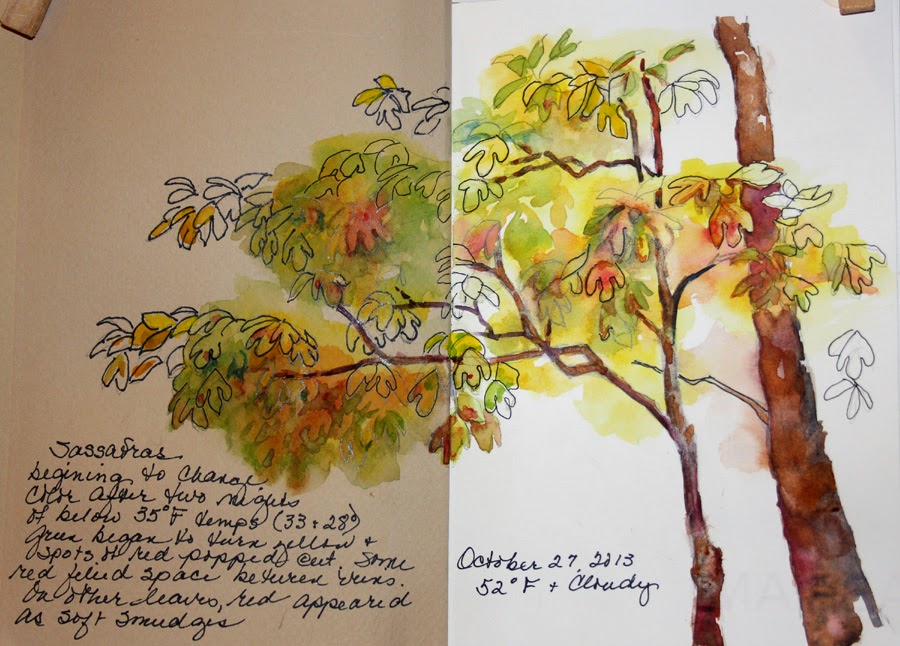
Autumn Sassafras Leaves

It has been fascinating to watch the gradual change of the leaves on the sassafras sapling that sits near my feeders and the bird bath.
Above is a sketch of the sapling created half on the tan book facing, half on smooth hot press watercolor paper in my sketchbook.

The leaves turned yellow after a couple of freezing nights and then revealed spots of red. On some leaves, red completely filled the space between veins, and on others, the red appeared as random smudges with no particular boundary. Observing the overnight changes was magical.
 
I also realized, I only noticed these details because I was watching for color so I could paint them!  We certainly take in our world differently when we see it through our artist eyes!

Visit my blog post on enjoying movement and surprise in watercolor in my "Fun with Fall Leaves" series at Vickie's Sketchbook.
To learn more about the how and why of autumn color visit:  Why Leaves Change Color 

Saturday, October 26, 2013

Having Fun with Fall Leaves!

There is nothing like the palette that autumn brings to our senses, as leaves turn from shades of green to a wide array of yellows, gold, orange and red.  This spectacular display is due to the interplay of three pigments found in leaves:  chlorophyll (green), carotenoids (yellow-orange) and anthocyanin (red).  
As temperatures drop, trees stop producing chlorophyll, enabling the other color pigments to shine through. Going for a walk this time of year gives your eyes new colors to feast on every day. 
I brought these leaves inside out of the chill to enjoy painting them.  All this color means the chlorophyll in the leaves has been broken down into nitrogen, sugars and starches and moved to storage cells in the twigs in preparation for winter.  Isn't that facinating?  

Visit my blog series Fun with Fall Leaves and enjoy reading about the amazing science behind autumn beauty at this link: Why Leaves Change Color

Thursday, October 3, 2013

Common Yellowthroat

This beautiful yellow warbler was introduced to me at the banding table at Seven Islands Wildlife Refuge, in Knoxville, Tennessee.  You can see one of my sketches of this bird in an earlier post on this blog.
Banding is a scientific study, an effort to record the occurence of birds during a variety of seasons to aid in assessing the health and numbers of a bird population and to learn about bird use of a given habitat. For me, it also represents the opportunity to study a bird species for future art projects.  The common yellowthroat is a busy warbler species that favors shrubby grassland.  
I have enjoyed getting acquainted with this bird's beauty and spunky personality upclose while helping to record data during banding sessions.  The painting you see above was used as a commemorative print to celebrate the refuge's change to Tennessee's first state birding park!  It was a thrill to bring my refuge observations into this painting for the event!

The common yellowthroat spends much of its time foraging for small insects in the dense vegetation of fields. It's beautiful song, "witchety, witchety, witchety", will always bring to mind summer sunrise on the refuge! Listen to the common yellowthroat song at Cornell's site.

To see the progression of this painting visit:  Common Yellowthroat Painting
To see how I used my sketchbook to help make decisions for the painting visit:  Using your sketchbook to jump-start your painting, and to see more about the celebration event visit:  Seven Islands Becomes First State Birding Park.

Thursday, August 29, 2013

Fun with Hummingbirds!

My favorite morning activity this time of year is to take my cup of coffee out on the patio and watch the hummingbird activity.  I added new flowers to my hummingbird garden in the spring and the rewards are plentiful!  More hummingbirds nectaring flowers to photograph and paint!
Above you see one of my most recent hummingbird sketches--a hummer nectaring monarda.  In Knoxville, TN, USA, my bird club hosted its hummingbird festival last Saturday  For the event, I combined this image with "hummer with black and blue salvia", and my "male hummingbird study" into a boxed set of note cards. It is a treat to see my images displayed on art items and talk about art with people who walk up to admire them! At the same time, I get to promote a bird I love--hummingbirds!
Above, a juvenile ruby-throated hummingbird visits black and blue salvia.

For more hummingbird images, visit:  Vickie's Sketchbook.  And for a glimpse of the fun we had at the festival visit:  The Wonder of Hummingbirds Festival.  I enjoyed seeing my hummingbird art as the logo art for this festival!

Monday, August 12, 2013

Hummingbird and Black and Blue Salvia

This is one of my favorite times during the summer months. The first brood juvenile hummingbirds are out of the nest and the hummingbirds at my feeders have increased more than three times.
I planted a hummingbird garden earlier in the summer looking forward to this occasion. It hasn't been easy to maintain. I've also had plenty of other wildlife--voles, chipmunks and moles! They've up-end plants and tunneled beneath them taking away the earth from the roots. As a result, many had to be transferred to containers! The hummingbirds don't care and there are plenty of blooms, so I guess that makes us all happy. 

Visit the Hummingbird Days of Summer at Vickie's Sketchbook to learn more about how we are celebrating hummingbirds in Tennessee.  Also visit Hummingbirds and Pollination to see the relationship between hummers and pollen in action!  

Sunday, June 30, 2013

Peregrine Falcon

The Peregrine Falcon is not an easy bird to observe.  Most of the time in Tennessee we see them migrating through or, occasionally, wintering over on a building where they hunt for pigeons.
The watercolor, "Peregrine Falcon" (below), appears in my article "The Peregrine Falcon in Tennessee" in the July/August issue of the Tennessee Conservationist Magazine published by the TN Dept of Environment and Conservation.  The sketches above in my sketchbook gave me practice in getting my mind wrapped around the shape and expression of this incredible species.  

I had the good fortune to encounter a falconer giving an educational program with his Peregrine while I attended a Sandhill Crane Festival in Fairbanks, AK, last summer.  While my mind was on vacation, and the article forgotten, I found myself attracted to this bird and took photos while I observed his attitude and behavior.  These photos turned out to be great help in refreshing my memory while creating the painting!
The Peregrine Falcon was one of the first species to be added to the Endangered Species List in 1973 with only 324 breeding pairs confirmed in all of North America, a decline attributed to the widespread use of DDT after WWII.  After many years of restorative efforts, the Peregrine was removed from the List in 1999 and in 2012, USFWS reported that between 2000-3000 breeding pairs of Peregrine Falcons were confirmed in the United States, Canada, and Mexico.

Links and resources:
Peregrine Falcon article in TN Conservationist Magazine
More details on the progress of the painting
Cornell with more information on the Peregrine Falcon

Tuesday, February 19, 2013

Yellow-rumped Warblers

Winter is a special time for watching birds.  For one thing, bare limbs make birds easy to see.  And for the second, you often get to see birds that you don't have during the warm breeding season.  In Tennessee, Yellow-rumped Warblers are one of those birds.
They breed in northern states and Canada, so we only get to see them while they're migrating or if you're lucky, when they chose your yard for their wintering grounds.  I have been so lucky this year.  Above you see a sketch I made of one of these warblers frequently seen hopping around under the feeders, and for the first time, I saw one sitting on my sunflower feeder picking up seeds.

More normally seen flittering around in evergreens eating insects and grubs, its always a surprise to find one sitting still enough to capture a photo.  But this winter season, I've been fortunate to see them frequently and engaged in a number of foraging activities.
They are what I call "my favorite bird of the week".  It is impossible to watch their busy personalities without wanting to capture that distinctive attitude in a sketch. While perched on the seed feeder, this warbler gave sharp warning chirps to the other birds and chased away even the tufted titmice that happened to land on the feeder.
Above, after feeding on the ground and in the flower pots for a while, this warbler seemed to respond to the warmth of the sun and began to maneuver all around the trunk and limbs of the hemlock appearing to be finding insects or grubs.

To see more images of the yellow-rumped warblers visiting this winter click here.
To see their beautiful breeding plumage visit Cornell All About Birds:  Yellow-rumped warbler

And to see what's been keeping me busy and away from blogging in the past few months, visit the new expanded version of the Discovery Birds Activity Book--36 pages and 75 illustrations!

Thursday, August 2, 2012

Keeping Wildlife in Your Heart...

Seeing your sketch or painting turn into an exhibit panel to help educate children and adults about taking care of wildlife is a magical experience!
You have to use a lot of imagination to envision two separate paintings of disproportional size becoming united into one large image.  That's the fun of working with two additional artists, one that conceives the exhibit panel idea, the other who transforms that vision into the final result.  What a delight for me as an artist!
This has been my recent experience in a joint project with a local nature center.  I created "muddy water" with bubbles (below) on a 22 x 30 sheet of watercolor paper and a more detailed rendition of a red-eared slider (above) for an exhibit panel designed to help educate children and adults about respecting wildlife and the need to keep the wild in their habitat--to hold them in your heart and not take them home.
For example, did you know that wild animals rarely survive when returned to the wild?  We have native red-eared sliders in Tennessee and it is illegal to possess a native wild species in our state.  Why?  Because the removal of a wild animal not only threatens the species but disrupts the delicate ecosystem.  Additionally, non-native red-eared sliders released in Tennessee do not know how to survive in a strange environment and can spread disease to native species.  These and other important facts are the messages displayed in the new exhibit panel at Ijams Nature Center in Knoxville, TN.
Another one of the joys of sketching nature--being able to give something back!

To see more about this exhibit panel and how it was made visit:  Keeping the Wild in Your Heart at Vickie's Sketchbook

Links and resources:
Video about buying wild turtles
Ijams Nature Center
Red-eared sliders

Wednesday, July 4, 2012

Hummingbird Sketch Bookmark!

Check out this exciting book mark!

I love working with a great graphic designer! Actually, there was no work involved on my part. Just a nice fit with Melinda Fawver,  in Knoxville, TN, fellow member of the Knoxville Chapter of the Tennessee Ornithological Society (KTOS). Melinda designed this beautiful bookmark as a promotional tool for the
2012 Hummingbird Festival:  
The Wonder of Hummingbirds.

My hummingbird watercolor, the focal point for the bookmark was a fun experiment with color and light, in an effort to capture the movement and energy of hummingbirds.  I am delighted to see it promoting these wonderful birds that are so amazing to have in our yards.

Hummingbird migration season will be cranking up soon as northern breeding birds begin moving south and the broods of local hummers begin to fledge.  I am already seeing increasing visits to my feeders.  In our area, as in many others, it is especially important to keep nectar feeders fresh because of the extreme temperatures and drought.  In Knoxville, east Tennessee, we had 107 degrees F last Saturday in the middle of a string of three-digit days.  We are all, birds included, eagerly waiting for our next full day of steady rain.

To see the original sketch for the bookmark on Sketching in Nature visit:    Hummingbird Studies.  Also click this link to see my attempts to capture hummingbirds in flight.

For more information about our Hummingbird Festival and hummingbirds visit:  2012 Hummingbird Festival, Knoxville, TN and to see more of my hummingbird sketches, visit hummingbirds at Vickie's Sketchbook.  You cannot watch these birds without falling in love with them!

Happy Independence Day, USA!


Wednesday, April 11, 2012

Red-Shouldered Hawk Territory in Print!

Wow! That's all I could say when I held the printed version of my red-shouldered hawk sketchbook in my hand for the first time.  It felt like magic.  Of course, creating a book isn't magic at all.  It's many hours of hard work.  But knowing this didn't dampen the impact.  In the end, seeing that vision transformed into something solid and real in my hand felt like magic.        
The making of a book is a complex endeavor, one that is about patience, communication, and team work, as much as it is about the artist's vision.  This little book is life-like in its replication of the sketchbook's size and colors.  The colors are so close in fact, that it's hard to tell the difference between the original book and the printed version.  And that makes me smile. Matching color is the greatest hurdle you experience while creating a printed reproduction of your art.  
Of course, the book is even more of a treasure to me because of the experiences it holds, a quite-by-chance encounter with a nesting pair of red-shouldered hawks leading to many hours of intimate observations, including nesting, copulation, nuptial feedings, and even viewing the bare pink flesh of the female's brood patch through my camera's lens.  
And then, there's all that I learned in the process, about me, about sketching in nature, about hawks, their nature and behavior.  Even the waiting during dead times required endurance and kept me deeply rooted to the project, making me determined to see it through.  And when the wait was over, what the hawks taught me in humility, patience, determination, respect for their space and their nature has now joined the ranks of my significant life lessons, internalized and available for future reference.  And if you've ever done this, sketched in nature in challenging circumstances, you'll know what all that got me--a desire to experience this challenge again and again!  
From observation, to completed sketch, to printed book--a journey of perseverance, fun and hard work.  But in the end it all feels like magic.
  
Creating art is not for the faint of heart.  It challenges you inside and out, especially when that art is focused on something real, and alive and moving, and unpredictable.  You, the artist, are the same--alive, moving, unpredictable.  But you've trained yourself to be still, knowing the treasures that can be found while remaining focused and invisible.  And just when you think you might evaporate from the waiting, a hawk appears, opens your heart and heightens all your senses.  And a sketch is born, a visual story of all that you've taken in with your senses.  Into your heart the hawk flies, and out through your hand and onto the paper.


This is the essence of Red-shouldered Hawk Territory, A sketchbook journey through nesting season--the story of one season's natural wonder through the heart and hand of an artist.  I hope it inspires many others to pick up their sketchbook and let their stories unfold.

Links and resources: 

To read more about this book and the experiences surrounding it, visit Red-Shouldered Hawk Territory at Vickie Henderson Art, and The Treasure in the Experience at Vickie's Sketchbook.  Information about ordering the book can be found here.

You'll find my blog posts with images from Red-shouldered Hawk territory by clicking the link.  The last post will appear first.  Scroll to the bottom and click "older" to move backward to the first post.  
To see my past Sketching in Nature blog posts on red-shouldered hawk territory, visit this link:  red-shouldered hawk. 

For more information about the species, visit Cornell's site on Red-shouldered Hawks.    

Sunday, February 26, 2012

American's Hooded Crane

Hooded cranes are native to Asia but we had a hooded crane wintering in southeast Tennessee from December 14th 's to February 5th, 2012.  Following that period, it was next seen at the Goose Pond Wildlife Management Area in Green County, Indiana from February 8th to 12th where it was last reported by birders. No one actually knows how this rare visitor ended up in the eastern United States.  
I saw this crane at the Hiwassee Wildlife Refuge during our TN Sandhill Crane Festival.  As I was researching this endangered species, I remembered that I first saw a hooded crane at the International Crane Foundation in Baraboo, Wisconsin, in 2005.  I remembered that this small crane, only 3.3 ft. tall compared to our 4-5 ft. sandhill cranes in the east, became excited and leaped into the air while I was viewing her. In the sketch, she has just landed and is holding her tertiary wing feathers fluffed up into a bustle over her tail.

A secretive bird whose breeding territories were only first discovered in 1974, the Hooded Crane primarily nests in the remote and inaccessible sphagnum bogs scattered through the taiga in southeastern Russia, and in China, in forested wetlands in mountain valleys. These remote habitats are currently threatened by progressive dams, mining, and draining for agriculture in both China and Russia.

To learn more about this endangered crane and its habitat, how scientists are helping, and see the beautiful images of Dr. Guo Yumin, of Beijing Forestry University, visit my blog series:  America's Hooded Crane at Vickie Henderson Art, and my introduction to this sketch at Vickie's Sketchbook.

Links and References:
International Crane Foundation:  Hooded Crane
Dr Guo Yumin's work:  Grus Monacha International Aid

Saturday, October 22, 2011

A Northern Harrier Hunting--Vickie Henderson

The Northern Harrier is categorized in a bird family all its own because of its unique habits and body structure.  Unlike other hawks, they hunt from sound, as well as sight and have stiff facial bristles, similar to owls, to help conduct sound.    
Besides appearing enormous because of their slender bodies and 40-46 inch wing span (102-118 cm), these birds are amazing acrobats, able to hover in place to hone in on their prey.  The duration of this hovering is unique to Northern Harriers and the American Kestrel in North America.  

Because they breed in northern states and are just arriving on wintering grounds in east Tennessee, placing this bird in this painting this time of year presented me with a challenge.  But I am always encouraged by the amount of information that gets stored away in our memories while we are observing nature.  And even more amazing, it's ready to be retrieved and guide us when we need it!  
I used many reference photos to help with the finer details on the bird and a generous amount of imagination to create the landscape, one that I'm familiar with from having seen this bird gliding over fields many times, and as recently as last spring.  Above you see some initial sketches I made to work out the body position before beginning the painting. On the left, a male hovering, and to the right a female gliding.  You can see the owl-like appearance in the sketch to the right and also the difference in gender color.  The male has grayish plumage above, and is white below, gaining him the nickname of ghost bird, while the females are shades of golden brown.  Both have banded tails.    

To see more of my explorations while creating this painting visit:  Northern Harrier Hunting at Vickie's Sketchbook.  More information about the Northern Harrier can be found at Cornell's "All About" page.

Wednesday, September 21, 2011

Sketching Hummingbirds in Flight--Vickie Henderson

I have had the exceptional pleasure of enjoying the largest seasonal migration of hummingbirds I have witnessed in recent years.  Almost a week ago, as a cold front was moving in, I arrived home from the office to find more than fifty hummingbirds converging on my feeders all at once, eager to drink and take advantage of the front.  
With plenty still moving through last weekend, I sat outside with them for a while and tried sketching them.  A fascinating experience.  Hummingbirds move their wings at a speed of 40-80 beats per second and their flying speed ranges from 30-50 mph.  In addition they are hot-tempered and territorial when it comes to their nectar source which they need for their high-energy life styles, so trying to sketch them in flight is a considerable adjustment for your visual memory.  

What was nearly as fascinating as watching the birds, was noticing changes in my focus and perception.  How my mind began to adjust, simplifying and searching for specific shapes, such as the line of the back as they hovered, the shape of the main body, the distance between head and shoulder, the way that beak comes out of the face.  Without looking at the paper, I visually tried to grab a shape, just one.  It was like experiencing the short-hand version of both memory and drawing.   
After about an hour of sketching, I snapped some images of the same flight positions I had been trying to sketch outside and put about six of them in a digital slide show on my laptop.  I tried sketching again while the slide show was in motion.  This was amazing. Sketching seemed effortless at this speed!  Not what I would have experienced without the attempt to sketch them in "real time".
The sketch above was my favorite even though it was sketched from the slide show.  It was in creating this sketch with such ease that I realized how much I had learned from my efforts!  

To see more about this sketching experience, visit:  Sketching Hummingbirds in Flight at Vickie's Sketchbook.
And to see amazing numbers of ruby-throated hummingbirds and their beautiful feathers up close, visit:  Swarming Hummers and The Beauty of Hummingbird Feathers at Vickie Henderson Art.

Thursday, September 8, 2011

Hummingbird Studies--Vickie Henderson

This is my favorite time of year to watch hummingbirds.  The heavy migration time in the east varies depending on where you live.  In east Tennessee it's now.  Tropical storm Lee has pushed cold air and lots of rain our way and hummingbirds are coming down in droves, escaping the wind and rain.
This creates a perfect opportunity to enjoy and observe their behavior.  I have five feeders out now and they are all busy.  Yesterday while refilling two of them, I was amazed to see that every feeder had three to four hummers settled on it, quietly drinking.  Just what makes them settle down peacefully for a moment is a mystery of subtle hummingbird communication.  It doesn't last long.  A moment later, they are chirping with tails fanned and giving chase!

Hummingbirds from the north begin migrating through Tennessee in July.  Last year by September 19th, all of our male Ruby-throated hummingbirds had departed; by mid October most all of the hummers here will be gone and settled on their wintering grounds in southern Mexico and Central America.

To see more about my hummingbird studies, visit:  Hummingbird Studies--Movement and Light, at Vickie's Sketchbook.  For more information about Ruby-throated hummingbirds visit:  The Hummingbird Days of Summer, at Vickie Henderson Art.