Showing posts with label Florida. Show all posts

Sunday, July 15, 2012

Black-eyed Susan ~ Elizabeth Smith

Click to view larger.

Summertime yellows, I see them everywhere here in Florida!  Fragments of yellow blossoms flash against the green landscape like tiny bits of sunlight.  Tickseed, beach sunflower, cassia, and black-eyed Susans are all blooming now. 

Black-eyed Susan (Rudbeckia hirta) differs from many of our yellow composite wildflowers by the shape of the fertile array of disk flowers (the brown center); it has a distinctive cone shape that is similar to Echinacea or purple coneflower.  In fact, another common name for black-eyed Susan is yellow coneflower.

Wikipedia reports that the roots have been used like those of Echinacea.  Black-eyed Susan contains anthocyanin, an antioxidant found in many purple, blue, and red fruits such as blueberries, raspberries, and cranberries, as well as the stems, leaves, and flower petals of some plants.  Historically, different parts of the wildflower were used by Native Americans for various ailments.  The Cherokee used the roots for snakebite, worms, and earaches.1   Seminoles used the coneflowers for headaches and fevers. 2

Black-eyed Susan grows as a wildflower throughout most of the United States, but is also a popular cultivated garden flower.  It’s a biennial plant, with a two year life span, but sometimes grows as a short-lived perennial.  Forming a basal rosette of leaves the first year, plants send up stems and bloom the second year.  In Florida, I usually see them growing along the edges of grassy areas near pine flatwoods.  Black-eyed Susan blooms attract bees, butterflies, and other insects forging for nectar and pollen, and birds for the ripe seedheads. 

The leaves and stems are scabrous, an interesting-sounding word that always bring to my mind the term “frabjous” from The Jabberwocky.  Scabrous actually has a more ordinary meaning: rough, or having a rough surface, an apt description of the coarse bristly hairs covering those parts.  The species name refers to these hairs as well; hirtus is from the Latin for “hairy.”  The genus name of Rudbeckia was bestowed by Linnaeus to honor Olaus Rudbeck, one of his botany professors.

Reading and researching black-eyed Susan online brought up some other fascinating tidbits.  Sending a black-eyed Susan bouquet to a loved one in Victorian times meant “encouragement.”  I also came across a charming andromantic legend about black-eyed Susan and sweet William, memorialized in a poem by English author John Gay.  I grew up knowing sweet William as a type of wild phlox, with five petals and light blue-to-lavender in color.  It’s more probable that the name sweet William actually refers to a type of Dianthus, which is native to Europe.

I drew this as part of The Sketchbook Project in the small sketchbook provided.  If you’re not familiar with the project, you can read about it here.  So far, my booklet seems to be turning into a collection of flowers found in Florida – but we’ll wait to see what else might appear on its pages!  So far, I think this one has to be my favorite; after sketching and reading about this common wildflower, I have a deepened appreciation for its uncommon beauty and history.

**Note: ethnobotany information is intended for educational purposes only, please consult reliable  sources before attempting to duplicate any medical uses!**


Media:
The Sketchbook Project sketchbook,
Pitt Artist pen in black, size XS for the sketch, and S for the text
Kimberly watercolor pencils, Derwent Inktense,
Niji Aquabrush, small size.

For further reading:
US Department of Agriculture, with range map http://plants.usda.gov/java/profile?symbol=ruhi2
Floridata, descriptions and growing information  http://www.floridata.com/ref/r/rudb_hir.cfm


~ Elizabeth Smith, Naples, Florida, USA

Monday, March 12, 2012

Prickly pear in bloom


Prickly pear in bloom, originally uploaded by Elizabeth Smith.

This native cactus grows throughout Florida, growing both wild and cultivated.  I sketched this prickly pear cactus blooming along the boardwalk at the Naples Preserve.  I’ve seen prickly pear growing behind the dunes at the beach, sandy scrub areas like those found at the Preserve and some spots in Rookery Bay, and in pinelands. 

Florida has several prickly pear species, and I’m not sure which this might be – possibly Opuntia humifusa (sometimes referred to as Opuntia compressa), which is common throughout the state, as well as the eastern United States, and even northward into Canada.  They prefer full sun and well-drained soils, the flattened pads popping right out of the sand. 

The pads are jointed together, and are armed with large spines and small hair-like spines called glochids.  The clear yellow blooms have numerous stamens at the center, which must have something very delicious to offer – I saw numerous blue-green bees foraging with great abandon!  At Naples Preserve, prickly pear also provides food for the resident gopher tortoises, although humans have used it for centuries.

I’m familiar with the edibility of the fruits and pads; one can visit the local supermarket and see both for sale in the produce department in season.  I knew that some Opuntia species are home to the cochineal, an insect that produces carminic acid which is used to make a red dye (think carmine red).  What I didn’t know was that the plant was used for food, dyestuff, medicine, and trade by the Maya and Aztec peoples. 

More recently, Luther Burbank developed a spineless variety of Opuntia in the early 1900’s.  He suggested that all of the parts of this versatile cactus could be used.  The more I read about this plant, the more I realize that prickly pear cactus is a useful and fascinating plant.  I’m not going to be able to tell you all about this cactus in one blog post, so I hope you’ll have a chance to explore on your own. 

Elizabeth Smith ~ Naples, Florida, USA

Links for more information:

Wikipedia, on Opuntia species.
Cochineal insects see what they look like and how to dye with them.
WikiHow: Preparing prickly pear for eating

Monday, January 23, 2012

Sketching and painting at Fakahatchee Strand


Fakahatchee grassy marsh, originally uploaded by Elizabeth Smith.

“There are still remnants of the old wild Florida. There is always something. Anytime. Day or night, cold or warm, in the rain or shining sun you can find bits of the old wild left around, if you can only get away from your fellow man for a spell.” ~ Archie Carr

One way to rediscover the old wild Florida is to visit Fakahatchee Strand Preserve State Park, which I did as part of the En Plein Art – Arts in the Fakahatchee event last Saturday. Fakahatchee Strand Preserve State Park has many different types of habitats: strand swamp, marl prairies, cypress strands, tropical hardwood hammocks where one can find royal palm groves, pine rocklands, and even an estuarine system. A group of us met on the south side of US 41, just across from the Big Cypress Bend Boardwalk, where an old remnant of the highway bordered a vast sea of gold and green grasses.


There were remnants of charred cabbage palms along the roadside, with interesting textures. I found myself sketching one of the palm trunks near the ground because of the dried palms fronds and grasses arranged around it. We are in South Florida’s dry season, and one can find this reflected in the plants and grasses. Things aren’t the crunchy dryness of late spring quite yet, when fire danger is high, but the ground beneath the sea of grasses is only damp, not wet or marshy.

As I painted, I found myself thinking of what it was like when men and women first encountered these habitats, and how their environment shaped their days and nights. Another artist and I walked out into grasses, which was hard going. They were taller than they looked, head height and higher in some places, the ground so low that we couldn’t get to a vantage point for painting. I settled for coming back to the road and painting along the edge, while she remained, creating a lovely intimate watercolor of grasses framing a clear blue sky.

 Off in the distance I observed wood storks flying in low over the grasses. Along the edge of the road, orange, white, and yellow butterflies nectared on the Spanish needles and rattlebox wildflowers in bloom. Overhead flew two large groups of tree swallows in seemingly random patterns. Later a trio of black vultures circled the sky. The sun was out all morning, with clear skies and occasional puffy clouds that soon vanished. Our high was 79 degrees (F)! What a beautiful day!

~ Elizabeth Smith, Naples, Florida, USA

Saturday, October 8, 2011

Sycamore leaf ~ Elizabeth Smith


Sycamore leaf, originally uploaded by Elizabeth Smith.

This leaf is from my recent trip to Copeland, Florida to draw and paint the Bula Baptist Mission church. There was a small stand of trees nearby, and I picked up some of the fallen leaves to paint later. Most of the fallen leaves were monotonously brown in color, but this particular one still had some green turning to a warm reddish brown (later it faded to an even medium brown color).

I used two pigments to create a brown and to liven up and exaggerate the colors I saw: Daniel Smith Sap Green and Cadmium Red. I added the veins later with a dark-brown watercolor pencil. I’m still testing the Strathmore Windpower Watercolor sketchbook, which is the paper I used for this study. The spiral bound 6x9 book is loaded with 15 sheets of 140 lb. cold-press paper and is a good value for the cost (under $10.00).

Sycamore trees are not common in Southwest Florida – they’re almost always planted as part of a landscaped home or institution. They are more common in the wild in north Florida, and are trees that prefer floodplains, although they adapt well to other habitats.


Their distinctive features: out-sized, broad palmate leaves; thin plate-like bark in mottled cream and brown colors, and a large height and spreading leaf crown. I’ve found the leaves to be great subjects for study because of the strong veins and interesting shapes they take when drying.

Interesting facts about sycamores in Florida:

•We have two co-champion trees, one in Orange County and one in Alachua County. Champion trees are documented as the largest representative tree of their species. If you’re a fan of big trees, you may want to visit these sites online:
American Forests
Native Tree Society (scroll down to BigTree/Tall Tree listings in the left navigation pane).


•We have sycamores growing here that traveled to the moon! Well, the seeds did, anyway. Hundreds of various species of tree seeds traveled on the Apollo 14 mission to the moon on January 31, 1971 as part of a joint NASA/USFS project. The seeds were germinated upon return to earth, and seedlings ended up at the University of Gainesville, The Kennedy Space Center, and Cascades Park in Tallahassee.

~ Elizabeth Smith, Naples, Florida, USA

Sunday, July 31, 2011

Sketching on the road ~ Elizabeth Smith

We had to travel from Florida to Alabama a couple of days ago, and to while away the hours as a passenger (9 of them!),  I did  some sketching and painting in the car.

Now, picture the scenery flashing by and the challenges of capturing a semblance of it!  My first tries were not very effective, but as I fell into a flow of observation and a combination of gesture and contour drawing, I made some progress.  I found myself remembering the large shapes and referring to similar landscape details to fill in.

What resulted were composite sketches and memory drawings.  I feel that these exercises really strengthened the way I looked at things.  That was my focus, rather than the resulting drawing.  I used a kind of "wandering pen" line, searching out shapes, textures, and values.

As we traveled from south to north, I found myself noticing subtle changes in the land and the foliage - things I had seen before, but now I connected to them more deeply.  I also found myself being more aware of the interaction of time, weather and distance as I wrote down details. 

When we stopped for gas, I had a little more time to sketch an oak tree (the sketch at the top of the drawing).  The sketch at the bottom turned into a composite of several majestic oak trees hung with Spanish moss that occasionally lined the highway.  When stopped at a rest area, I was able to collect a twig and leaves for detailed study. 

I know this type of sketching might not be enjoyable for everyone, but for me it was a wonderful chance to keep my hand in.  These were sketched with a Pitt artist pen (XS size) in my Aquabee sketchbook (6x9 inches).

~  Elizabeth Smith, Naples, Florida, USA  (on the way to Alabama!)

Monday, June 6, 2011

Buttonbush ~ Elizabeth Smith

A curiously flowered shrub, the buttonbush takes its name from the round button-like fruits. The flowers are described as looking like pincushions, puffballs, or ping-pong balls, and are about 1 to 1-1/2 inches in diameter. Buttonbush enjoys damp areas and thrives in swamps, marshes, and along water edges throughout most of the eastern United States. It ventures into the Midwest just past the Mississippi River and grows in selected moist pockets in Arizona and California.

The creamy white flower balls have a sweet scent and attract bees, hummingbirds, and butterflies. The fruit ball is composed of small nutlets, which serve as a food source for ducks and other birds. The bushy growth provides cover for birds and other small animals. The leaves on this buttonbush are whorled in groups of three, but they also grow in opposite pairs. buttonbush is deciduous, which means that it drops its leaves in the fall or winter. The new growth on this shrub is tinged with red on the petioles (leaf stems) and the tips of the leaves.

Although considered inedible for humans and horses, deer are reported to enjoy the foliage and young twigs. Buttonbush leaves, bark, and roots had wide uses as a decoction, a gargle, and poultice and were used by Native Americans and European settlers to cure ailments from dysentery to toothache. However, the plant contains toxins that often had worse effects than the illness it treated, and eventually fell out of favor.

I often draw directly in ink in the field with a bit of preliminary color, adding more color and calligraphy labels later.  I used a Sepia Micron Pigma pen and a combination of Kimberly and Derwent watercolor pencils with a Niji Aquabrush.  Late May and early June days in southwest Florida can be extremely HOT until our summer rains start.  This is a buttonbush growing along the boardwalk at Freedom Park here in Naples.  It was a nice shady spot, and the boardwalk has a convenient rail, perfect for resting a sketchpad!

If you’d like to read more about buttonbush, please visit the following links:

Wikipedia
Floridata
Florida’s Nature

~  Elizabeth Smith,  Naples, Florida, USA

Monday, April 11, 2011

Apple snail studies ~ Elizabeth Smith


Apple snail studies, originally uploaded by Elizabeth Smith.

This empty snail shell was found in a ditch near some woods in town, and although I know it’s an apple snail, I’m not sure which one it is. Florida has one native species of apple snail,  and several invasive species – causing concern among biologists and farmers. The invasive species are probably released from home aquariums. Apple snails are popular in the aquarium trade because they’re attractive and are effective tank cleaners.

Apple snails are the largest freshwater snails on earth; the snail shell I sketched is about 3 inches long! The fact I find most interesting about these snails is their breathing structures. Some snails have gills, and some have lungs, while some (like the apple snail) have both gills AND lungs. Having both breathing arrangements allows them to successfully weather our wet and dry seasons. The Florida apple snail is the main food for the limpkin and the Florida snail kite, an endangered species. No wonder biologists are concerned over the nonnative invaders.

I sketched this shell from several different angles with a Sakura Micron Pigma sepia color pen with an 01 point. Lately, I’ve found myself sketching directly with ink more often, bypassing the preliminary pencil lines. It’s very freeing (once you get over the initial *yikes* factor), and I find that with a fine point and hatch lines, my false starts fade into the rest of the drawing. Anyway, I hope you get a more immediate connection to my subject with this method – unfortunately, I find that the more detail I add, the tighter my drawing gets. Some days I find it very difficult to loosen up my drawing style.

If you’re interested in reading more about these snails, please visit these additional links:

Technical Bulletin on Apple Snails from the Commissioner of Agriculture (PDF)
USGS (United States Geologic Survey), about the Florida apple snail (PDF)

You can also click on the caption below the image to view it on my Flickr photostream.

Saturday, February 12, 2011

Fog ~ Elizabeth Smith


Fog!, originally uploaded by Elizabeth Smith.
The weather in southwest Florida in the wintertime tends to be drier than our humid summers (also known as the rainy season). Lately, though, we’ve had an abundance of fog. Fog in the morning is not unusual, when cold landmasses meet the warmer air off of the Gulf of Mexico. But fog at 2 p.m.? Very unusual. We watched the visibility become worse as the afternoon progressed, when normally the fog is lifting and melting away with the sunshine.

I captured a composite watercolor sketch in my nature journal of the cabbage palms near the beach. Since a foggy atmosphere dampens and desaturates the color of things, I used a limited palette of neutral colors. Later I added a touch of watercolor pencil for some foggy texture, trying to add a dense feeling.

Drier days are predicted, thank goodness. Last month the fog was so thick across the center of the state that officials closed the section of Interstate 75 that connects Naples and Ft. Lauderdale (about 105 miles)!

~ Elizabeth Smith, Naples, FL, USA
You can click on the image caption above to see it larger on my Flickr photostream.

Saturday, January 1, 2011

Gulf Fritillary Butterfly ~ Elizabeth Smith


Gulf Fritillary Butterfly, originally uploaded by Elizabeth Smith.

I’ve read that in the winter months, Gulf Fritillaries migrate from southern US states into the south Florida peninsula. Maybe that’s why I’m seeing so many of these brightly colored and patterned butterflies lately. Or perhaps it’s the new growth of Passiflora species I see popping up throughout my yard. Gulf Fritillaries use Passiflora as a larval food as well as a nectar source, and I often see the butterflies and caterpillars near this plant.

My model for these studies was found on the ground, possibly a victim of one of our recent freezing temperature dips. I was sad to find it dead, but happy to be able to observe it closely and sketch it from different angles. If you’d like to see an earlier journal entry showing the Passiflora leaves, and the Gulf Fritillary caterpillar and chrysalis, please click here.

To read more, see beautiful photos, and learn some interesting facts about the Gulf Fritillary butterfly, please visit these links:

University of Florida IFAS

Tree of Life

Butterfly Fun Facts

Wikipedia

You can also click on the caption under the image to view it on my Flickr photostream. A very happy New Year to my online friends!

~ Elizabeth Smith, Naples, FL, USA

Sunday, November 21, 2010

My curiosity cabinet ~ Elizabeth Smith

Things from my yard
The natural things I see below my feet - these small items tell a story of place and life.

The story of place is about habitat: rocks and soil and water and climate. Tropical heat and the harsh bite of salt, the legacy of marine sediment and the alchemy of fresh water meeting ocean. This is the history of Florida.

Things from an estuary
The story of life reflects a connection to the other life forms that share this space, and adaptations to place. Flower > berry> bird> seedling> plant> flower completes a cycle of life.  How this leaf curls and why this leaf becomes needle-like, how an oyster clasps an underwater root, how these seeds are thrown from a pod, but those seeds fly on the wind.


Things from Iowa
 I invite you to share a journey of exploration of the simple wonders all around us through the bits and pieces that I collect in my images, my version of the wunderkammer (wonder-room) or cabinet of curiosities.  Click here to see more of these collections on my Flickr photostream.

The "cabinet of curiosities" concept started in Renaissance Europe, mainly by aristocrats with a bent for collecting, who accumulated curious and strange objects (some of which were fictional!), and housed them in a special room to show to friends and colleagues.

Wikipedia has a comprehensive entry on the history of these collections and their evolution into museums, as well as a summary of how virtual wunderkammern - such as this blog - are being created and shared.

~ Elizabeth Smith, Naples, Florida, USA

Saturday, November 20, 2010

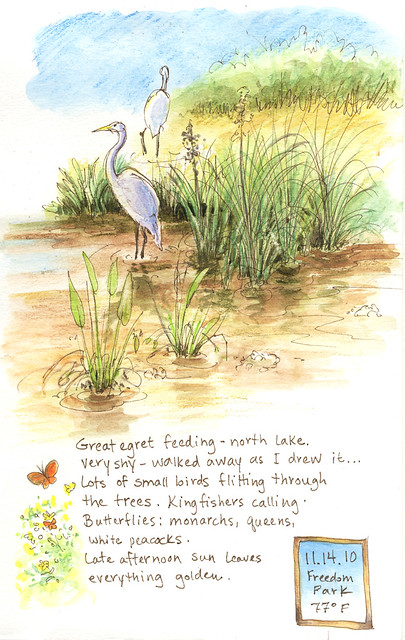
Great egret ~ Elizabeth Smith

It surprises me how a short time out in nature with my sketchbook can eliminate a week’s worth of stress! Last Sunday afternoon was warm with a cool-ish breeze, and filled with a lovely golden light.

I sat to the side of the path that winds around the north lake at Freedom Park, reveling in the abundance of butterflies nectaring on cassia and Spanish needles. As I started to sketch the grasses and water, a great egret walked into view.

I knew this was a great egret and not the white version (morph) of the great blue heron because of its black legs. Great blue heron legs are yellow, though sometimes grayish-yellow. Great egret legs are definitely black.

For the longest time I had no memory device to remember this trivia, until I associated *egret = ebony* to describe the ebony-like leg color. Now I just have to remember that it doesn’t apply to every egret! We have snowy egrets (black legs, yellow feet), and cattle egrets (yellow legs and feet) here in Southwest Florida, but they’re smaller birds with slightly different head and neck shapes.

Pond apple trunk
 This lake is part of a constructed wetland designed to relieve flooding during our rainy season (approximately June through September) and to purify water before it enters Gordon River and Naples Bay. The park also incorporates existing wetlands to the east, which has old stands of cypress and laurel oak, and some lovely old red mangroves and pond apples.

I sketched these directly with a Sakura Micron Pigma pen, and then added watercolor pencil to the lake sketch, washing over it with clear water from my Niji waterbrush. If you’d like to read more about great egrets, visit the links below.
National Geographic
The Cornell Lab of Ornithology
Audubon

~Elizabeth Smith
Naples, Florida, USA

Monday, November 8, 2010

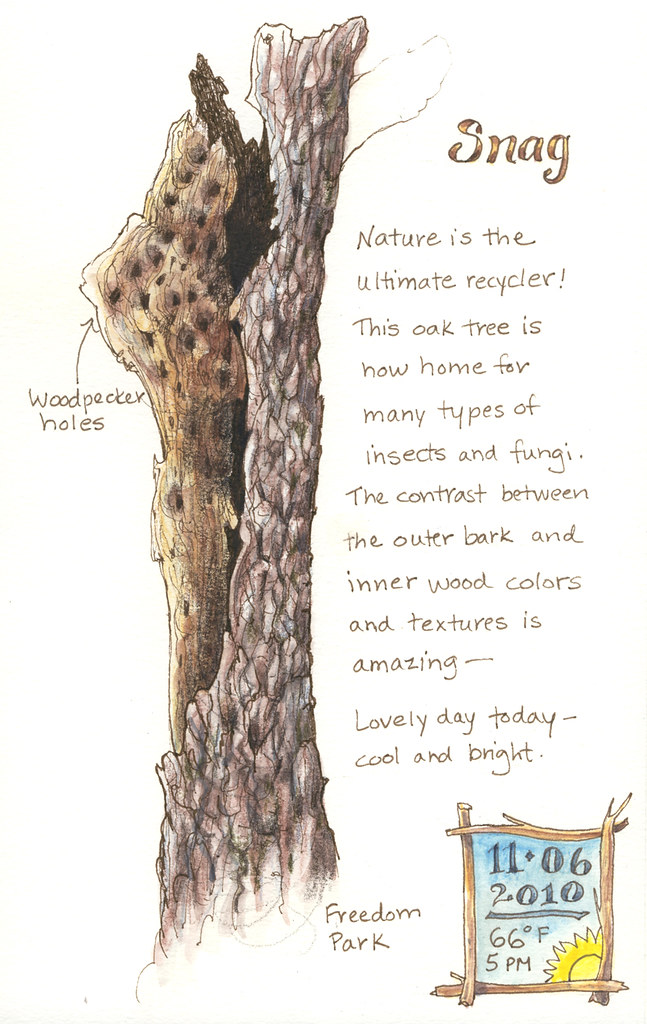
Tree snag ~ Elizabeth Smith


I confess to a fascination with dead wood, perhaps related to childhood memories of exploring woodpiles and decomposing logs. The echo of life is still there –I can imagine the seedling reaching for the sun, the unfurling of bud and leaf and inflorescence, the ripening of fruit or nut.

After death, another cycle of life begins – that of detritivores. On the microscopic level, bacteria and fungi colonize and start the breakdown process.

Invertebrates such as beetles, borers, and termites process wood nutrients or feast on fungi, and are feasted on in turn by vertebrates such as woodpeckers, anoles, and armadillos. Dead trees are used as homes by many species, including birds, bats, and squirrels.

This particular tree was an oak, probably a laurel oak. Something damaged it (lightning, a falling tree?), and the bark shows signs of regrowth round the split. The exterior bark and interior wood seemed to mirror each other, a glimpse of the past and present.

While nature may be extravagant, nothing goes to waste; all is consumed, refashioned, and repurposed – nature is the ultimate recycler.

You can click on the image to view it larger on my Flickr photostream.

~ Elizabeth Smith, Naples, Florida USA

Monday, October 25, 2010

Painting a Loggerhead Sea Turtle--Vickie Henderson

What a joy this painting was to create.  The biggest challenge for me was the sea and sand, but I was so eager to see this turtle come to life, that I plunged in anyway, letting my eyes guide me through confusion.
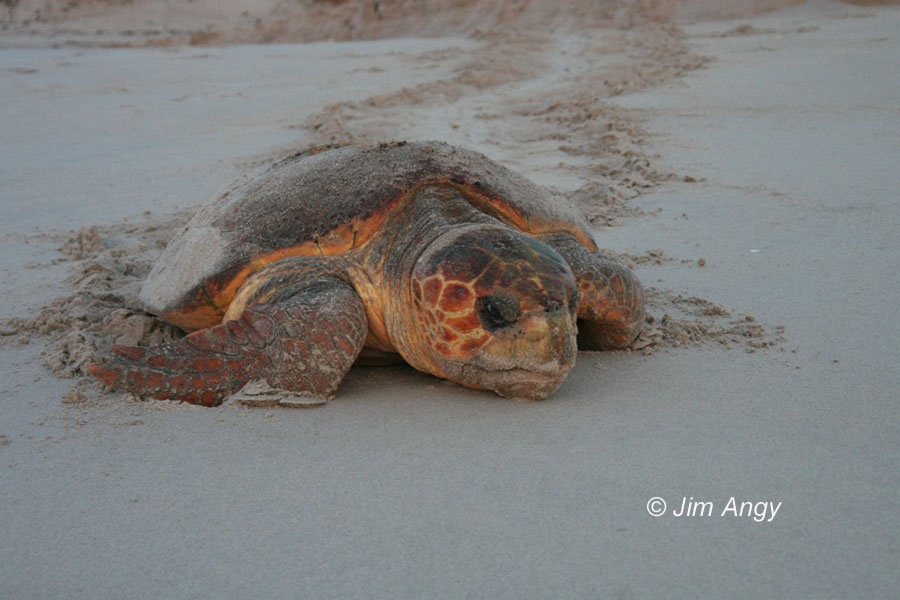
All the while I painted, I enjoyed incredible memories of late night, moonlight beach walks and watching these ancient creatures lay their eggs, 150 of them, then cover them again with great swings of their massive front flippers.  This is the only time a female sea turtle comes to shore after they initially hatch and reach the sea.  The males never return to shore at all.
Here is my initial attempt to create areas of sand and foam above.  I realized as I stood back from it, that this wasn't working--all that clutter would distract from the turtle and the angle was wrong.  So I used my scrubber lightly to smooth things out (below), change the angle and tried again.  I wanted everything in the painting to enhance the turtle, point to the turtle, background colors to highlight and reflect her colors, and the texture of sand and foam to lead to her.
The really fun thing about plunging in and marching into unknown areas of creating, you're going to learn something no matter how it turns out, something about painting and something about yourself.  I find these discoveries so gratifying, even if not beautiful, simply because I faced the unknown and gave it a good try.
Loggerhead sea turtle tracks leading to her nest and back to the sea

Capturing my June sea turtle experience on paper was an intimate experience that stirred my curiosity and pulled me deeper into a connection with an ancient vertebrate that has always captured my intrigue.  In my previous post, Curiosity and A Loggerhead Sea Turtle, I mention new terms that I found in my research as I tried to understand her anatomy.  I also bought a wonderful book on the secondary market, written by a biologist who lives in the same area of Florida (Brevard County) where I participated in my sea turtle walks.  In his book, Sea Turtles, Blair Witherington took me even deeper into the beauty, mystery, and heart of these ancient creatures, describing them as elegant in their element, the sea, and providing beautiful photographs along with poetic details of their lives.  A wonderful book.
A late Loggerhead nester returning to the sea.  With permission from friend, Jim Angy.

As for the new terms, here's some of what I learned about sea turtle anatomy.  Each species of sea turtle, seven altogether, has a characteristic number of large scutes (shell plates) on their hard carapace (shell), as well as a characteristic arrangement of scales on their head.  They have more flexible shells than land turtles, with the carapace and plastron (under shell) being joined by a bridge of supple cartilage, allowing for more speed and maneuverability as they navigate through many miles at sea.  Blair Witherington, as a young herbetologist, thought they were slow and clumsy, as would most of us.  Instead, he discovered while swimming underwater with them, they were actually very elegant and had effortless speed in the sea.

Watercolor on 9 x 12" Arches 140# cold pressed paper.  Pigments used:  WN French Ultramarine, WN New Gamboge (yellow), WN Van Dyke Brown, WN Burnt Sienna, a touch of DVP Permanent Rose as needed, and WN Permanent White Gouache.  Most of my grays are a mix of ultramarine and burnt sienna.

Links:
For the story of my June visit to Brevard County, FL to see nesting sea turtles, visit The Loggerhead Sea Turtle at Vickie Henderson Art and Space Coast Beach Buzz with Marge Bell.
More about creating this painting at Painting a Loggerhead Sea Turtle--Part II
To learn more about sea turtle nesting on the coast of Florida visit Archie Carr National Wildlife Refuge.

To see a peak into Blair Witherington's beautiful book visit Sea Turtles, An Extraordinary Natural History of Some Uncommon Turtles.  This book is out of print, but with some patience you can find it at a good price on the secondary market.  I bought mine at Amazon for less than $12 and its brand new. ( The real draw back of this, the author doesn't get compensation in this secondary market and his book is wonderful!)  

Sunday, October 3, 2010

Anhinga ~ Elizabeth Smith


Anhinga, originally uploaded by Elizabeth Smith.

A lot of viewers may not be familiar with the Anhinga, but it’s a common bird along the waterways of Florida.

Sometimes called the Snake Bird or Water Turkey, it can be seen diving, swimming or drying its feathers along our canals, bays, and lakes. Anhingas are called the Snake Bird because when they emerge from underwater and swim for shore, their long sinuous neck resembles a snake. They’re very distinctive in appearance; the males are black and white, while the females and juveniles are deep brown with a buff or light brown neck.

Often striking a pose on a perch near the water, they spread their wings wide to dry in the sun. Their wings in this position remind me of a black cape with epaulets and silvery white ribbons. Anhingas pose like this because they don’t secrete oil to waterproof their feathers (like ducks or geese do), and rely on air drying in order to fly. This lack of oil helps make them less buoyant, allowing them to dive more efficiently and stay underwater longer.

A member of the Darter family, you may have guessed that these birds are piscivores, or fish-eaters. For a quick overview of the Anhinga, visit The Cornell Lab of Ornithology ; included are some short facts, a distribution map, and an audio record of their call. For a more in-depth read, visit the Wikipedia entry.

I found this Anhinga sitting on the bridge walkway over one of the lakes at Freedom Park, and took several reference photos for drawing later. I've never had a chance to get this close to one of these beautiful birds before creating a flustered takeoff, and I'm happy I didn't cause this bird any apparent stress!

Clicking on the image above will take you to my Flickr photostream.

Elizabeth Smith
Freedom Park, Naples, FL, USA

Sunday, August 1, 2010

Sand dollar ~ Elizabeth Smith


Sand dollar, originally uploaded by Elizabeth Smith.

Memories: wading through the warm surf to a sand bar off the beach, the heat stinging one’s shoulders, the gentle nibble of small fish testing ankles, the startling movement of something inching away underfoot.

Live sand dollars are often found in shallow water near the shoreline or on sand bars, and are more mobile than most people think. If you are lucky you’ll find an intact skeleton (called a test) on the sand, bleached by the sun, like the one I painted for my nature journal. I don’t know much about these fascinating creatures, so naturally I went off on an Internet search adventure.

For more reading about the sand dollar, see this entry in Wikipedia. I also find that information written for children is a wonderful way to get an overview of my subject, and I especially liked this printable page from Enchanted Learning (complete with a sand dollar to color!). However, I also found a video on YouTube of a sand dollar burying itself, and another one here moving across the sand in time-lapse footage.  Pretty cool!

And, of course, many people are familiar with the Christian legend of the sand dollar.

You can click on the image above to view it larger on my Flickr photostream.
~Elizabeth Smith, Naples, Florida, USA

Sunday, July 18, 2010

Bumble bee (also bumblebee) ~ Elizabeth Smith


Bumble bee, originally uploaded by Elizabeth Smith.

I found this bee on the ground and couldn’t resist the opportunity to study it in detail. I’m not fond of bees or other stinging insects, but I’ve always had a soft spot for bumble bees.

The sound of its common name “bumble” seems to fit so well! It fits the rumbling buzzing sounds and the way the bees forage for nectar and pollen: clumsily bumping and nuzzling blossoms in an apparent aimless way.

When I draw or paint something, it spurs me to research my subject a little more deeply – now that I know it better from my observation and drawing, I need to answer the questions that surface during the process.

Florida has five species of bumble bees! In my entomological ignorance, I thought there was just one. Florida is a long state north to south, so we encompass several zones and many habitats. I learned that the further south one travels in Florida, the fewer bumble species there are.

I tried to use the identifier interface at Discoverlife.org to find out which bumblebee this might be, but didn’t succeed. Perhaps I entered some incorrect information or this bee is an anomaly; I just don’t know enough about bees to know what I might be missing. The portal for bumblebees is here if are interested.

I further learned that bumbles nest underground or in convenient cavities. Growing up in Iowa, most country kids know the importance of bees for crop pollination. Without bees, our food base would suffer. I found that bumblebees are also valuable for something called “buzz pollination.” Their technique dislodges firmly held pollen, and they are especially sought for greenhouse pollination or for certain plants such as tomatoes, potatoes, eggplant, blueberries, and cranberries.

Next time you visit the produce department or vegetable roadside stand, thank a bumblebee!

You can click on the image above to view larger on my Flickr photostream.

~ Elizabeth Smith, Naples, Florida, USA

Saturday, July 10, 2010

A Florida Scrub Jay and It's Two-fold Gift--Vickie Henderson

Nature is the inspiration for my art, always giving me a lift and a gift at each encounter.  But painting is not always an easy endeavor,  primarily because I'm creating.  And creating involves risk, stepping into the unknown.  I have to deal with my own obstacles, like self-doubt and  fear.
Besides giving me delight at our first meeting, this endangered Florida Scrub Jay gave me another boost while I was painting him.  When I began to doubt that the painting's values were going to work, I focused on the bird's face and completed the other details in its body.  At that point, I fell in love with the bird all over again and the light and dark values began to fall into place.

For more about the progress of this painting and its challenges, visit:  A Florida Scrub Jay and the Illusive Nature of Confidence at Vickie's Sketchbook.

9 x 12 watercolor on Arches 140# cold press paper

Sunday, June 13, 2010

Gulf fritillary ~ Elizabeth Smith


Gulf fritillary, originally uploaded by Elizabeth Smith.
It’s not often I get to draw these handsome butterflies up close – a chance glance at the ground, and I knew this was my next subject. Gulf fritillaries seem to be everywhere right now; usually we see the brilliant orange to chestnut top parts of their wings as they nectar or rest. Although this butterfly was somewhat battered, the bottom surface of the hindwing was in excellent shape. It’s hard to see this in my drawing, but the white-gray spots are a metallic silver. Beautiful!

Gulf Fritillaries use passionvine as their larval food source, which also happens to work well as a nectar plant!

You can click on the image above to view it on my Flickr photostream.

~ Elizabeth Smith, Naples, Florida, USA

Sunday, May 9, 2010

Coral bean ~ Elizabeth Smith


Coral bean, originally uploaded by Elizabeth Smith.

If you wander through a park or the woods in southwest Florida in late spring, and come across a leafless shrub with dark brown stems and covered with bright red tubular flowers, it’s most likely the distinctive coral bean. I’ve always admired this plant, but had never learned much about it. This was my opportunity!

Sketching and researching coral bean was fascinating; capturing the vivid lipstick red flowers not just a simple matter of filling in the outlines. Several plants dotted the higher elevations of Freedom Park, so I was able to find one with emerging leaves and one that had a ripening seedpod.

Coral bean is placed in the bean family. In the fall, the ripe seedpods turn dark and open to display bright red seeds that are poisonous. There are reports that early folk medicine used the bark and leaves for various ailments, sometimes, however, with fatal results. The beautiful red and black seeds were strung for jewelry and used in crafts. Since coral bean contains a curare-like alkaloid, I suggest enjoying the beauty of this shrub in the landscape!

If you click on the image above you can see it larger on my Flickr photostream.

Saturday, April 24, 2010

Blue Porterweed ~ Elizabeth Smith


Blue Porterweed, originally uploaded by Elizabeth Smith.

This unusual plant can be found wild in well-drained disturbed soil, and is often cultivated in south Florida. Considered endemic by some, purists debate its status as a true Florida native. A similar but larger relative exists, often confusing identification between the two.

Zebra Longwing and Julia butterflies love the flowers, and I recently learned that it’s also the host plant for Tropical Buckeye larva. The flowers on this plant are a violet to violet-blue, but I’ve seen blossoms that veer into a vivid clear blue with very little violet.

I resorted to the Internet to find out why this is called porterweed, ironically finding the answer from an acquaintance here in Florida. Roger Hammer is (among many things) the Senior Interpretive Naturalist in the Miami-Dade Parks Department, and in his online article (click here to read) he clears up the mystery. A foaming porter-like tea (porter is beer or ale) has been made from the plant to treat several conditions, hence “porterweed.”

Thanks for visiting! You can click on the image above to view larger on my Flickr photostream.