Showing posts with label eggs. Show all posts

Saturday, April 15, 2017

happy easter

I was teaching in my class and I'd prepared, timely, as it's nesting time here in europe, a sheet with pictures of urban songbirds and other larger species' eggs, as a good exercise. While everyone worked over the photographs, I went outside and collected a few twigs and grasses, to stimulate compositional ideas.
So I did my own bit too.
The paper is very poor, but it came out quite nice.
Eggs are of (top to bottom) : blackbird, swift, swallow, robin, hooded crow, herring gull (Rome is full of them!) and starling. Proportions might well be wrong...
So Happy Easter to you all!

Monday, August 4, 2014

sketching birds at the Australian Museum

I  spent a few hours at the Australian Museum in Sydney on Saturday and today. I wish I visited more often. I have a membership so can get in for free, so I should make effort to visit. The problem is  - to many wonderful things to draw, to many projects !
 
The Australian Museum
 
Although there are many wonderful floors to explore and sketch, I seem to always head for the Search & Discover Room . It is an information and resource centre. You have a chance to  touch and feel real specimens, and take them to a desk to position and sketch. I had SUCH a good time. Sometimes lines just flow from the pencil. It happened here.
 
I have sketched a few Australian birds before . As with any subject, the more you draw and really LOOK and SEE  it, the more understanding you have of it and the better you get.


I usually draw in a 13 x 19 cm Moleskine Watercolour sketchbook.  The only times that I want to draw BIG are at the Museum and the Zoo. So I took an A3 sketchbook this time.
I also took an old ledger that I had bought. I want to explore drawing on printed surfaces.
 
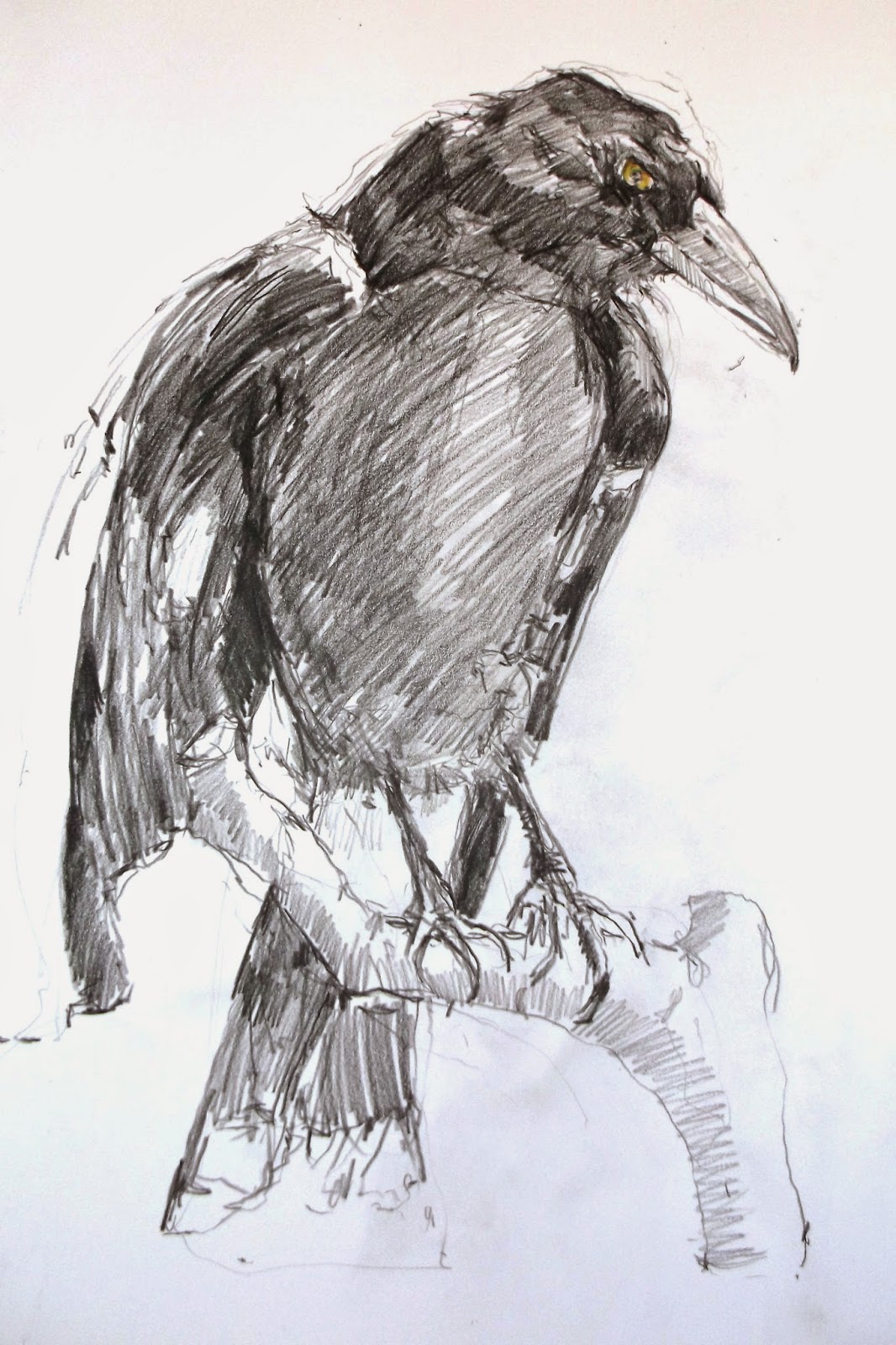
Currawong


He is almost all black in colour. but I decided to finish in this sketch stage and not "colour in"
 
A3 Arches 300 GSM Smooth Watercolour Paper
 
Pied Currawongs are found throughout eastern Australia. They prefer forests and woodlands, and has become well adapted to suburban areas. Throughout its range it is common and familiar. Average size: 48cm Source: http://www.birdsinbackyards.net/species/Strepera-graculina
Their song  can be heard in Australian suburbs

Currawong
 
I sketched him again, but really  had to add all black otherwise he looked like a penguin with a white front.


magpie
 
The Australian Magpie is black and white. It is slightly smaller than the currawong  Its nape, upper tail and shoulder are white in males, grey in females. Across most of Australia, the remainder of the body is black. They are common and conspicuous birds.Australian Magpies are found wherever there is a combination of trees and adjacent open areas, including parks and playing fields. Australian Magpies can be very aggressive during breeding season and attacks on humans and pets can occur.
They have a beautiful song which I love to hear. It is a loud musical flute-like song, often performed as a duet or by groups


I always draw in watercolour pencil. On this page I was showing another sketcher, Jane how I use watercolour pencils to draw and blend. I have been using them everyday for over five years and love what can be done with them.
 
 
I draw lots of things and they all go on flickr https://www.flickr.com/photos/alissaduke/

Tuesday, April 29, 2014

Killdeer Egg - Laura Gillis


First, I want to apologize for my long absence from this blog. I let life get in the way and I have missed being here but I have enjoyed seeing your posts! So, here’s a little sketch I did in my nature journal. I’m so happy to be back in the journal and on the blog. 

I found this Killdeer egg in the driveway yesterday and at first glance it looked like a perfect egg... just far from any nests and in the wrong place. Then I realized that it was broken. 

We have several Killdeer around our place this spring and I am always looking for their nests and they are hard to find. About the only way I have found a nest is to see mama bird dragging her wing and trying to lead me away from the eggs. These crazy birds like to nest in the gravel along side the road - a pretty dangerous place to be out here.


Sadly, I think it is highly probable that Shorty or one of the neighboring dogs had an omelette for yesterday’s breakfast.

Tuesday, November 15, 2011

Eggs with a conscience - Maree

The question is not, "Can they reason?" nor, "Can they talk?" but rather, "Can they suffer?"
~Jeremy Bentham


W&N watercolours on Bockingford 300gsm - some of my chickens' eggs

From beasts we scorn as soulless,
In forest, field and den,
The cry goes up to witness
The soullessness of men.
~M. Frida Hartley

Free-range eggs are laid by happy hens that roam freely around outdoors in the day and snuggle up in their barn at night. They are fed a vegetarian diet of grains and pulses with no animal by-products or fish meal. You can buy them in large, extra-large and jumbo sizes.

Organic free-range eggs are produced in conditions regularly inspected by Ecocert, an international monitoring body, to ensure that organic farming practices are followed. These hens feed freely on an organically certified wheat-based vegetarian diet that contains no animal by-products or fish meal. The yolks of organic eggs are naturally paler due to the wheat-based diet.

In the battery cage system (the dominant form of egg farming in the world), the hens are confined in cages with a sloping floor so that their eggs roll away in order to prevent faecal contamination of the eggs.

The cages are normally stacked on top of each other in houses with no access to natural
light. The houses use various automated conveyor belt systems to bring the hens food, capture their waste and take away their eggs.

Because of the cramped conditions (sometimes less than an A4 sheet of paper per hen – for life!), alternative farming methods for eggs have increased in popularity. These include barn, free-range and organic (also free range, but with the additional requirement of organically produced feed).

“Freedom to behave naturally” (one of the 5 freedoms that all animals should receive according to the Farm Animal Welfare Council in the UK) is one of the greatest welfare concerns for the world’s egg laying chickens.

Research has shown that hens have a strong preference for laying their eggs in a nest and are highly motivated to perform nesting behaviour. Hens also show a strong preference for a littered floor both for pecking and scratching and for dust-bathing, and a preference to perch, especially at night.

Battery caging prevents all of this as the hens are kept in barren cages without perches or litter, and are so confined for most of their lives that they cannot even flap their wings.

Barn chickens are kept loose in huge warehouses. These chickens have the freedom to move about inside the barn on littered floors, and are provided with perches and nests. However space is usually quite limited. Free range systems allow hens to express natural behaviours to a much greater extent. Free range chickens have daily access to large outdoor areas. This enables them to dust bath, forage for food, flap their wings and move freely.

Organic systems are similar to free range systems but in addition the hens are fed on organic feed (grown without the use of synthetic fertilizers and pesticides).

Free-range egg production in South Africa is regulated by the Agricultural Product Standards Act. Woolworths free-range egg supplier farmers are fully compliant with the regulatory requirements and the requirements for free-range production as stipulated by the South African Poultry Association.
Info from "Woolworths TasteMag"

(Here's a question arising from Kate's comment below : are 'organic' eggs different to 'free-range' eggs...? My free-range hens' egg yolks are bright orange.... I have also found this website that states Egg yolk colour is not a good guide).


Thursday, July 14, 2011

Kiep's first egg! - Maree

As grains in the cornfield, for thee have I shucked,
Words of love do I offer, yea of praise and renown,
Winged yet earthbound, as seraphs cast down,
To thee have I whisper'd, to me hast thou clucked.
Pulchritudinous poultry, from beak to thy legs,
To gaze at thy galliform soul is to sing
Of the unbested arm and the untested wing;
I toast thy fowl beauty as I toast thy fresh eggs.
Say not love is folly 'twixt chickens and men;
For hath not my heart forged a bond with thy breast?
Yea, a thick bond, which thickens, like mud in a nest,
And quickens my pulse for thou pullet, thou hen.
O chicken, surpassing the swallow or dove,
As thou swallow my corn, spurn not my love.
- Unknown


Shortly after my previous post about Kiep getting all grown-up and wanting to start laying eggs, she walked into my Studio and summarily jumped up on one of my tables housing my Keyboard and some art materials and started scratching around. I immediately knew she wanted to lay an egg! With great excitement I found a box, put a towel in it and filled it with some grass. She carried on like an old mother hen for about 10 minutes, scratching and organising the grass to her liking and then settled down to the serious business of egg-laying!

It was obvious that this first egg was not going to be an easy task and after some grunting and groaning and glassy-eyed expressions, suddenly, there it was!


The first egg!

Then it was time to proclaim this great feat to the world with a lot of squawking and cackling on top of the Keyboard!

Sunday, January 9, 2011

The beauty of bird eggs


These are Common quail eggs, with different hues and markings.

Birds belonging to burrow or hole nesting species tend to have white eggs. Birds nesting in the open, however, need to camouflage their eggs, and they do so exquisitely. First, the ground colour is acquired as pigment during shell formation. Later, superficial markings are added. Brown and black speckles and blotches are the result of the breaking down of blood pigments. Bile pigments produce green and bluish hues. Some species, such as Grebes, depend on mud and rotting nest vegetation to stain and splotch their whitish eggs. The largest egg is a Yellow-legged gull, a subspecies of the Herring gull found in Northern European countries. The middle one is a Common quail and the thirds a European starling.