We often think of browns and grays as drab colors, especially in the overcast days of winter. But these colors also help birds hide in the winter months!
The Brown Creeper's dark brown patterned feathers not only make this bird stunning, they are the perfect camouflage when the creeper sits still on a tree trunk to escape the eyes of a predator.
For more about the Brown Creeper, visit Vickie's Sketchbook--Stunning Brown Creeper.
Showing posts with label bird sketches. Show all posts
Monday, January 14, 2019
Sunday, November 30, 2014
Gray Jays in Manitoba, Canada
Every time I meet a new member of the Corvidae Family I am smitten. Jays, as a group, are smart resourceful and delightful when you have an opportunity to watch their behavior. The Gray Jay is even more amazing because of where it lives--in the boreal and subalpine coniferous forests of North America. It is a year round resident in these unforgiving extreme winter environments!
Several adapative qualities have helped this jay thrive in this environment, including its thick, fluffy plumage and its hoarding behavior. Gray Jays begin cacheing food--berries, arthropods and mushrooms--in late summer and continue as winter arrives. They coat the food with copious amounts of sticky saliva and hide it under bark or lichen and in the crevices of trees, sometimes covering it with another piece of bark or lichen. This food helps sustain the birds through the winter and into their breeding season which begins before winter ends!
For more information, visit my blog post at Vickie Henderson Art: Gray Jays: Bold, Smart, Resourceful!
Sunday, March 23, 2014
Amethyst Sunbird female - Maree
W&N watercolour on Bockingford 300gsm
Amethyst Sunbird female feeding on the Kniphofia (Red Hot Poker) flowers in my garden
I'm always utterly thrilled when these little beauties visit my garden. With all the rain we've had, my Red Hot Pokers have been an absolute magnet for insects and birds and when I hear these sunbirds twittering in my garden I always rush out, sketchbook or camera in hand. The male is pitch black with the most gorgeous metallic throat patch and one could easily miss his inconspicuous little wife perched on the flowers.
The Amethyst Sunbird, also called the Black Sunbird (Chalcomitra amethystine) mainly occurs in Africa south of the equator. Its natural habitat is dry savannah but it is extremely fond of gardens.
It goes out of its way to visit a large clump of nectar-bearing plants. Here in my garden, it feeds on nectar from the Aloe, Kniphofia, Halleria lucida (Tree fuchsia) and a nectar mix in one of my bird feeders. It’s diet is supplemented with insects and often hawks flying insects from the trees or bushes, also gleaning them from leaves and branches. Nectar is obtained either from flowers or from garden feeders, which it uses readily (note that in feeding experiments it was found to prefer sucrose rather than sugar).
This Sunbird is not threatened, in fact its range has increased recently due to the spread of wooded gardens.
.
Monday, September 9, 2013
Kite's foot detail - Maree
“The wild hawk stood with the down on his beak
And stared with his foot on the prey.”
- Lord Alfred Tennyson

Kites are raptors with long wings and weak legs which spend a great deal of time sitting on overhead wires and hovering when they have spotted prey. They have featherless feet, but they also developed a range of other impressive adaptations that help them hunt most anything in their environment. Each foot has four powerful toes with sharp talons. Tiny projections on the bottom of their feet called “spicules” help kites grasp their prey.
The Black-shouldered Kite occurs in India, South-East Asia, south-western Europe and across sub-Saharan Africa, from southern Mauritania to Eritrea south to southern Africa. Here it is very common across the region but especially in South Africa, north-eastern Zimbabwe and central Botswana, occurring in most habitats but generally preferring grassland, transformed fynbos and cultivated land. It is largely absent from closed woodland, forest and desert.
A Staedtler HB pencil sketch detail of the Black-shouldered Kite's foot in my Moleskine large sketch-book 8" x 5"
And stared with his foot on the prey.”
- Lord Alfred Tennyson

Kites are raptors with long wings and weak legs which spend a great deal of time sitting on overhead wires and hovering when they have spotted prey. They have featherless feet, but they also developed a range of other impressive adaptations that help them hunt most anything in their environment. Each foot has four powerful toes with sharp talons. Tiny projections on the bottom of their feet called “spicules” help kites grasp their prey.
The Black-shouldered Kite occurs in India, South-East Asia, south-western Europe and across sub-Saharan Africa, from southern Mauritania to Eritrea south to southern Africa. Here it is very common across the region but especially in South Africa, north-eastern Zimbabwe and central Botswana, occurring in most habitats but generally preferring grassland, transformed fynbos and cultivated land. It is largely absent from closed woodland, forest and desert.
A Staedtler HB pencil sketch detail of the Black-shouldered Kite's foot in my Moleskine large sketch-book 8" x 5"
Thursday, September 5, 2013
African Joy and Sorrow - Maree
"The triumph of life is the joy experienced thereafter."
- Maree
Guinea standing on the wall, forlornly calling his missing wife.
A couple of years ago, one of my guinea fowl sitting on eggs was killed by a dog, leaving 10 eggs, on the point of hatching, without a mother. I gathered all the eggs and put them in a basket with a hot water bottle, trying to keep them warm to see if any of them would hatch. Two days later still nothing, but on the third day I heard a weak peep-peep from one of the eggs. None of the others showed any sign of life, so I decided to take matters into my own hands and open the one that was peeping. I gently peeled away the shell and lifted out a perfectly formed little guinea fowl, and placed him on the warm towel, drying his little body with a soft cloth until he lifted his little head and stared me straight in the eye.
That was the beginning of a beautiful, long relationship with "Guinea", who spent five years following me everywhere and providing us with endless hours of pleasure with his surprising antics. He even lured a wild guinea fowl female from the wild (they used to pass through our property in large flocks, travelling from one field to another) and together they reared 5 clutches of beautiful little guinea fowl, all of whom stayed on our property for many years.
When Guinea's wife disappeared one day, he was inconsolable, standing on the wall and calling for hours in that haunting 'phe-twee, phe-twee, phe-twee' that is so typical of the South African bush. After that, he would often disappear for a day or two until, one day, he didn't come home at all. I hoped and presumed that he had found another family and was happily roaming the fields surrounding our property.
“This life as you live it now and have lived it, you will have to live again and again, times without number, and there will be nothing new in it, but every pain and every joy and every thought and sigh and all the unspeakably small and great in your life must return to you and everything in the same series and sequence -- and in the same way this spider and this moonlight among the trees, and this same way this moment and I myself. The eternal hour glass of existence will be turned again and again -- and you with it, you dust of dust!”
- Friedrich Nietzsche
::
Tuesday, September 3, 2013
Golden Bishop (Euplectes afer) - Maree
“Birds are a miracle because they prove to us there is a finer, simpler state of being which we may strive to attain.”
- Doug Coupland
W&N watercolour on in my Moleskine Nature Journal
I did a quick sketch while he was on the reed at my pond and then referenced the colours from one of my bird books. This is the Golden Bishop’s breeding colours and he is difficult to distinguish from the Red Bishop when not breeding, but is generally much paler below, with faint streaking confined to the sides of the breast and the flanks.
This bird is known as the “Goudgeelvink” in Afrikaans and when not breeding, is nomadic in large flocks over grasslands. They prefer to breed in reed beds surrounding dams and near rivers.
It is locally common in the Eastern half of South Africa, with more localised populations in northern Namibia, northern and south-eastern Botswana and Zimbabwe. In the breeding season it mainly occupies marshes or seasonally flooded areas, but when isn’t breeding it can move into dry habitats such as cultivated areas.
.
Monday, June 17, 2013
Wood Storks, Anhinga and Ibis.... Oh my!
![]() |
| Back view of a Wood Stork tending eggs in its nest. |
I toted my birding scope and camp stool to a wonderfully shady spot and set up my portable studio.
The scope is pointed at Wood Storks that are on the ground. You can see the rookery area in the upper left of the image. Those tiny white specs are storks.
![]() |
| click to enlarge |
When I first arrived I made quick sketches of several different rookery birds in my 8.5 x 11 Stillman and Birn Alpha Series Journal. The Anhinga was sketched using the 'snap shot' method and I used the blind contour technique for the White Ibis and the juvi Wood Stork. It was quite warm and most of the birds either had their mouths open, or wings held high and wide to cool off.
![]() |
| click to enlarge |
I noticed an adult Wood Stork near the top of the rookery tending eggs in its nest, its back to me. He/she would carefully nudge and rotate the eggs. I started the above sketch using blind contour, then finished up with my favorite modified contour (you get to peek and adjust). I so love having a birding scope. Upon close study of this Stork, I noted the black of its wings had a wonderful dark green color mixed in with the black. I loaded the waterbrush with Holbein Royal Blue and laid it in the darkest areas of the wings, then added hookers green and burnt sienna to mix and mingle with the blue. I love mixing colors directly on the Alpha paper.
In between sketching and painting I did a lot of observing. I even attempted digi-scoping with my iPhone and am quite pleased with the results! There is enough detail for me to use these photos to sketch from - please feel free to do the same!
![]() |
| click to enlarge |
![]() |
| click to enlarge |
![]() |
| A lot of the adults kept their wings up and open like this to shield their chicks and eggs from the sun. You can see a bit of this adult's wing in teh previous photo. |
The male Anhinga's breeding plumage is stunning. What really caught my eye were the wispy golden feathers that were on its head and neck. Of course when I settled in to sketch this beauty, he felt the need to go hunting for his charges... I wasn't able to get a proper look at his wing patterning or his feet, so I went from memory... don't look real close :)
The Anhinga and Great Egrets all had their mouths open and their cheeks were fluttering. I learned later that the part of their head/cheek area is call a gular and what they were doing to keep cool is gular fluttering. Love learning new things!
Labels:
Anhinga,
bird sketches,
ibis,
Pam Johnson Brickell • Low Country SC,
pen with watercolor,
Wood Stork
Saturday, September 1, 2012
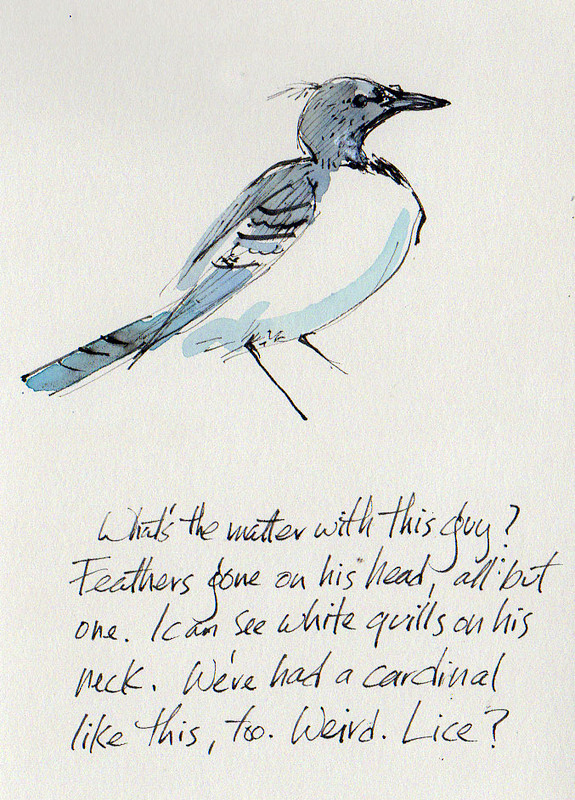
Anybody have an idea what's wrong with this guy?
He had almost no feathers on his head...just the one sticking up, dark skin and little white quills sticking out on his neck. I'm assuming something like lice.
We've had a cardinal in similar condition, and a wren that didn't look too great...
| I don't know if this is the same jay or not...if so, looks like his feathers are coming back! I couldn't get a very good photo, unfortunately. |
Friday, August 24, 2012
City Life - the Australian White Ibis
The breeding season for the Australian White Ibis, Threskiornis molucca,
has started here in Brisbane. Couples are building nests with twigs and
small branches, usually not far from water and high on trees like
Mangroves, Palms and also thick Bamboo. Some may probably already have
eggs or young hatchlings.
Labels:
Australia,
bird sketches,
birds,
ibis,
Matteo Grilli,
watercolor
Saturday, June 9, 2012
Bird sketches
A few sketches done in a WWF natural reserve near Rome, in May, through my telescope, and coloured at home. Curlew sandpipers, wood sadpipers, and black-winged stilts. Ah- and a (female) marsh harrier.
When I originally sketched these, I only used graphite pencils. It's hard enough to squint through a telescope and hold a sketchbook, maybe trying to identify a bird on the book, while splashes of rain make you run for shelter from time to time!
So the colours remained in my backpack and the sketches stayed colourless in my book for a while. But I itched to give them some body and setting. So I found time and will after a couple of weeks from the actual observation. If you wish to compare, I've posted both versions ( and latin names of birds) to my blog Conci's colours.
For me it's like a little miracle every time I can bring back to life something that I've observed, and colour helps so much, though you can do excellent work without.
Pencil scans very poorly- at least on my scanner- so the effect on the web is altered by contrasting it and making it look blacker that graphite actually is- it loses its grey warmth that's so pleasant.
When I originally sketched these, I only used graphite pencils. It's hard enough to squint through a telescope and hold a sketchbook, maybe trying to identify a bird on the book, while splashes of rain make you run for shelter from time to time!
So the colours remained in my backpack and the sketches stayed colourless in my book for a while. But I itched to give them some body and setting. So I found time and will after a couple of weeks from the actual observation. If you wish to compare, I've posted both versions ( and latin names of birds) to my blog Conci's colours.
For me it's like a little miracle every time I can bring back to life something that I've observed, and colour helps so much, though you can do excellent work without.
Pencil scans very poorly- at least on my scanner- so the effect on the web is altered by contrasting it and making it look blacker that graphite actually is- it loses its grey warmth that's so pleasant.
Sunday, January 22, 2012
African Snipe
Between the two seas the sea-bird's wing makes halt,
Wind-weary;
while with lifting head he waits
For breath to re-inspire him from the gates
That open still toward sunrise on the vault
High-domed of morning.
- Algernon Charles
Wind-weary;
while with lifting head he waits
For breath to re-inspire him from the gates
That open still toward sunrise on the vault
High-domed of morning.
- Algernon Charles
HB Graphite pencil and colourwash in Moleskine notebook
Sketches of various angles and detail of an African Snipe I spotted in St. Lucia (Zululand, South Africa).
The African Snipe, Gallinago nigripennis, also known as the Ethiopian Snipe, is a small stocky wader. It breeds in eastern and Southern Africa in wet mountain moorland and swamps at altitudes of 1700 - 4000m. When not breeding it disperses widely, including into coastal lowlands.
Some other interesting information on the Snipes : After following the birds’ migration south from Sweden to central Africa using tiny tracking devices, Swedish scientists found that the birds fly non-stop over a distance of around 4,200 miles (6,760km) at a phenomenal 60 mph (97kph). Now how great is that?!

Thursday, November 24, 2011
Red-chested Cuckoo - Maree
A bird in the hand is a certainty, but a bird in the bush may sing.
Bret Harte
30th October 8.04 am and I heard the Piet-My-Vrou (Red-chested Cuckoo - Cuculus solitarius) for the first time this season! It's rather late, I normally hear them at the beginning of October, but it's as if they've waited for the first rains before being heard! (We had 20mm of rain last night and 15mm the night before, so the world around here is looking and smelling sparkling clean!) They're extremely shy and very hard to spot, but I managed to get a quick (not-so-good!) shot with my camera before he disappeared back into the thick foliage. Had to use my bird book to complete all the colours.
I have held most bird species in my hands at least once, but with the Red-chested Cuckoo I have not had that pleasure.
In Southern Africa, all cuckoos are "migratory" (the Klaas's and Emerald Cuckoos appear to be resident in the warmer east), arriving from Central or Eastern Africa at the start of the rainy season in late September and October. Upon arrival, the males establish territories and advertise their presence to females (and birdwatchers!) by calling incessantly, sometimes even after dark.
The Red-chested Cuckoo is mainly found in the eastern half of southern Africa, and is quite common in protected areas, living in a wide range of habitats. It feeds mostly on invertebrates, particularly hairy caterpillars but also grasshoppers and beetles, amongst others. Our Blue Gum trees (Eucalyptus) get over-run by caterpillars in Oct/Nov and I just love watching this Cuckoo scrambling up and down the trunk collecting them.
It mostly parasitizes members of Muscicapidae (robins, thrushes, flycatchers, etc.), rushing into their nests, and removing the host's eggs before laying one of its own, all in just 5 seconds! Once the chick is 2 days old, it evicts the host's eggs and nestlings. It stays in the nest for 17-21 days, and is dependent on its host parents for 20-25 days more, before becoming fully independent. It is the weirdest sight seeing the little Robin rushing around feeding this chick 5 times her own size!
This Cuckoo occurs throughout Africa south of the Sahara, but avoids arid regions. In southern Africa it is common in eastern Botswana, Zimbabwe, Mozambique, Swaziland and eastern and southern South Africa. It generally prefers Afromontane forest, closed woodland, Miombo woodland, open Savannah thickets, stands of trees in human settlements, mature gardens and parks.
Bret Harte
30th October 8.04 am and I heard the Piet-My-Vrou (Red-chested Cuckoo - Cuculus solitarius) for the first time this season! It's rather late, I normally hear them at the beginning of October, but it's as if they've waited for the first rains before being heard! (We had 20mm of rain last night and 15mm the night before, so the world around here is looking and smelling sparkling clean!) They're extremely shy and very hard to spot, but I managed to get a quick (not-so-good!) shot with my camera before he disappeared back into the thick foliage. Had to use my bird book to complete all the colours.
I have held most bird species in my hands at least once, but with the Red-chested Cuckoo I have not had that pleasure.
In Southern Africa, all cuckoos are "migratory" (the Klaas's and Emerald Cuckoos appear to be resident in the warmer east), arriving from Central or Eastern Africa at the start of the rainy season in late September and October. Upon arrival, the males establish territories and advertise their presence to females (and birdwatchers!) by calling incessantly, sometimes even after dark.
The Red-chested Cuckoo is mainly found in the eastern half of southern Africa, and is quite common in protected areas, living in a wide range of habitats. It feeds mostly on invertebrates, particularly hairy caterpillars but also grasshoppers and beetles, amongst others. Our Blue Gum trees (Eucalyptus) get over-run by caterpillars in Oct/Nov and I just love watching this Cuckoo scrambling up and down the trunk collecting them.
It mostly parasitizes members of Muscicapidae (robins, thrushes, flycatchers, etc.), rushing into their nests, and removing the host's eggs before laying one of its own, all in just 5 seconds! Once the chick is 2 days old, it evicts the host's eggs and nestlings. It stays in the nest for 17-21 days, and is dependent on its host parents for 20-25 days more, before becoming fully independent. It is the weirdest sight seeing the little Robin rushing around feeding this chick 5 times her own size!
This Cuckoo occurs throughout Africa south of the Sahara, but avoids arid regions. In southern Africa it is common in eastern Botswana, Zimbabwe, Mozambique, Swaziland and eastern and southern South Africa. It generally prefers Afromontane forest, closed woodland, Miombo woodland, open Savannah thickets, stands of trees in human settlements, mature gardens and parks.
Monday, November 7, 2011
Blackeyed Bulbul (Pycnonotus barbatus) - Maree
Let the farmer remember that every bird destroyed, and every nest
robbed, is equivalent to a definite increase in insects with which he
already has to struggle. He will soon appreciate the fact that he has
a personal interest, and a strong one, in the preservation of birds.
- Henry Oldys
The Blackeyed Bulbuls are regular visits to my garden, enjoying a snack at the various bird tables and splashing in the shallows at the pond. They are very gregarious birds and will call one another incessantly should they lose sight of one another. They are also always the first to spot a snake in my garden, and their alarm calls always lure me out to see what's going on. They eventually have the whole garden bird population in uproar, flitting from branch to branch above the snake, letting it know in no uncertain terms that it's definitely not welcome! They have the same reaction when they spot Torti, my Mountain tortoise, although I can't for the life of me think why!
Found just about everywhere in Africa except in the dry South West and on the Cape.
robbed, is equivalent to a definite increase in insects with which he
already has to struggle. He will soon appreciate the fact that he has
a personal interest, and a strong one, in the preservation of birds.
- Henry Oldys
The Blackeyed Bulbuls are regular visits to my garden, enjoying a snack at the various bird tables and splashing in the shallows at the pond. They are very gregarious birds and will call one another incessantly should they lose sight of one another. They are also always the first to spot a snake in my garden, and their alarm calls always lure me out to see what's going on. They eventually have the whole garden bird population in uproar, flitting from branch to branch above the snake, letting it know in no uncertain terms that it's definitely not welcome! They have the same reaction when they spot Torti, my Mountain tortoise, although I can't for the life of me think why!
Found just about everywhere in Africa except in the dry South West and on the Cape.
Sunday, November 6, 2011
Blackeyed Bulbul sketch - Maree
“I know why the caged bird sings, ah me,
when his wing is bruised and his bosom sore;
when he beats his bars and he would be free,
it is not a carol of joy or glee,
but a prayer that he sends from his heart's deep core.”
- Paul Laurence Dunbar
The Bulbuls were very frisky in my garden this afternoon - lots of chattering and fighting going on, I'm not sure over what, but they were decidedly upset and no matter how hard I looked, I couldn't find any reason like maybe a crow or a snake or some other stranger that they might not like in the territory.
when his wing is bruised and his bosom sore;
when he beats his bars and he would be free,
it is not a carol of joy or glee,
but a prayer that he sends from his heart's deep core.”
- Paul Laurence Dunbar
Pencil sketch in hand-made sketchbook with Daler-Rowney Acid-free Heavy Weight 220gsm (135lbs) sketching paper - 6" x 8"
The Bulbuls were very frisky in my garden this afternoon - lots of chattering and fighting going on, I'm not sure over what, but they were decidedly upset and no matter how hard I looked, I couldn't find any reason like maybe a crow or a snake or some other stranger that they might not like in the territory.
Saturday, November 5, 2011
Black-crowned Night Heron Juvi
Black-crowned Night Heron Juvi, a photo by PJBee on Flickr Great Egrets and Night Herons have been roosting of late in the trees surround a pond by our home.
This morning there were five egrets and a couple of herons but by the time I made it back out to sketch them the egrets were gone.
This juvi paid me no mind and posed beautifully. I should have had my scope as peering through bins then looking down to the paper was a bit challenging. You can lock a scope to one spot. I had to search for the bird each time I held the bins up :) Ah, but it's all part of the joy of sketching plein air!
Labels:
bird sketches,
bird sketching,
birds,
Pam Johnson Brickell • Low Country SC,
plein air,
watercolors
Wednesday, August 3, 2011
mystery bird
I have long wondered why birds won't come to my bird feeders. This may be the reason why . . .
This mystery bird and his mate are living in a huge nest at the top of our old elm tree. Near as I can guess, it may be a small falcon or a Mississippi kite. But my bird book doesn't list the kite as a bird-eater --- this bird and his mate definitely eat other birds, the remains of which I find scattered on the ground now and then.
There is at least one baby in the nest. Its cries remind me of hawks but this bird is smaller. Any guesses?
Monday, July 25, 2011
Cape Wagtail thinks it's Spring! - Maree
Birds are a miracle because they prove to us there is a finer, simpler state of being which we may strive to attain.
- Doug Coupland

I have a clear view from my bath into the bathroom court yard, where the Wagtails have been nesting in my Fan Palm for the last 2 seasons. While in the bath this morning, I was watching them through the open doors chasing the Weavers, who steal bits and pieces of the Fan Palm to build their nests with, and the reason soon became clear. Both parents were busily carrying nesting materials and obviously revamping their old nest for this season's babies. The Fan Palm's trunk is covered in a thick, coarse type of hairy stuff, and they have neatly hollowed out a space and lined it with lots of soft materials like feathers and woolly bits. Whenever the babies hatch and start to fledge, it's such a pleasure watching them in the court yard begging for food until they manage to get enough height to clear the wall and follow their parents into my garden.
Can I take it, then, that Spring is just around the corner...?
- Doug Coupland

I have a clear view from my bath into the bathroom court yard, where the Wagtails have been nesting in my Fan Palm for the last 2 seasons. While in the bath this morning, I was watching them through the open doors chasing the Weavers, who steal bits and pieces of the Fan Palm to build their nests with, and the reason soon became clear. Both parents were busily carrying nesting materials and obviously revamping their old nest for this season's babies. The Fan Palm's trunk is covered in a thick, coarse type of hairy stuff, and they have neatly hollowed out a space and lined it with lots of soft materials like feathers and woolly bits. Whenever the babies hatch and start to fledge, it's such a pleasure watching them in the court yard begging for food until they manage to get enough height to clear the wall and follow their parents into my garden.
Can I take it, then, that Spring is just around the corner...?
Friday, July 22, 2011
On a windy day - Maree
On a windy day let's go flying
There may be no trees to rest on
There may be no clouds to ride
But we'll have our wings and the wind will be with us
That's enough for me, that's enough for me.
— Yoko Ono
Pen and wash sketch in my Moleskine watercolour sketch-book of a Seagull as they passed over my property. I pretended to have some food and this chap came quite close to have a look!
There may be no trees to rest on
There may be no clouds to ride
But we'll have our wings and the wind will be with us
That's enough for me, that's enough for me.
— Yoko Ono
Pen and wash sketch in my Moleskine watercolour sketch-book of a Seagull as they passed over my property. I pretended to have some food and this chap came quite close to have a look!
Saturday, July 16, 2011
Whoooo? You! - Maree
“A wise old owl sat on an oak;
The more he saw the less he spoke;
The less he spoke the more he heard;
Why aren't we like that wise old bird?”
- Unknown
Had a visit from the Spotted Eagle Owl last night. It's full moon and it was beautifully bright outside. When I heard him I softly crept into the garden and spotted him sitting in one of the trees. I just love talking to him and he talks right back! When he goes Whoo Wh-o-o-o! and I mimic it, he immediately replies with another Whoo Wh-o-o-o-o! I even had him following me around the corner of the house, wanting to see WHO this intruder is that dares to challenge his territory! The female was also close-by, I could hear her Whoo Whoo - Wh-o-o-o-o! but didn't catch a glimpse of her.
It's nice to know that they are still around and hopefully catching the rats, which I struggle to keep under control because I refuse to put down rat poison. However, I did hear that there's a product on the market now that is more humane on the rats and also safe as far as pets and owls go.
This Owl is a medium to large owl with prominent ear tufts, its height is 45cm and its weight is from 480 to 850g. The wingspan is 33cm. They are nocturnal hunters, and spend most of the day concealed in trees, rock ledges or abandoned burrows.
The more he saw the less he spoke;
The less he spoke the more he heard;
Why aren't we like that wise old bird?”
- Unknown
Had a visit from the Spotted Eagle Owl last night. It's full moon and it was beautifully bright outside. When I heard him I softly crept into the garden and spotted him sitting in one of the trees. I just love talking to him and he talks right back! When he goes Whoo Wh-o-o-o! and I mimic it, he immediately replies with another Whoo Wh-o-o-o-o! I even had him following me around the corner of the house, wanting to see WHO this intruder is that dares to challenge his territory! The female was also close-by, I could hear her Whoo Whoo - Wh-o-o-o-o! but didn't catch a glimpse of her.
It's nice to know that they are still around and hopefully catching the rats, which I struggle to keep under control because I refuse to put down rat poison. However, I did hear that there's a product on the market now that is more humane on the rats and also safe as far as pets and owls go.
This Owl is a medium to large owl with prominent ear tufts, its height is 45cm and its weight is from 480 to 850g. The wingspan is 33cm. They are nocturnal hunters, and spend most of the day concealed in trees, rock ledges or abandoned burrows.
Sunday, July 10, 2011
White-browed Sparrow Weaver - Maree
A Bird
A bird came down the walk,
He did not know I saw;
He bit an angleworm in halves
And ate the fellow, raw.
And then he drank a dew
From a convenient grass,
And then hopped sidewise to the wall
To let a beetle pass!
- by Emily Dickinson

These White-browed Sparrow Weavers used to be regular visitors to my old garden and, sad to say, I've not spotted them at all since moving to our new smallholding many years ago. My last sighting was in May 1996. I see their environmental status is listed as LC "Least Concern", so I cannot understand the reason at all as to why I have not noticed them lately. They have a general, harsh 'chik'chik' call when they're flocking, as well as a loud, liquid 'cheeoop-preeoo-chop' whistle, which I really miss...
The White-browed Sparrow-Weaver is found in greatest numbers in north-central southern Africa. While this species most densely populates at dry regions with woodland or wooded grassland in northern South Africa, its range includes Botswana, the North-west Province and Western Gauteng, northern and central Namibia, and western Zimbabwe. It is seen very often in South Luangwa National Park, Zambia and southern Malawi. Populations may be found as far north as Ethiopia.
A bird came down the walk,
He did not know I saw;
He bit an angleworm in halves
And ate the fellow, raw.
And then he drank a dew
From a convenient grass,
And then hopped sidewise to the wall
To let a beetle pass!
- by Emily Dickinson

These White-browed Sparrow Weavers used to be regular visitors to my old garden and, sad to say, I've not spotted them at all since moving to our new smallholding many years ago. My last sighting was in May 1996. I see their environmental status is listed as LC "Least Concern", so I cannot understand the reason at all as to why I have not noticed them lately. They have a general, harsh 'chik'chik' call when they're flocking, as well as a loud, liquid 'cheeoop-preeoo-chop' whistle, which I really miss...
The White-browed Sparrow-Weaver is found in greatest numbers in north-central southern Africa. While this species most densely populates at dry regions with woodland or wooded grassland in northern South Africa, its range includes Botswana, the North-west Province and Western Gauteng, northern and central Namibia, and western Zimbabwe. It is seen very often in South Luangwa National Park, Zambia and southern Malawi. Populations may be found as far north as Ethiopia.
Subscribe to:
Posts (Atom)