Showing posts with label Australia. Show all posts

Saturday, November 22, 2014

Pacific Black Duck - Australia


Fitzroy Gardens , Melbourne
I am fortunate that the first part of my walk to work in Melbourne city is through the beautiful Fitzroy Gardens, with its traditional English plantings and ponds. I have discovered here are a few families of birds that live there : two Australian wood duck families, one with ducklings that are just past their fluffy stage,  peewees (mudlark), a kookaburra and magpies, crows and my favourite duck...


the Pacific Black Duck.
 
I liked the descriptions online that call it a sociable and a dabbling duck.  
 
The Pacific Black Duck is found in all but the most arid regions of Australia. Outside Australia, its range extends throughout the Pacific region. The Pacific Black Duck is one of the most versatile of the Australian ducks. It frequents all types of water, from isolated forest pools to tidal mudflats. The Pacific Black Duck is closely related to the Mallard (Source  http://www.birdsinbackyards.net/species/Anas-superciliosa)


I know where to find them by the pond and how close I can get to them on land before they dive into the water. The more I draw them the more familiar I become with the shape of their body and head - the curves and subtleties that give them their form and character.

 
I also know immediately which colour of watercolour pencils (Walnut Brown. Burnt Umber and Ivory mixed with a little Yellow) to use to draw them. I can pick the colours out of my pencil wrap and start straight away !


It has a dark body, and a paler head with a dark crown and facial stripes. There is an iridescent green patch on the wing. This is when the Derwent Inktense Teal Green comes out of the box !


Tuesday, January 29, 2013

Mount Crawford Forest

This weekend my boyfriend and I had a motorbike ride to Mount Crawford Forest. I had about half an hour to make a small watercolor sketch. The forest is so dense, damp and dark, very unusual for South Australia!


Saturday, January 26, 2013

snails and cicadas

Drawing of insects from an Australian garden, given to me by friends and family - a snail and cicada
Watercolour pencil in Moleskine Sketchbook


I had always called both of these cicadas and so when I was drawing these I had to actually find out what they were. I was right . They ARE both cicadas. The shell is what the nymph discards when it emerges from living underground.. I remember them being on paperbark trees. At high school we used to put them on our jumpers  like a  brooch.

This particular cicada is a Bladder Cicada. Not the nicest of names, but definitely the prettiest cicada. It ia the less ïnsect-looking" cicada I think

Cicadas are well known for their song/drone. It happens in summer around dusk. The noise is so loud that we always had to close the windows on those hot Queensland summer nights toblock the noise.
The male Bladder Cicadas have the greatly enlarged abdomen, largely hollow. This is the resonating chamber to amplify the loudness of their songs. Females are smaller in size and relatively smaller abdomen.


and here is the snail......


Friday, January 18, 2013

Botanical studies


During the past holiday weeks I decided to start working on some botanical sketches of leaves, just to start looking into the never-ending shades of greens and how to achieve them. I'm finding it very daunting yet fascinating. During the last year or so I started studying colours very thoroughly and in doing so I took out all the colours of my palette that didn't have the features I needed to achieve my goals. I ended up using a rather limited choice of favourite pigments which has been able to provide me with any colour I needed so far. I like keeping it simple to get the best and most varied mixes out of them. It worked, until I started mixing to match those greens... Any thought from the botanical artists reading this will be much appreciated.
http://matteogrilli.blogspot.com.au/

Wednesday, January 9, 2013

jellyfish on the beach - Australia

Gold Coast, Australia. I spent two days at the sunny Gold Coast in Queensland. (where it was much cooler than Sydney)


I had a few hours to myself at the end of the afternoon and went back to the beach specifically to draw. The first object was a bluebottle jellyfish.


I had particular interest in drawing this creature as I had been stung by one while swimming in the ocean that morning. It was not big, but had a large fine tentacle that wrapped around my legs. OUCH it stung ! That lasted about 15 minutes and then welts were there for a few hours. http://en.wikipedia.org/wiki/Portuguese_man_o'_war

When I returned to the beach later in the day to draw, there were signs up at the patrolled beaches warning of Marine Stingers in the water.
Studying and drawing the jellyfish was fascinating – the blue colour is so intense in some area - it is almost jewel-like.


I drew other things on the beach and then came across a bell or blubber jellyfish. These are the sort of jelly fish that I vaguely remember seeing on the beach as a child. However, none has been as perfectly formed as this one !!


I am not a beach person and did not grow up on the coast or have beach holidays. So this past few days was an education and an adventure !

Tuesday, January 1, 2013

Royal Botanic Garden Sydney : Alissa Duke

Congratulations to Kate and to the the Sketching in Nature blog for winning the Making a Mark Award. This is a wonderful site and opportunity for sharing and exploring nature around the world  through art!

Last week, a sunny Summers day in Sydney was the perfect opportunity to do some urban nature sketching in the Royal Botanic Garden in the center of Sydney.

I sketched with three friends and we started under the shade of a large Moreton Bay Fig. I was distracted by a Dusky Moorhen that had built its nest right next to the fountain spout in a nearby pond. There were a few young dusky moorhens around the pond area, so I am not sure if there were any eggs. I wonder if the Gardens staff have kept the fountain off during these months.?


These White Ibis are prolific in Sydney city, seen around rubbish bins, as well as in the parks and gardens. They are very beautiful lookings birds. If only there were not so many of them., and they were not a nuisance.They are great subjects to capture quickly on paper. I used ink and then added some watercolour pencil.The tagged one caught my eye. I have since found out that Research is currently under way that involves banding and wing-tagging Australian white ibis (Threskiornis molucca) within the Sydney region. The aim is to monitor ibis’ movements, breeding and habitat preferences. Colour-banding and numbered wing-tags allow identification of individual ibis; observations have been received from across the Sydney region and as far away as Shepparton (Vic), Coffs Harbour (NSW), Brisbane and Townsville (Qld).


The Lotus Pond is  always changing. There was only one Lotus flower in the pond, but lots of green leaves to draw.
And my favourite, quintessential  duck is the Pacific Black Duck. They have so much character in their face with those lovely markings.


Thursday, November 22, 2012

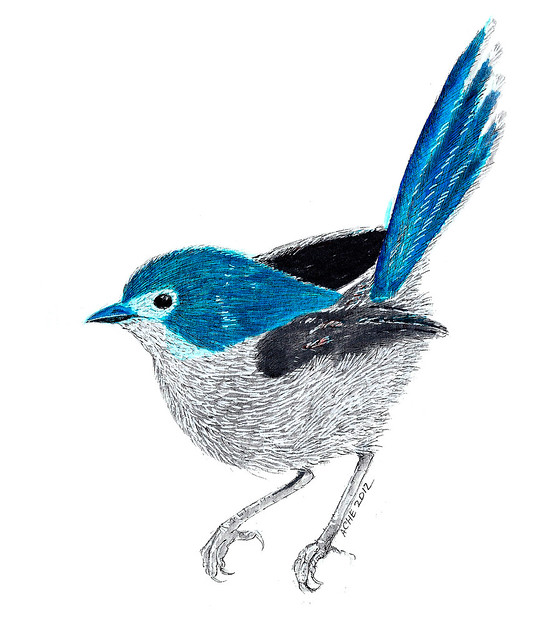
Lovely Fairy-Wren Female

I love Fairy-Wren birds, which are very common species in South Australia. Male birds are very bright colored with all kinds of blue, and female birds come in more gentle and elegant shades of grey and blue. They are truly restless birds, pleasure to watch, but very hard to sketch. I tried many times and always came out with series of spoiled paper instead. Recently I bought a bird bath for my backyard and Fairy-Wrens are regular visitors. At least I can take a picture of them now and use it and the life models as support draw them properly.

Monday, November 19, 2012

An Australian Spring Walk


You are very welcome to follow this link to read the full article.
Thank you.
Matteo

Sunday, September 30, 2012

birds nest project : Alissa Duke

This is a small (8cm x 4 cm x 6cm) nest that I was given. I am not sure what bird it belonged to. It is from SouthEast Queensland, Australia. I have looked online today and not found an answer. I will go the the library and look into it and also maybe send a photo to the museum.
My project now is to explore methods of drawing this little birds nest. The ink version is ok. It is when I attempt to draw nests in watercolour pencil that I have problems.The problems are with the colour and shadow and line . and trying to find a method that suits my own style of drawing. I have three other birds nests at home to draw, and so I am keen to learn.. I  Thankfully Nature Artists group members (below) have provided me with some suggestions and guidance.


SUGGESTIONS
Karen Engelbretson: Book - America's Other Audubon" by Joy M. Kiser. Also, artist Wendy Brockman paints nests.
Mindy Lighthipe: http://www.johnmuirlaws.com/drawing-birds Drawing Birds Tutorial
John Muir Laws
Antshrike Artist: Book calledAvian Architecture How Birds Design, Engineer, Build Book
Peter Goodfellow HB

Candace Millsop: Claudia Nice uses pen & ink w/watercolor and has several books and Cathy Johnson has really great books too! And one called Bird, Egg, Feather, Nest by Maryjo Koch

Susan Fox: You might google Alphonse Mucha to see how he handled the design of women's hair and think about how what he does relates the problem you're trying to solve.

Laura Gould I did a step by step record of a wrens nest I did late this past winter. http://www.flickr.com/photos/jizogarden/sets/72157629375590967/with/6916005781/


Monday, September 24, 2012

A visit to the beach in Adelaide, Australia: Alissa Duke

 I spent the weekend in Adelaide, South Australia for a seminar . I had some free time before 9am and walked  a few blocks to the beach. I did a small sketch at the beach, before it started to rain lightly. That is not so great with watercolour pencils and paper.
So I stopped drawing and walked down onto the beach and collected some shells. It is amazing that different beaches can produce new and exciting shells. I only had  about half an hour to spare, but could have spent all morning there. I put the shells in my sunglasses case, as it as the only place I could think to store them !


I think the bit and pieces of shells and stones are more interesting as the perfect shells that I used to look for on the beach when I was little. I have been drawing these shells back home in Sydney this week and there are a few more to sketch.


Friday, August 24, 2012

City Life - the Australian White Ibis


The breeding season for the Australian White Ibis, Threskiornis molucca, has started here in Brisbane. Couples are building nests with twigs and small branches, usually not far from water and high on trees like Mangroves, Palms and also thick Bamboo. Some may probably already have eggs or young hatchlings.

Sunday, July 8, 2012

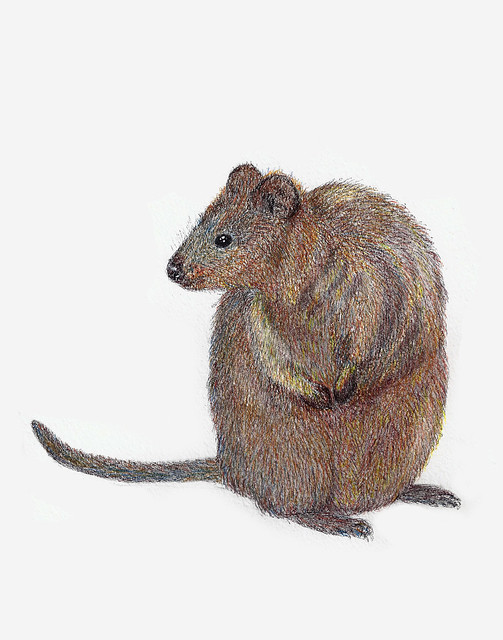
Quokka

Hello everyone!
I have recently been invited to join this wonderful blog, which I am really proud of. As this is my first post, I will say a few words about myself. My name is Anna, I am an illustrator and an artist. Originally I am from Russia but four years ago I moved to Australia, which became my home. I hope you will forgive me making mistakes, as I am not a native speaker of English.
As an artist I love to be experimental with styles and techniques. I love abstract art and cartooning as well as drawing from life and my materials range from charcoal to color pencils, from watercolors to digital painting. You can see examples of my art on my website.
One of the greatest sources of inspiration for me is animal life and marine creatures.
In my free time I volunteer at my city's zoo, and almost all holidays I spend snorkeling, diving and drawing sea dwellers.
Today I would like to present my drawing of a Quokka, small and very cute Australian marsupial. It has a baby in a pouch, that's why it is a bit lopsided.
I made a rough sketch of it in the zoo yesterday and finished it off at home.

If you are interested in my process, here are major steps of my drawing:


Monday, May 21, 2012

Butterflies


The caterpillar of an Orchard Swallowtail is a noisy chewer, on the early stages the larva resembles a bird dropping, it later changes into a camouflaged green. Who could ever tell that from a bird-dropping-looking tiny creature an amazing butterfly will later develop?

Wednesday, March 14, 2012

Blue-faced Honeyeater

For more details on this beautiful bird please visit my blog

Wednesday, February 29, 2012

insects and beetles

For Christmas I was given a box of feathers, leaves, a nest, seed pods and a few beetles. In the last few days I have finally put aside time to draw some of them (in watercolour pencil in my Moleskine watercolour sketchbook) .

Unfortunately I am unable to provide very much technical information about them.I can tell you they were collected in Toowoomba, Queensland,Australia, probably along suburban footpaths, waterbird habitat or my mothers backyard !

This top page is what I always called a Stag Beetle. I have found out they are part of Rhinocerous Beetle family which covers many similar looking beetles with varying degrees of spiky and spiny features.


This second page has a few mysterious small black and brown insects. I know the highly un-technical name of the "click beetle" (middle left) which (when we were children) we used to put our finger on their back they would click and jump . The green cicada is also a familiar insect . Maybe the one above it is a Christmas beetle ???

I really enjoyed drawing ( or is it painting?) these. I also wanted to write all over it with notes. I have kept most of the beetles and bugs to draw again another day....

Monday, January 9, 2012

From Grand vistas to a single leaf

Happy New Year to everyone!
I haven't posted for a long time here... no excuse except trying to do too many things at the one time. I have been on my summer holidays here and last week (or was it the week before) I escaped the city and had a few days up in the mountains - the blue mountains(plateaus is more accurate)...it is only 1.5 hours drive from the center of Sydney. Wonderful vistas looking down into valleys.
Summer! 28WE_09 Pulpit Rock from Govets Leap

A consistent sandstone escarpment separates the tourist from the valleys - so any hikes involve a steep climb down and then back up again. As I was on my own I stayed on the top. Still plenty to see and sketch.
Summer! 28WE_07 Grose Valley view from Pulpit Rock
The mountains are supposedly bluer than normal due to the haze of the eucalyptus oil from all the gum trees - sometimes the blueness is very strong.
Summer! 27TU_07 The three Sisters
The most famous rock formation is the three sisters
Summer! 28WE_06 Pulpit Rock overview
...but my favourite place is pulpit rock which few people know about - you can walk down to an exposed rocky outcrop and sit on a bench and feel like you own the valley.
Summer! 28WE_08 Pulpit Rock-the scary part!
There is the scary 'pulpit' itself... I wasn't quite up to sketching way down there this time.
Summer! 27TU_09 Plant studies
From sketching the grand vista I picked the most ordinary leaf and tried to describing it using the coolest 6 page laminated card that I got at a nearby shop. I can see that I am going to use this card to appear very knowledgeable! I never realised that there were so many different types of leaf bases and that they all have names. I am rather discovered by this discovery...
Botanical Field Guide _Stefan Mager & Dr Geoff Burrows
More details here

Sunday, January 8, 2012

Fungi on stick

I was given this fungi on stick to draw. It was picked up off a footpath in Toowoomba, Queensland Australia and probably came from an oak or plane tree, as there are lots of those planted along the footpaths there. Unfortunately that is as specific as I can be.


For Christmas, I was also given lots of nature objects that my family had been collecting for me from the walks around the waterbird habitat, parks and footpaths. They had as much fun picking things up off the ground as I will have drawing them . These include seed pods, leaves, feathers , eggs, a nest, insects. (many are still to be identified......) The BEST Christmas present !

Tuesday, January 3, 2012

The Pied Butcherbird


This bird may be considered the singer of the bush, with its huge repertoire of calls and songs of its own but also borrowed from other sources. For some reason they are aware that when a human is gardening there might be insects and worms around, so they come and perch very closely to the working gardener and carefully observe the surroundings until an insect runs away from the digging and pruning. The hunter then quickly flies down and grabs its meal.Their calls and songs are made up of a wide range of mellow, sweet, mysterious and sad whistles and it is one of the most characteristic sound of the bush and suburban gardens.
www.matteogrilli.blogspot.com