Showing posts with label watercolor pencil. Show all posts

Sunday, July 15, 2012

Black-eyed Susan ~ Elizabeth Smith

Click to view larger.

Summertime yellows, I see them everywhere here in Florida!  Fragments of yellow blossoms flash against the green landscape like tiny bits of sunlight.  Tickseed, beach sunflower, cassia, and black-eyed Susans are all blooming now. 

Black-eyed Susan (Rudbeckia hirta) differs from many of our yellow composite wildflowers by the shape of the fertile array of disk flowers (the brown center); it has a distinctive cone shape that is similar to Echinacea or purple coneflower.  In fact, another common name for black-eyed Susan is yellow coneflower.

Wikipedia reports that the roots have been used like those of Echinacea.  Black-eyed Susan contains anthocyanin, an antioxidant found in many purple, blue, and red fruits such as blueberries, raspberries, and cranberries, as well as the stems, leaves, and flower petals of some plants.  Historically, different parts of the wildflower were used by Native Americans for various ailments.  The Cherokee used the roots for snakebite, worms, and earaches.1   Seminoles used the coneflowers for headaches and fevers. 2

Black-eyed Susan grows as a wildflower throughout most of the United States, but is also a popular cultivated garden flower.  It’s a biennial plant, with a two year life span, but sometimes grows as a short-lived perennial.  Forming a basal rosette of leaves the first year, plants send up stems and bloom the second year.  In Florida, I usually see them growing along the edges of grassy areas near pine flatwoods.  Black-eyed Susan blooms attract bees, butterflies, and other insects forging for nectar and pollen, and birds for the ripe seedheads. 

The leaves and stems are scabrous, an interesting-sounding word that always bring to my mind the term “frabjous” from The Jabberwocky.  Scabrous actually has a more ordinary meaning: rough, or having a rough surface, an apt description of the coarse bristly hairs covering those parts.  The species name refers to these hairs as well; hirtus is from the Latin for “hairy.”  The genus name of Rudbeckia was bestowed by Linnaeus to honor Olaus Rudbeck, one of his botany professors.

Reading and researching black-eyed Susan online brought up some other fascinating tidbits.  Sending a black-eyed Susan bouquet to a loved one in Victorian times meant “encouragement.”  I also came across a charming andromantic legend about black-eyed Susan and sweet William, memorialized in a poem by English author John Gay.  I grew up knowing sweet William as a type of wild phlox, with five petals and light blue-to-lavender in color.  It’s more probable that the name sweet William actually refers to a type of Dianthus, which is native to Europe.

I drew this as part of The Sketchbook Project in the small sketchbook provided.  If you’re not familiar with the project, you can read about it here.  So far, my booklet seems to be turning into a collection of flowers found in Florida – but we’ll wait to see what else might appear on its pages!  So far, I think this one has to be my favorite; after sketching and reading about this common wildflower, I have a deepened appreciation for its uncommon beauty and history.

**Note: ethnobotany information is intended for educational purposes only, please consult reliable  sources before attempting to duplicate any medical uses!**


Media:
The Sketchbook Project sketchbook,
Pitt Artist pen in black, size XS for the sketch, and S for the text
Kimberly watercolor pencils, Derwent Inktense,
Niji Aquabrush, small size.

For further reading:
US Department of Agriculture, with range map http://plants.usda.gov/java/profile?symbol=ruhi2
Floridata, descriptions and growing information  http://www.floridata.com/ref/r/rudb_hir.cfm


~ Elizabeth Smith, Naples, Florida, USA

Saturday, February 12, 2011

Fog ~ Elizabeth Smith


Fog!, originally uploaded by Elizabeth Smith.
The weather in southwest Florida in the wintertime tends to be drier than our humid summers (also known as the rainy season). Lately, though, we’ve had an abundance of fog. Fog in the morning is not unusual, when cold landmasses meet the warmer air off of the Gulf of Mexico. But fog at 2 p.m.? Very unusual. We watched the visibility become worse as the afternoon progressed, when normally the fog is lifting and melting away with the sunshine.

I captured a composite watercolor sketch in my nature journal of the cabbage palms near the beach. Since a foggy atmosphere dampens and desaturates the color of things, I used a limited palette of neutral colors. Later I added a touch of watercolor pencil for some foggy texture, trying to add a dense feeling.

Drier days are predicted, thank goodness. Last month the fog was so thick across the center of the state that officials closed the section of Interstate 75 that connects Naples and Ft. Lauderdale (about 105 miles)!

~ Elizabeth Smith, Naples, FL, USA
You can click on the image caption above to see it larger on my Flickr photostream.

Saturday, November 20, 2010

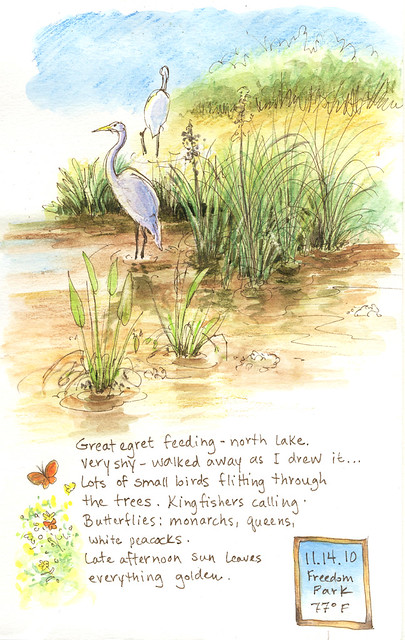
Great egret ~ Elizabeth Smith

It surprises me how a short time out in nature with my sketchbook can eliminate a week’s worth of stress! Last Sunday afternoon was warm with a cool-ish breeze, and filled with a lovely golden light.

I sat to the side of the path that winds around the north lake at Freedom Park, reveling in the abundance of butterflies nectaring on cassia and Spanish needles. As I started to sketch the grasses and water, a great egret walked into view.

I knew this was a great egret and not the white version (morph) of the great blue heron because of its black legs. Great blue heron legs are yellow, though sometimes grayish-yellow. Great egret legs are definitely black.

For the longest time I had no memory device to remember this trivia, until I associated *egret = ebony* to describe the ebony-like leg color. Now I just have to remember that it doesn’t apply to every egret! We have snowy egrets (black legs, yellow feet), and cattle egrets (yellow legs and feet) here in Southwest Florida, but they’re smaller birds with slightly different head and neck shapes.

Pond apple trunk
 This lake is part of a constructed wetland designed to relieve flooding during our rainy season (approximately June through September) and to purify water before it enters Gordon River and Naples Bay. The park also incorporates existing wetlands to the east, which has old stands of cypress and laurel oak, and some lovely old red mangroves and pond apples.

I sketched these directly with a Sakura Micron Pigma pen, and then added watercolor pencil to the lake sketch, washing over it with clear water from my Niji waterbrush. If you’d like to read more about great egrets, visit the links below.
National Geographic
The Cornell Lab of Ornithology
Audubon

~Elizabeth Smith
Naples, Florida, USA

Sunday, May 23, 2010

Tree Fuchsia flower - Maree

“And the day came when the risk to remain tight in a bud was more painful than the risk it took to blossom.”
- Anais Nin (French born American Author of novels and short stories, 1903-1977)


This was my first sketch of trying out my watercolour pencils, which I'd never used before and acquired at the end of last year. The Tree Fuchsia (Haleria lucida) was at the end of her flowering cycle and sporting all these lovely rose-hip type seed pods.

Saturday, April 24, 2010

Blue Porterweed ~ Elizabeth Smith


Blue Porterweed, originally uploaded by Elizabeth Smith.

This unusual plant can be found wild in well-drained disturbed soil, and is often cultivated in south Florida. Considered endemic by some, purists debate its status as a true Florida native. A similar but larger relative exists, often confusing identification between the two.

Zebra Longwing and Julia butterflies love the flowers, and I recently learned that it’s also the host plant for Tropical Buckeye larva. The flowers on this plant are a violet to violet-blue, but I’ve seen blossoms that veer into a vivid clear blue with very little violet.

I resorted to the Internet to find out why this is called porterweed, ironically finding the answer from an acquaintance here in Florida. Roger Hammer is (among many things) the Senior Interpretive Naturalist in the Miami-Dade Parks Department, and in his online article (click here to read) he clears up the mystery. A foaming porter-like tea (porter is beer or ale) has been made from the plant to treat several conditions, hence “porterweed.”

Thanks for visiting! You can click on the image above to view larger on my Flickr photostream.

Friday, April 23, 2010

Tulip Sketches - Carolyn Pappas


I was gifted some tulips a few weeks ago and I am working on a watercolor painting of them. I've made a lot of preliminary sketches and I'm all ready to start the actual painting, but I'm feeling a little intimidated. As a way to procrastinate, I figured I would get outside to practice some more by drawing some tulips that are still outside. Plus, the time frame for tulips isn't too long and they are one of my favorite flowers. The tulips that I was gifted have already died off, but I've planted the bulbs so they can come up again next year.

Wednesday, April 21, 2010

Windmill Palm - Pam Johnson Brickell


Windmill Palm
Originally uploaded by PJBee
Sketched this pretty little tree at a friends house. It was loaded with fruit.

Tuesday, February 23, 2010

My latest rescue


Here's my latest rescue, a white rock dove, Columba livia.
I understand that an age old tradition wants white rock pigeons to be released at weddings, as a symbol of peace and a long lasting relationship. Doves mate for life and raise their brood together. However, I thought that racing pigeons should be released at weddings, because they can fly back home. Something must be going wrong, as wildlife rescue centres get more and more distress calls, telling of white doves unable to take off after being released.
This one was picked up off the ground after the wedding was over. She does a lot of wing flapping, but barely lifts herself off the ground! Not much of a chance of her surviving in the wild. But, she makes a wonderful model and is a very elegant bird.