Showing posts with label nature journal. Show all posts

Thursday, June 9, 2022

Reciprocity

Graphite and ink on paper
 

Nature replenishes my spirit in so many ways. Clean air and water. The simultaneous serenity and thrill while standing on the edge of millions of acres of public lands. Sunshine warming my face. The sound of rain on my rain jacket. Watching a bee fly; toads, deserts, murmuration.

Trees are an organism for which I am supremely grateful. I have always loved them, even before I could understand the depth of what that means.

On a grand scale, trees have sustained cultures for millennia. Closer to home and more personally, trees provide life-saving shelter, shade from the powerful sun, bone- and muscle-warming heat, magnificent beauty, the sound of wind moving through the leaves.

So I've been pondering lately, what do I give back to them? Indeed, what is the exchange between all of nature and myself? It did not take me long to make the connection.

A spotlight. Through my art and writing I shine a spotlight on the beauty, magnificence, importance, and cultural community that trees and forests provide; the very reasons we should be protecting, respecting and thanking them.

My hope is that my work will inspire others to broaden their interest in trees, to the point of finding themselves caring about trees in their own environment, maybe even becoming stewards of the land.

In the spirit of paying it forward, for the trees, click here for a beautifully made documentary created by a young Alaskan woman about the clear cutting of old growth forests in the Tongass National Forest of southeast Alaska.


Reciprocity.


Wednesday, March 16, 2022

A connection to place

 I think we’ve all known special places that have deep meaning for us personally.

 Maybe we don’t always recognize it at the time.  There are several natural places that are special to me, but those with the deepest roots are woven from my childhood memories.  Colors and shapes, smells and sounds, and textures like the tactile velvet of new buds or flaking limestone. 

 The memories stay vivid and strong – some more so, some less.  Most of them comforting, but some, not so much.   They speak of my relationships with nature.  They are both known and unknown, some barely lurking within my subconscious.  What I remember most are not the events, but the feelings those connections gave me.

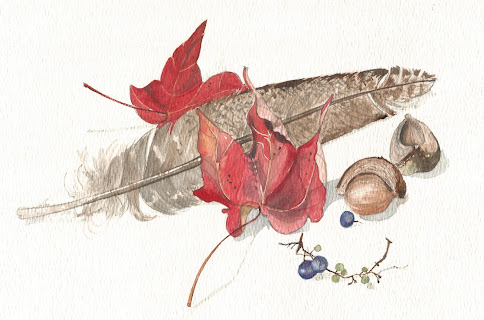
Maple leaves, owl feather, hickory nuts, and wild grape.

This is a small nature sketch done years ago, somewhere in the mid-1980s, of things collected on a walk through Iowa woods.  It was mid-autumn, and the season gave me treasures and a near infinity of browns and buff, with splashes of red and yellow.  Along the trail: leaves on limb and ground, sticks and branches and trunks and bark, seeds and frost-bitten fruits, empty acorn caps and sometimes a glimpse of gritty green. 

 The woods I rambled in are located in upper northeast Iowa, along a limestone ridge and bluff above a river.   It is a place of meditation, of quietness threaded with birdsong.   This is also a connection to a point in time.  Fall is a favorite season of mine; it feels like an important transition somehow, and I sometimes catch my breath waiting for the next thing to come.

It feels like a time to let life unwind, and a place to rest and heal. 

A sacred place.


Media:

Paper - unknown mass-produced watercolor paper pad
Watercolor paint, probably Grumbacher and/or Winsor & Newton
     (the colors still surprisingly bright after almost 40 years)
Craft brushes
# 2 Pencil


Tuesday, June 21, 2016

Starting a Nature Journal, with Jan Blencowe...

Don't miss this excellent post from Jan Blencowe!  So many good idead here...

http://janblencowesketchbook.blogspot.com/

Tuesday, March 1, 2016

Artists Inspired by Nature

My friends and I have one thing in common: we are inspired by what nature shows and offers us, be that birds, wood, autumn leaves or the sky.   

Sybille Tezzele Kramer, has a wonderful eye to look deep into soil; she never forgets to draw roots. Her vision also stretches out into space: it is rare to find a drawing by Sybille not showing the sun, moon or constellations. 

Liliya Tereshkiv collects nature objects and brings them home. There she translates them into woodwork and jewellery.  

Lois Mathews is a long time nature journaling artists. She lives far away from me, but through her sketches I have grown an understanding of her island. 

May I present my friends and what is on my wall? Please, enjoy.

.
Sybille Tezzele Kramer:
erbacce:unkraut.jpeg

Italian born Sybille Tezzele Kramer draws inspiration from her direct surroundings in Sud-Tirol. Sybille shows her appreciation for weeds with her drawing, named Erbacce/Unkraut. Notice Chamomile, Poppy, Alchemilla, Foxtail grass and Dandelion. Also, notice the smiling face of the weeds. Weed smiles because it is stronger than all the poison that is used. And why using it? Why do we categorize some plants as obnoxious weeds and others as ornamental plants? Why do we say some stones are pebbles and others are gemstones? Sybille creates a three-dimensional effect by drawing a heliocentric composition. Read more about this lovely drawing here. Sybille’s Erbacce/Unkraut/Weed is available here. The original Erbacce is touring through Italy as a mobile exhibition ‘Lo Sguardo Obliquo’.

Liliya Tereshkiv:

Liliya Tereshkiv, a Ukraine born artist, also living in Italy, is the woman behind Sorriso Design. Liliya shows us how nature inspires her by picking up leaves and pine cones and looking at the blue sky. Here is her lovely Etsy shop full woodwork, jewellery and home decoration. Have a look, you will be surprised. More of Liliya’s nature photos are here.


Lois Mathews:

For years by now, I’m enjoying the walks Lois Mathews records at her delightful blog Sketching on Whidbey Island. If there are sketches directly inspired by nature, they are Lois’ water-paintings. I don’t like to sit in front of a screen, but that all changes when I read Lois’s records and nature studies. Did I just feel a bit of fresh air? Or did I hear a songbird? Do I noticed footprints on the walking track? Lois’s nature journal enchants me.


Me:

An empty wall, wood and driftwood treasures and a few of my prints. I’ve put them together for a playful exhibition of a few of my prints. My love-birds and butterflies feel perfectly at home in their natural environment.


There is nothing definitive or pretentious about this, I can add and remove prints without damaging the wall. There is bark of an eucalyptus tree, a honeysuckle knot, pine-cone branches, driftwood, some wooden pegs and prints.


 ♥

Paula

Tuesday, September 3, 2013

Golden Bishop (Euplectes afer) - Maree

“Birds are a miracle because they prove to us there is a finer, simpler state of being which we may strive to attain.” 
- Doug Coupland


W&N watercolour on in my Moleskine Nature Journal

For years I’ve been entertaining and been entertained by the Red Bishop in my garden (Tarlton, Gauteng, South Africa) and yesterday, for the first time ever, I had nine new visitors – Golden Bishops! My heart fairly bounced when I saw the splashes of golden yellow amongst the red of the Red Bishops at the feeding table – it looked like a colourful table setting for the festive season, mixed with the softer green-yellow of the Weavers. I immediately fetched my Bird Book, just to make sure, and to make notes, which I always do when I find somebody new in my garden.

I did a quick sketch while he was on the reed at my pond and then referenced the colours from one of my bird books. This is the Golden Bishop’s breeding colours and he is difficult to distinguish from the Red Bishop when not breeding, but is generally much paler below, with faint streaking confined to the sides of the breast and the flanks.

This bird is known as the “Goudgeelvink” in Afrikaans and when not breeding, is nomadic in large flocks over grasslands. They prefer to breed in reed beds surrounding dams and near rivers.

It is locally common in the Eastern half of South Africa, with more localised populations in northern Namibia, northern and south-eastern Botswana and Zimbabwe. In the breeding season it mainly occupies marshes or seasonally flooded areas, but when isn’t breeding it can move into dry habitats such as cultivated areas.

.

Thursday, August 25, 2011

Sparkleberry in Spring

 Yes, just because a sketch is made in the spring doesn't mean the page gets finished then :)  I got caught up in some research about May Day.

There was a lot of room left on the paper when I finished my plein air pen and watercolor sketch. And, since it was May Day and the sketch of Sparlkeberry... Well you know, just that tree's name on my tongue makes calligraphic notes sing in my head! I decided to settle into a more controlled environment to finish the dressing on this May Day page.


A tissue paper overlay is a great way to experiment with the placement of other elements you want to add to your page. It keeps the paper from being compromised from too much erasing.

The trick is matching the same placement that you like on the overlay. There are transfer papers you can use, or you can flip over the overlay and trace what's on the front side using a very soft pencil. Once finished, flip it back to the original side,lay it over your journal page and retrace your original lines with a sharp pencil. Lift the overlay tissue off of your journal page and your lettering will/should be on the paper beneath.


But, I know from experience that I lose total spontaneity when I use these methods. My lines become stiff as I get caught up in left brain control. I honor my free flowing plein air sketch too much to let that happen. I want all the elements to compliment that freedom. So I guess-ti-mate :)

My version of cooking without a recipe :)

Click on images to enlarge :)

Sunday, November 21, 2010

My curiosity cabinet ~ Elizabeth Smith

Things from my yard
The natural things I see below my feet - these small items tell a story of place and life.

The story of place is about habitat: rocks and soil and water and climate. Tropical heat and the harsh bite of salt, the legacy of marine sediment and the alchemy of fresh water meeting ocean. This is the history of Florida.

Things from an estuary
The story of life reflects a connection to the other life forms that share this space, and adaptations to place. Flower > berry> bird> seedling> plant> flower completes a cycle of life.  How this leaf curls and why this leaf becomes needle-like, how an oyster clasps an underwater root, how these seeds are thrown from a pod, but those seeds fly on the wind.


Things from Iowa
 I invite you to share a journey of exploration of the simple wonders all around us through the bits and pieces that I collect in my images, my version of the wunderkammer (wonder-room) or cabinet of curiosities.  Click here to see more of these collections on my Flickr photostream.

The "cabinet of curiosities" concept started in Renaissance Europe, mainly by aristocrats with a bent for collecting, who accumulated curious and strange objects (some of which were fictional!), and housed them in a special room to show to friends and colleagues.

Wikipedia has a comprehensive entry on the history of these collections and their evolution into museums, as well as a summary of how virtual wunderkammern - such as this blog - are being created and shared.

~ Elizabeth Smith, Naples, Florida, USA

Saturday, November 20, 2010

Great egret ~ Elizabeth Smith

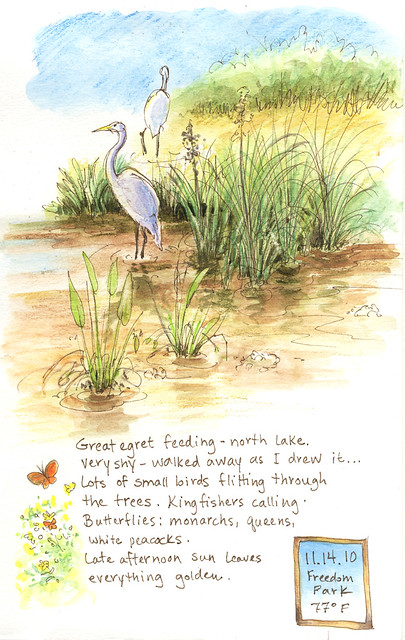
It surprises me how a short time out in nature with my sketchbook can eliminate a week’s worth of stress! Last Sunday afternoon was warm with a cool-ish breeze, and filled with a lovely golden light.

I sat to the side of the path that winds around the north lake at Freedom Park, reveling in the abundance of butterflies nectaring on cassia and Spanish needles. As I started to sketch the grasses and water, a great egret walked into view.

I knew this was a great egret and not the white version (morph) of the great blue heron because of its black legs. Great blue heron legs are yellow, though sometimes grayish-yellow. Great egret legs are definitely black.

For the longest time I had no memory device to remember this trivia, until I associated *egret = ebony* to describe the ebony-like leg color. Now I just have to remember that it doesn’t apply to every egret! We have snowy egrets (black legs, yellow feet), and cattle egrets (yellow legs and feet) here in Southwest Florida, but they’re smaller birds with slightly different head and neck shapes.

Pond apple trunk
 This lake is part of a constructed wetland designed to relieve flooding during our rainy season (approximately June through September) and to purify water before it enters Gordon River and Naples Bay. The park also incorporates existing wetlands to the east, which has old stands of cypress and laurel oak, and some lovely old red mangroves and pond apples.

I sketched these directly with a Sakura Micron Pigma pen, and then added watercolor pencil to the lake sketch, washing over it with clear water from my Niji waterbrush. If you’d like to read more about great egrets, visit the links below.
National Geographic
The Cornell Lab of Ornithology
Audubon

~Elizabeth Smith
Naples, Florida, USA

Sunday, October 3, 2010

Anhinga ~ Elizabeth Smith


Anhinga, originally uploaded by Elizabeth Smith.

A lot of viewers may not be familiar with the Anhinga, but it’s a common bird along the waterways of Florida.

Sometimes called the Snake Bird or Water Turkey, it can be seen diving, swimming or drying its feathers along our canals, bays, and lakes. Anhingas are called the Snake Bird because when they emerge from underwater and swim for shore, their long sinuous neck resembles a snake. They’re very distinctive in appearance; the males are black and white, while the females and juveniles are deep brown with a buff or light brown neck.

Often striking a pose on a perch near the water, they spread their wings wide to dry in the sun. Their wings in this position remind me of a black cape with epaulets and silvery white ribbons. Anhingas pose like this because they don’t secrete oil to waterproof their feathers (like ducks or geese do), and rely on air drying in order to fly. This lack of oil helps make them less buoyant, allowing them to dive more efficiently and stay underwater longer.

A member of the Darter family, you may have guessed that these birds are piscivores, or fish-eaters. For a quick overview of the Anhinga, visit The Cornell Lab of Ornithology ; included are some short facts, a distribution map, and an audio record of their call. For a more in-depth read, visit the Wikipedia entry.

I found this Anhinga sitting on the bridge walkway over one of the lakes at Freedom Park, and took several reference photos for drawing later. I've never had a chance to get this close to one of these beautiful birds before creating a flustered takeoff, and I'm happy I didn't cause this bird any apparent stress!

Clicking on the image above will take you to my Flickr photostream.

Elizabeth Smith
Freedom Park, Naples, FL, USA

Sunday, July 18, 2010

Bumble bee (also bumblebee) ~ Elizabeth Smith


Bumble bee, originally uploaded by Elizabeth Smith.

I found this bee on the ground and couldn’t resist the opportunity to study it in detail. I’m not fond of bees or other stinging insects, but I’ve always had a soft spot for bumble bees.

The sound of its common name “bumble” seems to fit so well! It fits the rumbling buzzing sounds and the way the bees forage for nectar and pollen: clumsily bumping and nuzzling blossoms in an apparent aimless way.

When I draw or paint something, it spurs me to research my subject a little more deeply – now that I know it better from my observation and drawing, I need to answer the questions that surface during the process.

Florida has five species of bumble bees! In my entomological ignorance, I thought there was just one. Florida is a long state north to south, so we encompass several zones and many habitats. I learned that the further south one travels in Florida, the fewer bumble species there are.

I tried to use the identifier interface at Discoverlife.org to find out which bumblebee this might be, but didn’t succeed. Perhaps I entered some incorrect information or this bee is an anomaly; I just don’t know enough about bees to know what I might be missing. The portal for bumblebees is here if are interested.

I further learned that bumbles nest underground or in convenient cavities. Growing up in Iowa, most country kids know the importance of bees for crop pollination. Without bees, our food base would suffer. I found that bumblebees are also valuable for something called “buzz pollination.” Their technique dislodges firmly held pollen, and they are especially sought for greenhouse pollination or for certain plants such as tomatoes, potatoes, eggplant, blueberries, and cranberries.

Next time you visit the produce department or vegetable roadside stand, thank a bumblebee!

You can click on the image above to view larger on my Flickr photostream.

~ Elizabeth Smith, Naples, Florida, USA

Sunday, June 13, 2010

Gulf fritillary ~ Elizabeth Smith


Gulf fritillary, originally uploaded by Elizabeth Smith.
It’s not often I get to draw these handsome butterflies up close – a chance glance at the ground, and I knew this was my next subject. Gulf fritillaries seem to be everywhere right now; usually we see the brilliant orange to chestnut top parts of their wings as they nectar or rest. Although this butterfly was somewhat battered, the bottom surface of the hindwing was in excellent shape. It’s hard to see this in my drawing, but the white-gray spots are a metallic silver. Beautiful!

Gulf Fritillaries use passionvine as their larval food source, which also happens to work well as a nectar plant!

You can click on the image above to view it on my Flickr photostream.

~ Elizabeth Smith, Naples, Florida, USA

Monday, April 12, 2010

Iris ~ Elizabeth Smith


Iris, originally uploaded by Elizabeth Smith.

Sunday – rainy and stormy – a perfect day to get out my reference photos of this native iris. I took these on Easter Sunday as we meandered through the Corkscrew Sanctuary Boardwalk. These are also blooming at Freedom Park in Naples, dotting the wet ground in subtle bursts of color.

I’m trying out my new Kimberly watercolor pencils in the Aquabee sketchbook. So far, so good!

You can click on the image above to view it larger on my Flickr photostream.

Monday, March 29, 2010

Tillandsia - Elizabeth Smith


Tillandsia, originally uploaded by Elizabeth Smith.

This Tillandsia sp. Is just one of the many types of epiphytes that abound in certain types of trees here in Southwest Florida. Although some people mistake them for parasites, they don’t harm the trees; collecting their nutrients solely from dust and moisture in the air and from the organic debris that collects in their leaf bases. They are part of the Bromeliad family, a huge group that includes the cultivated pineapple.

The red spike is a series of bracts that cover the real flowers, which haven’t emerged yet. The flowers are small, about 1/8 inch or so, and I seem to remember that this one has tiny purple petals with yellow stamens. The seeds are dispersed through wind, often with fluffy gear that helps them travel far.

I know that insects and lizards also use these plants, and probably attract birds, who then attract other predators. My imagination wonders at the microcosm of other life that must exist within these dull green leaves!

You can click on the image above to view it larger on my Flickr photostream.

Tuesday, February 16, 2010

Maple seeds - Elizabeth Smith


Maple seeds, originally uploaded by Elizabeth Smith.
Here in Florida, spring seems to come early. Samaras are growing on the red maples – those wonderful little pairs of seed and wing that delight the child in us! Some people call them helicopters, and some call them keys; I’m sure there are many other names in different parts of the world for this type of interesting seed dispersing device.

Amazing what can be found on the internet…I didn’t know maple seeds were edible for one!
**Disclaimer: one should ALWAYS confirm edibility and then positively identify the plant or tree before eating.  Even when sure that it is edible (speaking as one with allergies), try only a small amount and wait to see how you will react.**

Samara definition

How to eat maple seeds

NASA’s make a maple seed "helicopter" page

You can click on the image above to view it larger on my Flickr photostream.

~ Elizabeth Smith, Naples, FL, USA

Sunday, January 3, 2010

Crepe Myrtle seed capsules - Elizabeth Smith


Crepe Myrtle seed capsules, originally uploaded by Elizabeth Smith.

I enjoyed drawing these seed capsules, found on a recent walk. They turned out to be the perfect subject for my new Sakura Pigma sepia pens, a Christmas gift!

You can click on the image above to view it larger on my Flickr photostream.

~ Elizabeth Smith, Naples, FL USA

Saturday, December 19, 2009

Dead Wood - Elizabeth Smith


Just a piece of wood...

You can click on the image to view it larger on my Flickr photostream.

~ Elizabeth Smith, Naples, Florida, USA

Monday, November 30, 2009

November Colors - Pam Johnson Brickell

Fall Mini Journal Spread Here are the first two pages of an 8 page mini journal dedicated to the Low Country's November Fall Colors.

We don't see the over all color noted in the North East or the Appalachian Mountains but, the Low Country doesn't lack for wonderful patches of striking pigments. To me, Sweet Gum trees are the most colorful. Sumac's are a deep crimson, Swamp Maples - a combo of yellows and reds, and then there's the Ash that takes your breath away with it's brilliant yellow orange leaves when surrounded by greens of pines and live and water oaks.

Wednesday, October 21, 2009

Remains of summer - Elizabeth Smith


Remains of summer, originally uploaded by Elizabeth Smith.

Well, I guess I should say that these are remains of a southwest Florida summer. Our few deciduous trees don’t usually lose their leaves until sometime in November or December, and we don’t have the grand color change of more northern areas. Instead, our changes are subtle.

The Live Oak trees in our neighborhood are producing a healthy crop of acorns, and soon we’ll be seeing pockmarks in the dirt as the squirrels stock up for lean times. They’ve been tearing off the scales of the Slash Pine cones to get at the seeds, leaving a bristly inner core of a rich burnt sienna color.

More and more bird flocks are traveling in the skies, the goldenrod is blooming on the roadsides, and the wheel turns once more.

You can click on the image above to see it larger on my Flickr photostream.

~ Elizabeth Smith, Naples, FL, USA

Friday, October 16, 2009

Nasturtium Water Color: Judy Butler


Nasturtium in my new handmade Journal 5 x 7
2009 Heavy Watercolor Paper

Nasturtium blooms are intricate and interesting with an explosion of orange in the back yard. They are one of the few things blooming in our late summer garden. My husband has picked bouquets often since June bringing them into my painting area. Now our first frost may happen next week and if not then, the week after for sure. I will be so sad to see them go but will look forward to their return next spring.


Watercolor painting of Nasturtium
2003 Nature Journal Entry

I just recently realized that I have often drawn them over the years. On this post are three of the different drawings I found in my nature journals in the last nine years. I like their bright orange, pink, and shades in between and find their whimsical shape very cheerful. The big playful round leaves are fun to paint.


Watercolor painting of Nasturtium
2000 Nature Journal Entry


Nasturtiums were my mother-in-law's favorite flowers. She kept a small bouquet of these happy blossoms on her kitchen table all summer long. She put them in a little test tube stand that was used in her father’s patient room during his country doctor’s practice in Gordonsville, Tennessee at the turn of the century. When I see them in the garden but especially when I paint them, I think of her and they make me smile.

Tuesday, October 13, 2009

Bracket fungi - Elizabeth Smith


Bracket fungi, originally uploaded by Elizabeth Smith.

Bracket fungi

These little shelf or bracket fungi were nestled at the base of a Sea Grape tree. It seems that all of the mushrooms I’ve seen lately remind me of food – these were the most delectable shade of caramel!

The ground is finally drying out after our September rains. We’ve been enduring a heat wave, breaking records yesterday and today with temperatures in the middle 90’s. It’s been a long summer, and we’re ready for a change.

You can click on the image to see it larger on my Flickr photostream.

~ Elizabeth Smith, Naples, FL USA